Last November I had the privilege to be a writing coach at the Inkhaven residency, an experimental month-long blogging retreat in Berkeley, California that attempted to pressure-cook the nutrients, insights, and words out of stellar writers using a simple commitment device: write and publish a 500-word blog post every day, or get kicked out. That’s it.
I mean, there were details. We also fed the participants and provided them with Optional Content, like workshops and visiting writers to consult with and social activities and such. But fundamentally, Inkhaven was there to light a fire.
Sometimes the best way to learn is by doing. You can read books about carpentry all night and day, or you can go out there and build ten bookshelves.
And oh, what bookshelves our bloggers built. Here are a few. I figure if you’re here reading me, you already have good taste, so you might find a new blog to follow among these:
I also really liked less social engineering and more actual engineering for this fertility crisis, please, her objections to the ongoing fertility/demographic collapse discussion – namely, it seems like it’s pretty happy to throw decades of social progress for women under the bus. I’m not entirely unsympathetic to the movement but we gotta have something better than that, and I thought this piece really captured that.
One of my favorite pieces from Vishal Prasad is on computer modeling to figure out why sex evolved and includes some fascinatingly weird-looking models of how relevant strategies might reach equilibrium over time. He also wrote about Agartha, a white supremecist conspiracy theory meme which has in recent times reached a surprisingly multicultural level of abstraction, and I also enjoyed learning about this.
Tomás Bjartur writes a lot of things, including banger fiction. I recommend Lobsang’s Children, a story about a child subsumed by a strange family legacy. Also Rational Teletubbies, which is, and this is the highest compliment I can give a piece of writing, a straight-up fever dream.
He also wrote Gork: The hero we need, an unexpected genuinely hopeful piece about twitter/X’s resident goofy problematic large language model, Grok. This analysis of its social context made me get the value of AI as a trusted public source of information. He explores this more in other pieces – we can certainly improve on Gork! – but this article is a good place to start.
Can’t afford your meds this month? For $20, HP’s AI-optimized healthcare accessibility gamification engine gives you a chance to cover one prescription. There’s even a jackpot tier – all drugs paid for 3 months! HP has already fully funded the insulin medication for over 10 families, and dramatically impacted the lives of thousands more.
As a millennial with ADHD, I for one can’t wait!
Camille Berger wrote some astoundingly beautiful and thought-provoking things. Here’s Burning Utopia, a short and compelling bit of fiction about the possible futures of AI, and here’s That Lying Bitch, a could-happen-tomorrow-sci-fi story about social dynamics and what it might look like when humans lose our edge.
He also wrote Forum Poweruser Forum, a delightful bit of speculative fiction about web forum design. A friend of mine summarized it well when said that he “couldn’t decide if this is horror or pornography.”
Adrià Garriga-Alonso wrote a great and approachable piece on why some of the statistical methods you might have learned in Stats 101 – like the Student’s T-test – are janky fossils from a time before computing was cheap and fast, and how we can easily do better.
Guy at Rival Voices wrote an approachable introduction to jhanas (states of bliss associated with Buddhist meditation, that many non-Buddhists also report attaining) that was well calibrated for the “skeptic killjoy” audience, which is to say, me.
Justin Kuiper examines clickbait, why it works, and considerations in deploying it ethically and tactically. He’s an expert at the youtube game and so has a refined eye for it.
I didn’t read every post published at Inkhaven, and there are many fantastic posts and fantastic authors not included in this little sampler platter. My apologies to those not featured; this is my personal failing. You-the-reader can find them, and scroll through bloggers and posts that might pique your fancy, at the Inkhaven Blogroll.
Cannot stress this enough: literally everyone was good at this.
If you’re reading this on February 28th, the day of publishing, you have the rest of the day to consider signing up for the second Inkhaven cohort this April – that’s right, it’s happening again, and soon! It’ll be in Berkeley California at the beautiful and ergonomic Lighthaven campus.
I won’t be working this one but I will be attending as a writing advisor, so I’ll be around that month and will attempt to dispense guidance and wisdom (if not full time.) Give it a go if you think you can blog with the best of ‘em.
This was an unusually cool sunset at Lighthaven. The sky isn’t usually red there, I promise.
Since I’ll be there but won’t be helping run the show in April, I’ll have more time for actually writing, and I have some upcoming projects I think you’ll like. Supporters help make that financially possible by throwing me a few bucks on Patreon.You could be one of them!
I’ve written for Asterisk before: What I won’t eat, on arriving at an equilibrium on the “it’s bad when animals suffer” vs. “but animal products taste good” challenge.
(h/t Bing’s copilot for the cover images, if you’re seeing them.)
Eukaryote Writes Blog is now syndicating to Substack. I have no plans for paygating content at the time, and new and old posts will continue to be available at EukaryoteWritesBlog.com. Call this an experiment and a reaching-out. If you’re reading this on Substack, hi! Thanks for joining me.
I really don’t like paygating. I feel like if I write something, hypothetically it is of benefit to someone somewhere out there, and why should I deny them the joys of reading it?
But like, I get it. You gotta eat and pay rent. I think I have a really starry-eyed view of what the internet sometimes is and what it still truly could be of a collaborative free information utopia.
But here’s the thing, a lot of people use Substack and I also like the thing where it really facilitates supporting writers with money. I have a lot of beef with aspects of the corporate world, some of it probably not particularly justified but some of it extremely justified, and mostly it comes down to who gets money for what. I really like an environment where people are volunteering to pay writers for things they like reading. Maybe Substack is the route to that free information web utopia. Also, I have to eat, and pay rent. So I figure I’ll give this a go.
Still, this decision made me realize I have some complicated feelings about the modern internet.
Hey, the internet is getting weird these days
Generative AI
Okay, so there’s generative AI, first of all. It’s lousy on Facebook and as text in websites and in image search results. It’s the next iteration of algorithmic horror and it’s only going to get weirder from here on out.
I was doing pretty well on not seeing generic AI-generated images in regular search results for a while, but now they’re cropping up, and sneaking (unmarked) onto extremely AI-averse platforms like Tumblr. It used to be that you could look up pictures of aspic that you could throw into GIMP with the aspect logos from Homestuck and you would call it “claspic”, which is actually a really good and not bad pun and all of your friends would go “why did you make this image”. And in this image search process you realize you also haven’t looked at a lot of pictures of aspic and it’s kind of visually different than jello, but now you see some of these are from Craiyon and are generated and you’re not sure which ones you’ve already looked past that are not truly photos of aspic and you’re not sure what’s real and you’re put off of your dumb pun by an increasingly demon-haunted world, not to mention aspic.
(Actually, I’ve never tried aspic before. Maybe I’ll see if I can get one of my friends to make a vegan aspic for my birthday party. I think it could be upsetting and also tasty and informative and that’s what I’m about, personally. Have you tried aspic? Tell me what you thought of it.)
Search engines
Speaking of search engines, search engines are worse. Results are worse. The podcast Search Engine (which also covers other topics) has a nice episode saying that this is because of the growing hoardes of SEO-gaming low-quality websites and discussing the history of these things, as well as discussing Google’s new LLM-generated results.
I don’t have much to add – I think there is a lot here, I just don’t know it – except that I believe most search engines are also becoming worse at finding strings of text put into quotation marks, and are more likely to search for the words in the text not-as-a-string. Bing was briefly the best that I’d seen of this, Google is the best now but I think all of them have gotten worse. What’s the deal with that?
Censorship
Hey, did you know Youtube flags and demotes videos that have the word “suicide” or “kill yourself”(/etc) in them? Many Youtube video makers get paid by Youtube for views on their videos, but if they’re in that setup, a video can also be “demonetized” meaning the maker doesn’t get paid for views. They can also be less likely to appear in search results – so it’s sort of a gray area between “just letting the content do whatever” and “deleting the content”. I don’t want to quite say that “you can’t say ‘suicide’ in new videos on Youtube”, but it equals out pretty close.
Tiktok has been on this for a while. I was never on Tiktok but it seems pretty rough over there. But Youtube is now on the same train. You don’t have to have the word “suicide” written down in the description or have a viewer flag the video or anything, youtube runs speech-to-text (presumably the same program that provides the automatic closed captions) and will detect if the word “suicide” is said, in the audio track.
Also, people are gonna talk about it. People making pretty sensitive videos or art pieces or just making edgy videos about real life still talk about it.
In fact, here are some of the ways Youtubers get around the way this topic is censored on the platform, which I have ranked from best to worse:
Making sort of a pointing-gun-at-head motion with one’s fingers and pantomiming, while staring at the camera and pointing out the fact that you can’t say the word you mean – if it works for your delivery, it is a shockingly funny lampshade. Must be used sparingly.
Taking their own life, ending themself, etc – Respectable but still grating if you pick up on the fact that they are avoiding the word “suicide”
KYS and variations – Contaminated by somehow becoming an internet insult du jour but gains points for being directly short for the thing you want to say.
Self-termination – Overly formal, not a thing anyone says.
Unalived themselves – Unsalvageably goofy.
Going down the sewer slide – Props for creativity; clear sign that we as a culture cannot be doing this.
So I know people who have attempted suicide and of the ones I have talked to about this phenomena, they fucking hate it. Being like “hey, this huge alienating traumatic experience in your life is actually so bad that we literally cannot allow you to talk about it” tends to be more alienating.
Some things are so big we have to talk about them. If we have to talk about them using the phrase “sewer slide”, I guess we will. But for christ’s sake, people are dying.
Survival tips
I’m reasonably online and I keep running into people who don’t know these. Maybe you’ll find something useful.
I was going to add in a whole thing about how “not all of this will apply to everyone,” but then I thought, why bother. Hey, rule one of taking advice from anyone or anything: sometimes it won’t apply to you! One day I will write the piece that applies to everyone, that enriches everyone’s life by providing them with perfectly new and relevant information. People will walk down the boulevards of the future thinking “hey, remember that one time we were all briefly united in a shining moment by the Ur-blog post that Georgia wrote a while ago.” It’s coming. Any day now. Watch this space.
USE MULTIPLE SEARCH ENGINES
Different web search engines are good at different things. This is surprisingly dynamic – I think a few years ago Bing was notable better at specific text (looking up specific quotes or phrases, in quotes. Good for finding the sources of things.)
I use DuckDuckGo day to day. For more complex queries or finding specific text, I switch to Google, and then if I’m looking for something more specific, I’ll also check Bing. I have heard fantastic things about the subscription search engine Kagi – they have a user-focused and not ad-focused search algorithm and also let you natively do things like just remove entire websites from search results.
Marginalia is also a fantastic resource. It draws from more text-heavy sources and tends to find you older weirder websites and blogs, at the expense of relatedness.
There are other search engines for more specialized applications, e.g. Google Scholar for research papers.
If you ever use reverse image searches to find the source of images, I check in all of Google Images, Tineye, and Yandex before giving up. They all have somewhat different image banks.
USE FIREFOX AS YOUR BROWSER
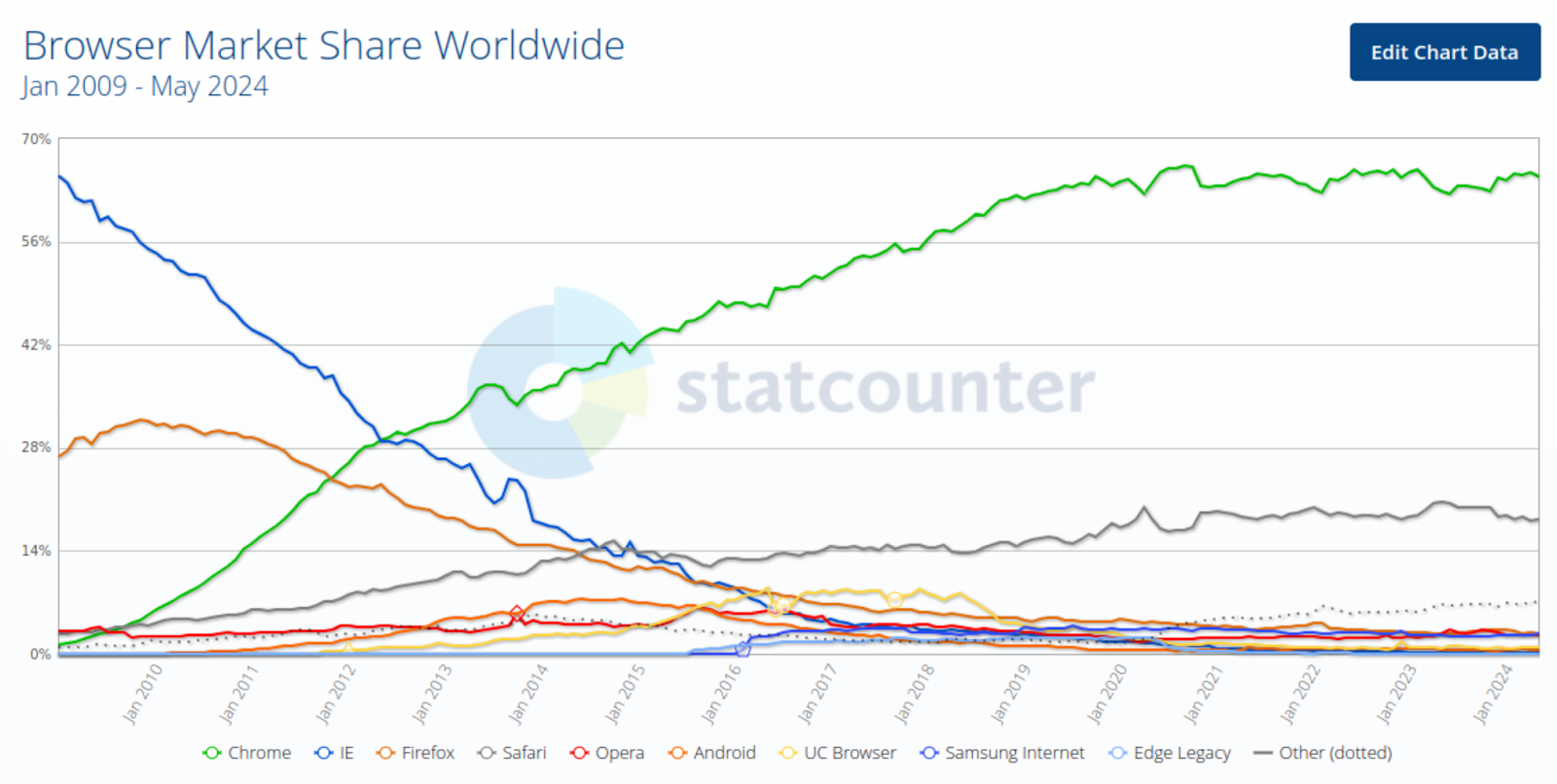
Here’s a graph of the most common browsers over time.
Chrome is a Google browser with Google’s tracking built into it, saving and sending information to Google as you hop around the web. Many of these features can be disabled, but also, the more people use exclusively Chrome, the more control Google can exert over the internet.
For instance, by majorly restricting what kind of browser extensions people can create and use, which is happening soon and is expected to nerf adblockers.
Please stick it to the man and support a diverse internet ecosystem. Use Firefox. You can customize it in a million ways. It’s privacy focused. (Yes, privacy on the web is still achievable.) It’s run by a nonprofit. It’s really easy to use and works well. It’s for desktop and mobile. Use Firefox.
(I also have a Chrome-derived backup browser, Brave, on my PC for the odd website that is completely broken either by Firefox or by my many add-ons and I don’t want to troubleshoot it. I don’t use it often! Or when I want to use Google’s auto-translation tools, which are epic – and Google’s are better than what I’ve found conveniently on Firefox. You can have two browsers. Nobody can stop you. But make one of them Firefox.)
READ BLOGS? GET AN RSS READER
I’ve heard from a few savvy people that they like the convenience of Substack blogs for keeping track of updates, and I was like – wait, don’t you have an RSS reader? Google didn’t have a monopoly on the RSS reader! The RSS reader lives on!
What it is: A lot of internet content published serially – blog posts, but other things too – has an RSS feed, which is a way of tagging the content so you can feed it into a program that will link to updates automatically. An RSS reader is a program that stores a list of RSS feeds, and when you use it, it goes and checks for new additions to those feeds, and brings them back to you. It’ll keep track of which ones you’ve clicked on already and not show you them again.
This means you can keep track of many sources: Substacks, blogs on any other platform, podcasts, news outlets, webcomics, etc. Most good blogs are NOT on substack. That’s not a knock on substack, that’s just numbers. If substack is your only way of reading blogs you are missing out on vast swathes of the blogosphere.
I use Feedly, which has multi-device support, so I can have the same feed on both my phone and laptop.
If you want to run your own server for it, I hear good things about Tiny Tiny RSS.
There are a million more, and your options get wider if you only need to use it on one device. Look it up.
FIND SOME PEOPLE YOU TRUST.
If you find yourself looking up the same kinds of things a lot, look for experts, and go seek their opinion first.
This doesn’t have to only be for like hardcore research or current events or such. My role in my group house for the past some years has been “recluse who is pretty decent at home repairs”. Here is my secret: every time I run into a household problem I don’t immediately know how to solve, I aggressively look it up.
In this example, Wikihow is a great ally. Things like Better Home and Gardens or Martha Stewart Living are also fairly known sources. If nothing else, I just try to look for something that was written by an expert and not a content mill or, god forbid, an LLM.
Sometimes your trusted source should be offline. There are definitely good recipe sites out there, but also if you really can’t stand the state of recipe search results, get a cookbook. I’m told experts write books on other subjects too. Investigate this. Report back to me.
PAY FOR THINGS YOU LIKE TO INCENTIVIZE THEIR EXISTENCE.
But if you have the money for the creators and resources of your favorite tools or stories or what have you, it’ll help it stay around. Your support won’t always be enough to save a project you love from being too much work for its creator to keep up with. But it’s gonna fucking help.
Hey –
If you don’t like Substack but want to support the blog, I am still on Patreon. But I kind of like what Substack’s made happen, and also many cool cats have made their way to it.
That said, here are some minor beefs with Substack as a host:
I want to be able to customize my blog visually. There are very few options for doing this. The existing layout isn’t bad, and I’m sure it was carefully designed. And this gripe may sound trivial. But this is my site, and I think we lose something by homogenizing ourselves in a medium (internet) that is for looking. If I want to tank my readership by putting an obnoxious repeating grid of jpeg lobsters as my background, that’s my god-given right.
(I do actually have plans to learn enough html to swap my WordPress site over to a self-hosted self-designed website, I just have to, like, get good enough with HTML and CSS and especially CSS to get Gwern’s nice sidenotes and hosting and how to do comments. It’s gonna happen, though. Any day now.)
I don’t like that I can only put other substack publications in the “recommendations” sideroll. It feels insular and social-network-y and a lot of my favorite publications aren’t on substack. I’ll recommend you a few the manual way now:
Jeff Kaufman’s blog: Life, domesticity, dancing and music, tech, pathogen detection and prevention.
Outsider Environments Europe: Cool richly artistically decorated houses and environments and stories of the people who create them.
For your experience of Eukaryote Writes Blog, I think the major theoretical downside of this syndication is splitting the comments section. Someone who sees the post on WordPress and leaves a comment there means that the person reading Substack won’t see it. What if there’s a good discussion somewhere?
But I already crosspost many of my posts to Lesswrong and usually if there’s any substantial conversation, it tends to happen there, not on the WordPress. Also sometimes my posts get posted on, like, Hacker News – which is awesome – and there are a bunch of comments there that I sometimes read when I happen to notice a post there but mostly I don’t. So this is just one more. I’ll see a comment for sure on LessWrong, Substack, or WordPress.
Anyway, glad to be here! Thanks for reading my stuff. Let me know if I get anything wrong. Download Firefox. On to more and better and stranger things.
George Stiffman shares how there are more and stranger kinds of tofu out there than you know. I’ve read an entire book on tofu and still learned cool stuff about tofu from this.
A new better Patreon has landed
This blog has a Patreon! Again! I’m switching from the old per month paymentmodel to a new pay per post system, since this blog has not been emitting regular monthly updates in quite some time. So if you get excited when you see Eukaryote Writes Blog in your feed, and you want to incentivize more of that kind of thing, try this new and improved system for giving me money.
Here’s the link. Consider a small donation per post. Direct incentives: Lots of people are fans. I’m no effective charity but the consistent revenue does have a concrete and pleasant impact on my life right now, so I do really appreciate it.
It’s important to me that the things I writehere are freely available. This will continue to be true! I might think of some short bits of content that will be patron-exclusive down the line, but anything major? Your local eukaryote is here to write a blog, not a subscription service. It’s in the name.
Helpful notes
To be clear, the payment will trigger per substantial new post. Updates of content elsewhere, metablogging like this, short corrections, etc, won’t count.
You can set a monthly limit in Patreon, even with the per-post model. For the record, I think it’s unlikely I’d put out more than 1-2 posts per month even in the long term future.
And of course, you can change your payment or unsubscribe at any old time you please.
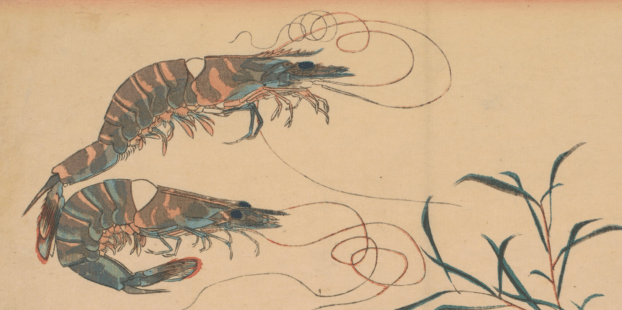
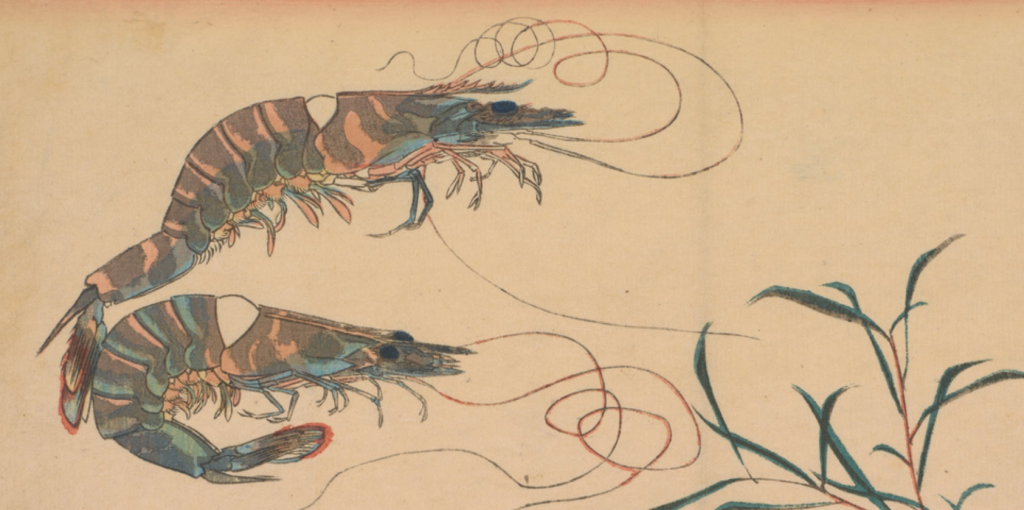
Excerpt of Horse Mackerel (Aji) with Shrimp or Prawn, by Utagawa Hiroshige, ~1822-23. Public Domain.
I’m writing a separate update in case the old unedited version is still lodged in your RSS feed. Read the new one instead! It’s the one that uses the word “cognitohazard” and can be found here.
UPDATE: I actually posted this to the wrong blog. But I’ll leave it up as a reminder that October has started, and as a taste of what’s happening over at the Month of Halloween 2018 for the rest of the month. Thanks for your patience!
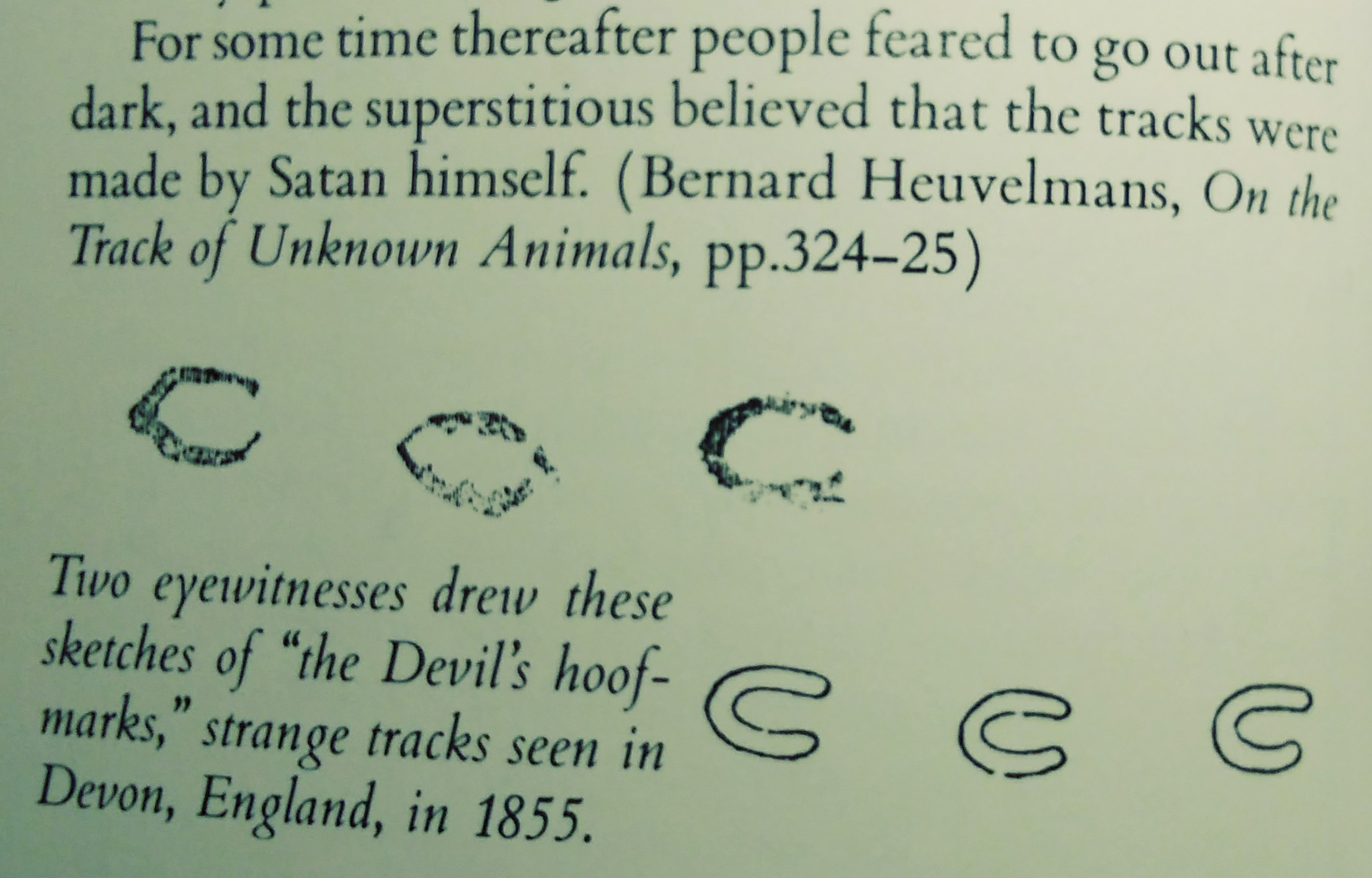
The story tells of a chilly February morning in 1855. Smoke from the night’s fires puffing up through chimneys. Villagers across the countryside of Southern England woke up to a strange sight: trails of large hoofprints in the thick snow, in single file. These trails crossed the county back and forth, making about a hundred mile journey. The tracks crossed rivers, wound through cities, and most disconcertingly were seen going straight up houses, across the roofs, and going down the other side, without a break. What or who would have left this one-legged gait?
This text and image is reproduced from Mysteries of the Unexplained, a 1982 publication of The Reader’s Digest Association
This is the first of a few Month of Halloween treats you’ll see drawn from Mysteries of the Unexplained. An early childhood staple of mine (originally making its appearance in my elementary school library), it contains a vast variety of mysterious news reports and anecdotes on a variety of subjects. The concept and some of the entries were borrowed wholesale from Charles Fort, a 1930’s writer who collected such stories as well and knit them together with his own bizarre philosophies. Mysteries of the Unexplained may be less original, but it at least pretends to maintain some objectivity, so there’s that.
(I’ve skimmed over some snippets of Fort’s writing and it reads like 1910’s newspaper journalism mixed with an advertisement for a salt lamp that purifies WiFi – which is to say, delightful.)
So as per everything that comes out of Fort and Mysteries of the Unexplained, I must clarify that this story possibly isn’t real. All of these accounts in this book came from someone and are written down as if infallible, and probably a large number of them were invented wholesale. Or are at least garbled versions of something real. We know that drawings and a description of the event were published in a London newspaper in 1855, and evidence was collected by a vicar in the area around the same time.
It was certainly enough to scare me in middle school. And it’s a good story, right?
I really like Halloween and the fall season, but I never feel like I appreciate it enough. To fix this, I’ll be writing or sharing a little bit about something spooky, unsettling, or just seasonally appropriate every day this October.
The same way I sometimes get interested in a topic and go learn a bunch about it, I tend to collect useful links and resources. So I’ve put some of those collections here. (The meta-resource page is linked on the sidebar.)
Current resource pages are:
Study music – music to listen to while studying or working
Cheap food – cheap and/or easy food and cooking resources, with a tendency towards vegan/vegetarian cuisine
I’m speaking at both lightning talk sessions (Saturday and Sunday afternoon) at the Effective Altruism Global conference SF this weekend. Catch me talking about evolutionary innovation and extinction on Saturday (5:15), and diversity in teams on Sunday (4:00).
On the off chance that you’ll be at the conference but haven’t already met me, or perhaps know me and want to chat more, feel free to comment on this post or send me an email at eukaryotewritesblog (at) gmail.com to arrange meeting up and saying hello.
I was at a party the night before and got into at least six different conversations about the existential risk / biology overlap, so I’m expecting this weekend to be a really good time. See you there!
(If you can’t make it, I’ll post the talks and longer versions of what I talked about here afterwards.)
Some housekeeping notes (not your monthly blog post):
I changed the format because I didn’t like the text settings on the old one. Let me know if anything looks broken. (In particular, the main type looks weird to me, but it’s ostensibly the same font and size, so I’m not sure why.)
I added a blogroll to this blog. A short version appears in the sidebar, a longer version appears on its own page.
Suggestions for new posts, feedback, fact-checking, spambots, etc., are always welcome at eukaryotewritesblog (at) gmail.com.
As a human with bills to pay, I’m vaguely considering ways of monetizing my writing here. I know that Patreon is a thing people sometimes use successfully. I think another interesting approach would be one where I provide a list of post topics that are in my to-write queue, and people commit some money towards whichever ones they want to read, and I get the money once the post is published – but I don’t think a mechanism there already exists, and it sounds like a pain to set up. If you have any thoughts or ideas in this area, I’d be curious to hear them.
Finally, I’m still looking for ways to make a nice-looking online dichotomous key. Let me know if you have ideas!








 Eukaryote Writes Blog