Category Archives: current events

Book review: Air-borne by Carl Zimmer

Remember early 2020 and reading news articles and respected sources (the WHO, the CDC, the US surgeon general…) confidently asserting that covid wasn’t airborne and that wearing masks wouldn’t stop you from catching it?

Man, it’s embarrassing to be part of a field of study (biosecurity, in this case) that had such a public moment of unambiguously whiffing it.
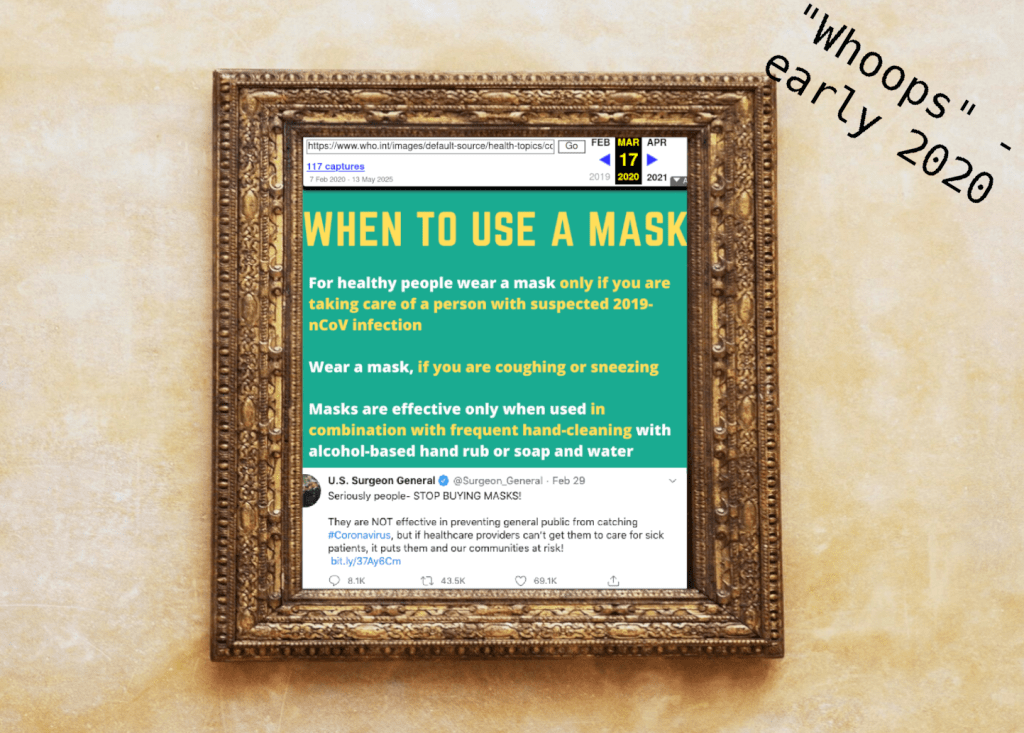
a framed relic - an internet archive screenshot of a World Health Organization graphic saying, among other things, "Masks are effective only when used in combination with frequent hand-cleaning" - and a tweet from the US Surgeon General saying "Seriously people- STOP BUYING MASKS! They are NOT effective in preventing general public from catching #Coronavirus." This framed relic is captioned "Whoops" - early 2020.

I mean, like, on behalf of the field. I’m not actually personally representative of all of biosecurity.

I did finally grudgingly reread my own contribution to the discourse, my March 2020 “hey guys, take Covid seriously” post, because I vaguely remembered that I’d tried to equivocate around face masks and that was really embarrassing – why the hell would masks not help? But upon rereading, mostly I had written about masks being good.

The worst thing I wrote was that I was “confused” about the reported takes on masking – yeah, who wasn’t! People were saying some confusing things about masking.

I mean, to be clear, a lot of what went wrong during covid wasn’t immediately because biosecurity people were wrong: biosecurity experts had been advocating for years for a lot of things that would have helped the covid response (recognition that bad diseases were coming, need for faster approval tracks for pandemic-response countermeasures, need for more surveillance…) And within a couple months, the WHO and the Surgeon General and every other legitimate organization was like “oh wait we were wrong, masks are actually awesome,” which is great.

Also, a lot went right – a social distancing campaign, developing and mass-distributing a vaccine faster than any previous vaccine in history – but we really, truly dropped the ball on realizing that COVID was airborne.

In his new book Air-borne: The hidden history of the air we breathe, science journalist Carl Zimmer does not beat around this point. He discusses the failure of the scientific community and how we got there in careful heartbreaking detail. There’s also a lot I didn’t know about the history of this idea, of diseases transmitting on long distances via the air, and I will share some of it with you now.


Throughout human history, there has been, of course, a great deal about confusion and debate about where infectious diseases came from and how they were spread, both before and to some extent after Louis Pasteur and Robert Koch et al illuminated the nature of germ theory. Germ theory and miasma theory were both beloved titans. Even after Pasteur and Koch had published experiments, the old order, as you may imagine, did not go quietly; there were in fact series of public debates and challenges with prizes and winners that pitted e.g. Pasteur up against old standouts of miasma theory.

One of the reasons that airborne transmission faced the pushback it did is that it was seen as a waffley compromise of a return to miasma theory. What, like both a germ and the air could work together to transmit a disease? Yeah, sure.

Airborne transmission was studied extensively in the 1950s. It eventually became common knowledge that tuberculosis was airborne. That other diseases, like colds and flu and measles, could be airborne, was the subject of intense research by William and Mildred Wells, whose vast body of work included not only proving airborne transmission but experimenting with germ-killing UV lights in schools and hospitals — and who remain virtually unknown to this day.

Let us acknowledge a distinction often made between droplet-borne diseases, where heavy wet particles might fly from a sneeze or cough for some six feet or so, to airborne diseases, which might travel across a room, across a building, wafting about in the air for hours, et cetera. This distinction is regularly stressed in the medical field although it seems to be an artificial dichotomy – spewed particles seem to be on a spectrum of size and the smaller ones fly farther, eventually becoming so small they’re much more susceptible to vagaries in air currents than to gravity’s downward pull. Droplet-borne diseases have been accepted for a long time, but airborne diseases were thought by the modern medical establishment to be very rare.

(I forget if Zimmer makes this point, but it’s also easy to imagine how it’d be easier for researchers to notice shorter-distance droplet-borne transmission – the odds a person comes down with a disease relates directly to how many disease particles they’re exposed to, and if you’re standing two feet away from a coughing person, you’ll be exposed to more of the droplets from that blast than if you’re ten feet away. Does that make sense? Here’s a diagram.)
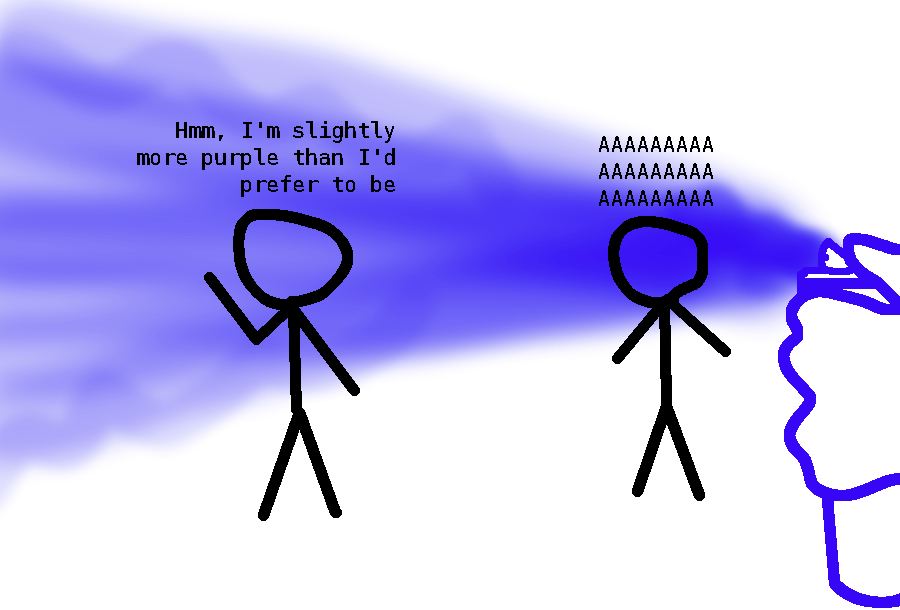
A drawing of two stick figures standing in a cone of purple mist being fired from a spray can. The figure further out in the spray looks at their arm and says "Hmm, I'm slightly more purple than I'd prefer to be". The figure closer to the nozzle, being hit more intensely by the direct blast of purple, screams "AAAAAAAAAAAAAAAA".
Aerosols disperse from their source over distances.

(But that doesn’t mean that ten-foot transmission will never happen. Just that it’s less likely.)

Why didn’t the Wells’ work catch on? Well, it was controversial (see the ‘return to miasma’ point above’), and also, they were just unpleasant and difficult to work with. They were offputting and argumentative. Also Mildred Wells was clearly the research powerhouse and people didn’t want to hire just her, for some reason.* Their colleagues largely didn’t want to hire and fund them or to publish their work. We have a cultural concept of lone genius researchers, but these are, in terms of their impact, often fictional – science is a broadly collaborative affair.

The contrast in e.g. Koch and Pasteur’s status vs. William and Mildred Wells made me think about the nature of scientific fame. I wonder if most generally-famous scientists were famous in their lifetimes too. Koch and Pasteur were. Maybe most famous scientists are also famous because they’re also good science communicators. I’m sure that also interplays with getting your ideas out into the world – if you can write a great journal article that sounds like what you did is a big deal, more people will read it and treat it like a big deal.

The Wells were not a big deal, not in their day nor after. Their work, studying disease and droplet transmission and the possibility of UV lamps for reducing disease transmission (include putting lamps up in hospitals and schools), struggled to find publication and has only recently been unearthed as a matter of serious study.

Far UV lamps are the hot new thing in pandemic and disease response these days. Everyone is talking about them.

There’s variations and nuance, but the usual idea works like this: you put lamps that emit germ-killing UVC light up in indoor spaces where people spend a lot of time. UVC light can causes skin cancer (albeit less than its higher-energy cousin, UVB). But you can just put the lamps in ventilation systems or aimed up at the ceilings, where they don’t point at people or skin but instead kill microbes in the air that wafts by them. Combined with ventilation, you can sterilize a lot of air this way.

William and Mildred Wells found results somewhere in between “positive” and “equivocal” – the affect being stronger when people spent more of their day under the lamps, e.g., pretty good in hospital wards and weaker in schools.

They’re not too expensive and could be pretty helpful, especially if they became de facto in places where people spend a lot of time – and especially in hospitals. Interest in this is increasing but there’s not much in the way of requirements or incentives for any such thing yet.

*Sexism. Obviously the reason is sexism.


The other heroes of the book are the Skagit Valley Chorale. In March 2020 a single Skagit Valley Chorale choir rehearsal transmitted multiple fatal covid cases during a single choir practice. Afterwards, the survivors worked with researchers, who figured out where everyone was standing, where points of contact were, did interviews and mapping and figured that there had been no coughing or sneezing, that the disease had in fact been flung at great distances just by singing – that it was really airborne. (There were other studies in other places indicating the same thing.) But this specific work of contact tracing was a focus and was instrumental and influential, and cooperation between academic researchers and these grieving choir members formed an early, distinct piece of evidence that covid was indeed airborne.

I think being part of research like this – an experimental group, opting into a study – is noble. It’s selfless, and what a heroic and beautiful thing to do with your grief and your suffering, to say: “Learn everything you can from this. Let what happened here be a piece in the answer to it not happening again.”

(Yeah, I got dysentery for research, but listen, nobody in the Skagit Valley Chorale got $4000 for their contributions. They just did it for love. That’s noble.)


There was also a cool thread of the story that involved microbiologists like Fred Meier and their interactions with the early age of aviation – working with Lindbergh and Earhart and balloons and the earliest days of commercial aviation to strap instruments to their crafts and try to capture microbes whizzing by.

And they found them – bacteria, pollen, spores, diseases, algaes, visitors and travellers and tiny creatures that may have lived up their all their lives. Another vast arm of the invisible world of microbes.


I’ve been interested in the mechanics of disease transmission for almost as long as I’ve been interested in disease. In freshman year in college I tried an ambitious if bungled study on cold and flu transmission in campus dorms. (That could have been really cool if I’d known more about epidemiological methods or at least been more creative about interpreting the data, I think. Institutions are famously one of the easier places to study infectious diseases. Alas.) Years later I tried estimating cold and flu transmission in more of an EA QALY/quantifying-lost-work days sense and really slammed into the paucity of transmission studies. And then covid came, and covid is covid – we probably got the best data anyone has ever gotten on transmission of an airborne/dropletborne disease.

More recently, I’ve been doing some interesting research into rates and odds of STD transmission, and there’s a lot more there: there’s a lot of interest and money in STD prevention, and moreover, stigmatized as they are, it’s comparatively easy to determine when certain diseases were caught. They transmit during specific memorable occasions, let’s put it like that.

For common air- or droplet-borne diseases? Actual data is thin on the ground.


I think this is one of the hard things about science, and about reasoning in and out of invisible, abstract worlds – math, statistics, physics at the level of atoms, biology at the level of cells, ecology at the level of populations, et cetera. You know some things about the world without science, like, you don’t need to read a peer-reviewed paper to know that you don’t want to touch puke, and you don’t need to consult with experts in order to cook pasta. The state of ambient knowledge around you takes care of such things.

And then there’s science, and science can tell you a lot of things: like, a virus is made of tiny tiny bricks made of mucus, and your body contains different tiny virus detectors (also themselves made of mucus), and we can find out exactly which mucus-bricks of the virus trigger the mucus-detectors in your body, and then we can like play legos with those bricks and take them off and attach them to other stuff. We know about dinosaurs and planets orbiting other stars.

And science obviously knows and tells us some useful stuff that interacts with our tangible everyday world of things: like, you can graft a pear tree onto a quince tree because they’re related. A barometer lets you predict when it’s going to rain. You can’t let raw meat sit around at room temperature or you might get a disease that makes you very sick. Antibiotics cure infections and radios, like, work.

And then there’s some stuff that’s so clearly at this intersection that you might assume it’s in this domain of science. Like, we know how extremely common diseases transmit, right? Right?

It used to blow my mind that we know enough about blood types to do blood transfusions and yet can’t predict the weather accurately. Now it makes visceral sense to me, because human blood mostly falls into four types relevant to transfusions, and there are about ten million factors that influence the weather. (Including bacteria.)

Disease transmission is a little bit like predicting the weather, because human bodies and environments are huge complicated machines, but also not as complicated, because the answer is knowable – like, you could do tests with a bunch of human subjects and come up with some reasonable odds. We just… haven’t.


Actually, let’s unpack this slightly, because I think it’s easy to assume that airborne (or dropletborne) disease transmission would be dirt cheap and very easy to study experimentally.

To study disease transmission experimentally, you need to consider three things (beyond just finding people willing to get sick):

First, a source of infection. If you’re trying to study a natural route of infection like someone coughing near you, you can’t just stick people with a needle that has the disease – you need a sick person to be coughing. For multiple reasons, studies rarely infect a person on purpose with a disease, let alone two groups of people via different routes (the infection source and the people becoming infected) – you might need to find a volunteer naturally sick with the disease to be Patient Zero.

Second, exposure. People are exposed to all sorts of air all the time. If you go about your everyday life and catch a cold, it’s really hard to know where you got the cold from. You might have a good guess, like if your partner has a cold you can make a solid statistical argument about where you were exposed to the most cold germs – or you might have a suspicion, like someone behind you on the bus coughing – but mostly, you don’t know. A person in a city might be exposed to the germs of hundreds on a daily basis. In a laboratory, you can control for this by keeping people isolated in rooms with individually-filtered air supplies and limited contact with other people.

Third, when a person is exposed to an infectious disease, it takes time to learn if they caught it or not. The organism might get fought off quickly by the body’s defenses. Or the organism might find a safe patch of tissue to nestle in and grow and replicate – the incubation period of the infection. It’ll take time before they show symptoms. Using techniques like detecting the pathogen itself, or detecting an immune response to the pathogen, might shave off time, but not a lot, you still have to wait for the pathogen to build up to a detectable level or for the immune response to kick in. Depending on the disease, they also may have caught a silent asymptomatic infection, which researchers only stand a chance of noticing if they’re testing for the presence of the pathogen (which depending on the pathogen and the tests available for it, might entail an oral or nasal swab, a blood test, feces test…)

So combine these things – you want to test a simple question, like “if Person A who is sick with Disease X coughs ten feet away from Person B, how likely is Person B to get sick?” The absolute best way to get clean and ethically pure data on this is to find a consenting Person A who is sick with the flu, find a consenting Person B (ideally who you are certain is not already sick, perhaps by keeping them in an isolated room with filtered air beforehand for the length of the incubation period), have Person A stand ten feet away and cough, and then sweep Person B into an isolated room with filtered air for the entire plausible incubation period, and then see if they get sick, and then have this sick person cared for until they are no longer infectious.

And then repeat that with as many Persons B as it takes to get good data – and it might be that only, like, 1% of Persons B get sick from a single sick person coughing 10 feet away from them. So then you need, I don’t know, 1000 Persons B at least to get any decent data.

It’s not impossible. It’s completely doable. I merely lay this out so that you can see that producing these kinds of basic numbers about disease transmission would instantly entail a lot more expense and human volunteers than you might think.

A friend of mine did human challenge trials studying flu transmission, and they did it similarly to this – removing the initial waiting period (which is fair, most people are not incubating the flu at any given moment) and with more intense exposure events, with multiple Persons B in a room actively chatting and passing objects around with a single Person A for an hour, and then sending Persons B to a series of hotel rooms for a few days to see if anyone got sick.

(What about going a step further: just having Person A and Persons B in a room, Person A coughs, and then send Persons B home and call them a few days later to ask about symptoms? You could compare this to a baseline of Persons C who were not in a room with a Person A coughing (“C” for “control”). Well, I think this would get you valid and usable numbers, but exposing people to infectious diseases that could then be freely passed on to nonconsenting strangers is considered a “bioethics no-no” – and so researchers have, to my knowledge, mostly not tried this.)

(Maybe someone did that in the sixties. That seems like something they’d have done back then.)

The point is, it’s like, expensive and medium hard to study airborne disease transmission experimentally. Adjust your judgment accordingly.


Anyway, fascinating book about the history of the history of that which you think might be better understood by virtue of being a life-and-death matter millennia old, but which is, alas, not.

Here are some questions I was left with at the end of the book:

  • What influences whether pathogens are airborne-transmissible? Does any virus or spore coughed up from the lungs have about the same chance of becoming airborne, or do other properties of the microbe play a role? (I was hoping the book would explain this to me, but I think the research here may not exist.)
  • Zimmer is clearly pro-far-UV but the Wells’ findings on far UV lamps in schools was in fact pretty equivocal – do we have reason to think current far UV would fare better? (I know I linked a bunch of write-ups but I’m not actually caught up on the state of the research.)
  • Some microbes travel for long distances, hundreds of miles or months, while airborne. Often high in the earth’s atmosphere. How are these microbes not all obliterated by solar UV?

Find and read Air-borne by Carl Zimmer.

Support Eukaryote Writes Blog on Patreon. Sign up for emails for new posts in the blog sidebar.

Crossposted to: [EukaryoteWritesBlog.comSubstackLesswrong]

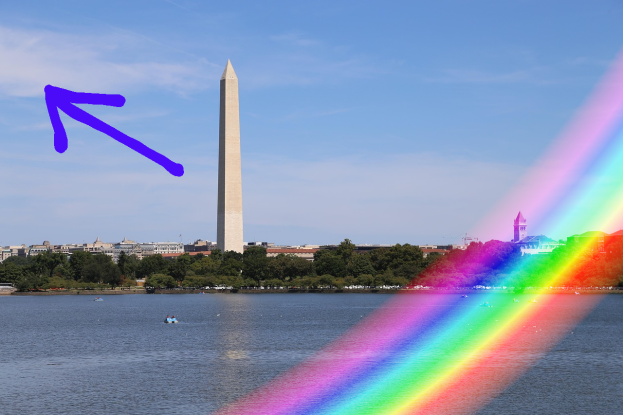
An arrow over the DC skyline, indicating AWAY. The faint arc of a rainbow overlays it.

Eukaryote Skips Town – why I’m leaving DC

I’ve spent the past 7 years living in the DC area. I moved out there from the Pacific Northwest to go to grad school – I got my masters in Biodefense from George Mason University, and then I stuck around, trying to move into the political/governance sphere. That sort of happened. But I will now be sort of doing that from rural California rather than DC, and I’ll be looking for something else – maybe something more unusual – do to next.

A friend asked if this means I’m leaving biosecurity behind. No, I’m not, but only to the degree that I was ever actually in biosecurity in the first place. For the past few years I’ve been doing a variety of contracting and research and writing jobs, many of which were biosecurity related, many of which were not. Many of these projects, to be clear, were incredibly cool and interesting, and I’m honored to have been able to be part of them, and hopefully to do more of them in the future.

But when I moved to DC, I was kind of hoping to start a capitol-capital-C Career in biosecurity: in something having to do with policy and governance of emerging technology. This Career, which surely would include 9-5 hours, health insurance, a 401(k), an office with beige carpeting, and maybe a security clearance and wearing a suit all day, well, uh – it never happened.

I tried. But maybe I didn’t try hard enough, or I don’t have the temperament for it, or I faced Structural Oppression, or some combination of the above. I don’t know. So I got by in other ways and kept trying to get a foot in there, for a long time.

Maybe longer than I should have spent. I’m an optimist. But 3 things have happened:

  1. True love called.
  2. The administration switched out.
  3. I think very intelligent AI might dramatically change the world very soon.

True love, and its invitation to move to California, speaks for itself. (Mine says things like “if you put a laboratory-style shaker machine in the oven, you wouldn’t have to stir the onions every five minutes for half an hour”, and then we discuss the logistics of this for an hour, and it’s great. Did you know they make shaking autoclaves? I didn’t until yesterday.)

The administration – hoo boy. So I’m not permanently writing off a biosecurity capital-C Career, personally. But I’m kind of guessing that over the next 4 years, the kind of jobs I’d been looking for – junior analyst or research positions in thinktanks or nonprofits or federal agencies – are going to be either flush with great well-qualified candidates looking desperately for new work, or nonexistent. RFK? Fucking RFK in HHS? What the fuck were they thinking? Christ.

Strong AI is a discussion this margin is too narrow to contain. I might be totally wrong about this. It would be my dream to write a “how I got caught up in the AGI x-risk hype even though everything turned out fine” essay 20 years from now. Hell, I’ll write a book. But a lot of very smart people are saying things might get weird very soon, and I can’t pretend that “enjoying the old world order while it lasts” isn’t a factor.


I went into biosecurity for utilitarian reasons, influenced by the effective altruism movement. And frankly, despite recent PR hits, I’m still completely on board with all of that. I’m hesitant to write this piece because it’s directly about my EA ambitions, and I’ve talked to a lot of EAs trying to get into biosecurity who want advice, and I have no idea what they should take away from my story or if any of this should be taken as any kind of advice.

I mean, public health in the US, as a political endeavor, is currently being broken into pieces with big hammers. The next four years aren’t a great time to move into biosecurity. But four years will pass and someone knowledgeable might be able to fix it later, right? Or if avian flu spills over into humans and it’s even fractionally as deadly as feared, maybe the political will to fight diseases will return. I don’t know.

And I’m also hesitant to give advice because I’m a sample size of 1 who clearly doesn’t know what went wrong. I really could have tried harder, and I legitimately feel like someone who’s a lot like me but 5% more ambitious or 5% less depressed, or even just 5% luckier, might have been able to make it work! A lot of people I know, who are weird and into effective altruism and depressed and more, have been able to make it work!

(If you’re still here because you want career advice, I tentatively wave you towards “Want to make a difference on policy and governance? Become an expert in something specific and boring“. Otherwise, this post of mine isn’t really going to help you.)

A friend who I’ve had some professional interaction with came to my going-away party. Late into the evening and a little whiskey-warmed, they mentioned that they thought that my aspiring political career had stalled out because I didn’t do a good job of presenting myself as a serious professional, that I spent my weirdness points on things like “being a little awkward” and “being gender-nonconforming”.

I don’t know how right my friend is. I thought this was an interesting take. It’s not like it hasn’t crossed my mind.

At first glance, the notion fills me with a righteous fury – like, if the only way I could make public health better was by fulfilling my socially-condoned sex role like a good girl, maybe public health can suck it!

But public health is measured in lives, so I don’t actually believe that. If you told me right now that I could with 100% certainty swing the ideal biosecurity career if I just femmed it up in the workplace, I’d do it. It’s worth it, because it’s the entire goddamn future of humanity, or at the very least, some of humanity.

But I guess my model of classic DC early-career presentability, at a very basic level, still goes like this:


“Pros”“Cons”
MinorGood rapport with interviewer
Makes people feel good about themselves
etc…
Not a sports fan
Poorly formatted resume
etc…
MediumGood communication
Knowledgeable
etc…
Gender-nonconforming (female)
A little awkward
etc…
MajorHistory of good projects
Fancy credentials
Rare technical skills
Buds with people on the team
etc…
Very awkward
Unpleasant to be around
Trans, gender-nonconforming (male)
Unignorably physically disabled
etc…

And you can have cons if you have enough pros to (in an employer’s eyes) outweigh them. This is, again, just a tailored version of weirdness points / idiosyncrasy credits. I guess I was hoping for employers who would be chill about the arbitrary and stupid cons, and/or that I’d be good enough at my work that the cons were outweighed by the pros.

Nobody ever gave me this advice unprompted, so maybe that’s something I can say – you will not necessarily know for sure.

But I had opportunities to ask, also – professors and DC-oriented college career advisors and colleagues and friends – ask them what kind of impression I was making, what was holding me back. And I didn’t, not really. That’s on me. It could have been any number of things. Doing more interview practice. Sending more cold emails. Not using “Times Sans Serif” in my resume even though it’s a great font.

Now, in my defense: Even if I had asked them, any individual of them might not have a good understanding of what was happening (for instance, I was often the only gender-nonconforming person in a workspace or classroom – does a much older professor, who thinks of themself as accepting person, really know how much of a ding that is?) – so I’d have to ask a lot of people. Some causes are more tractable than others, like, I know roughly how to change “visibly queer” but not how to fix “awkward”. And all that sounds really unpleasant, especially since it’d be taking a lot of mental energy I could use to be better at the work instead.

Also, while we’re being honest here: can you imagine if you force-femmed yourself for five years to improve your career chances, and then your career still didn’t pan out? It’d be humiliating! I don’t know that my ego could stand it.

(If you’d be into that, then imagine pretending to be a proud card-carrying ideologue of a political party you hate. It’s that kind of feeling.)

So, I’m out. Fuck that, fuck this, I’m off, I’m out, this eukaryote is heading west. I can do something useful somewhere else! If not, I can do something somewhere else!

Somewhere I can look at mountains.


Also, while I’m drawing my little lines in the sand: I’m bisexual, asexual1, polyamorous, and gender non-conforming. None of this will come as a surprise to anyone I’ve known well in the last few years, but I’ve avoided saying these hyper-publicly so far because of that silver specter of maximizing career capital. What if someone looks back at my work? Surely I’ll want to be maximally unobjectionable?

But now I’m laying that ghost in its grave. I’m upset at a political tide that sees these as frivolous luxuries or imagined deviations from a true universal way of life or worse, when they have led to some of the best things in my life and I feel more myself than ever – and like, just when society was getting good about them too! Fuck hatred, fuck fear, fuck indifference, and to that end, fuck closets. I am who I am, a person whose preferences are a little weird and a little hard to explain but ultimately harmless, and no amount of haranguing over the Woke Left will change that.

I also have depression and ADHD. I felt weird about putting them in the same category as the queer stuff because, frankly, they’re more clearly negatives. However, consider:

  1. Hiring bias against people with disabilities continues to be hella illegal
  2. People don’t talk about them enough and the political winds blowing toward these things is astonishingly bad
  3. I’m the one getting the worst of my brain, not anyone else, and the facts will be true whether or not I say them out loud, so let’s say them out loud.

Hey guys? Depression sucks so bad! I don’t even have a severe case but the degree to which it drags down your entire quality of life is vast and insidious. If you know what it’s like, you know, and please be compassionate to yourself; if you don’t, please be compassionate to those around you.


Okay, now that we’ve gotten that out:

For better or worse, be it bravery or stupidity, I find it very hard to be someone other than who I am. I will continue to do what I love, which includes reading and writing and thinking about biosecurity and diseases and animals and the end of the world and all that, and I will scrape out my existence one way or another. I hope to write more often. Thanks for joining me, and I hope you’ll stay tuned.

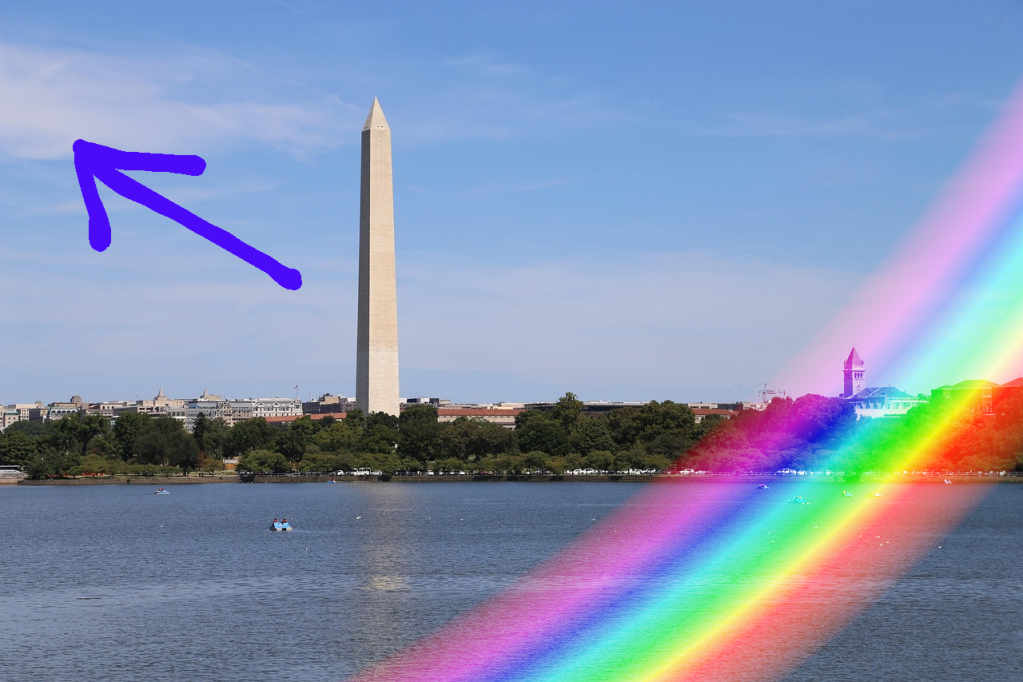
An arrow over the DC skyline, indicating AWAY. The faint arc of a rainbow overlays it.

(Also, if you want to rent a room in Arlington VA, hit me up.)

Support Eukaryote Writes Blog on Patreon. Sign up for emails for new posts in the blog sidebar.

Crossposted to: [EukaryoteWritesBlog.com SubstackLessWrongEffective Altruism Forum]

  1. “How are you both bisexual and asexual?” Okay, I’m biromantic and asexual. I usually say “bisexual” because more people have heard of that one. This is the one terminology quibble you get with me. Hope it was all you wanted and more! ↩︎

Web-surfing tips for strange times

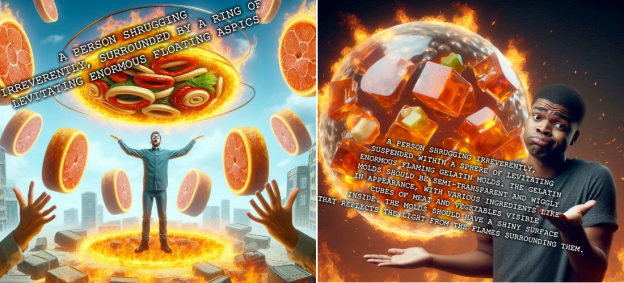
(h/t Bing’s copilot for the cover images, if you’re seeing them.)

Eukaryote Writes Blog is now syndicating to Substack. I have no plans for paygating content at the time, and new and old posts will continue to be available at EukaryoteWritesBlog.com. Call this an experiment and a reaching-out. If you’re reading this on Substack, hi! Thanks for joining me.

I really don’t like paygating. I feel like if I write something, hypothetically it is of benefit to someone somewhere out there, and why should I deny them the joys of reading it?

But like, I get it. You gotta eat and pay rent. I think I have a really starry-eyed view of what the internet sometimes is and what it still truly could be of a collaborative free information utopia.

But here’s the thing, a lot of people use Substack and I also like the thing where it really facilitates supporting writers with money. I have a lot of beef with aspects of the corporate world, some of it probably not particularly justified but some of it extremely justified, and mostly it comes down to who gets money for what. I really like an environment where people are volunteering to pay writers for things they like reading. Maybe Substack is the route to that free information web utopia. Also, I have to eat, and pay rent. So I figure I’ll give this a go.

Still, this decision made me realize I have some complicated feelings about the modern internet.

Hey, the internet is getting weird these days

Generative AI

Okay, so there’s generative AI, first of all. It’s lousy on Facebook and as text in websites and in image search results. It’s the next iteration of algorithmic horror and it’s only going to get weirder from here on out.

I was doing pretty well on not seeing generic AI-generated images in regular search results for a while, but now they’re cropping up, and sneaking (unmarked) onto extremely AI-averse platforms like Tumblr. It used to be that you could look up pictures of aspic that you could throw into GIMP with the aspect logos from Homestuck and you would call it “claspic”, which is actually a really good and not bad pun and all of your friends would go “why did you make this image”. And in this image search process you realize you also haven’t looked at a lot of pictures of aspic and it’s kind of visually different than jello, but now you see some of these are from Craiyon and are generated and you’re not sure which ones you’ve already looked past that are not truly photos of aspic and you’re not sure what’s real and you’re put off of your dumb pun by an increasingly demon-haunted world, not to mention aspic.

(Actually, I’ve never tried aspic before. Maybe I’ll see if I can get one of my friends to make a vegan aspic for my birthday party. I think it could be upsetting and also tasty and informative and that’s what I’m about, personally. Have you tried aspic? Tell me what you thought of it.)

Search engines

Speaking of search engines, search engines are worse. Results are worse. The podcast Search Engine (which also covers other topics) has a nice episode saying that this is because of the growing hoardes of SEO-gaming low-quality websites and discussing the history of these things, as well as discussing Google’s new LLM-generated results.

I don’t have much to add – I think there is a lot here, I just don’t know it – except that I believe most search engines are also becoming worse at finding strings of text put into quotation marks, and are more likely to search for the words in the text not-as-a-string. Bing was briefly the best that I’d seen of this, Google is the best now but I think all of them have gotten worse. What’s the deal with that?

Censorship

Hey, did you know Youtube flags and demotes videos that have the word “suicide” or “kill yourself”(/etc) in them? Many Youtube video makers get paid by Youtube for views on their videos, but if they’re in that setup, a video can also be “demonetized” meaning the maker doesn’t get paid for views. They can also be less likely to appear in search results – so it’s sort of a gray area between “just letting the content do whatever” and “deleting the content”. I don’t want to quite say that “you can’t say ‘suicide’ in new videos on Youtube”, but it equals out pretty close.

Tiktok has been on this for a while. I was never on Tiktok but it seems pretty rough over there. But Youtube is now on the same train. You don’t have to have the word “suicide” written down in the description or have a viewer flag the video or anything, youtube runs speech-to-text (presumably the same program that provides the automatic closed captions) and will detect if the word “suicide” is said, in the audio track.

Also, people are gonna talk about it. People making pretty sensitive videos or art pieces or just making edgy videos about real life still talk about it.

In fact, here are some of the ways Youtubers get around the way this topic is censored on the platform, which I have ranked from best to worse:

  1. Making sort of a pointing-gun-at-head motion with one’s fingers and pantomiming, while staring at the camera and pointing out the fact that you can’t say the word you mean – if it works for your delivery, it is a shockingly funny lampshade. Must be used sparingly.
  2. Taking their own life, ending themself, etc – Respectable but still grating if you pick up on the fact that they are avoiding the word “suicide”
  3. KYS and variations – Contaminated by somehow becoming an internet insult du jour but gains points for being directly short for the thing you want to say.
  4. Self-termination – Overly formal, not a thing anyone says.
  5. Unalived themselves – Unsalvageably goofy.
  6. Going down the sewer slide – Props for creativity; clear sign that we as a culture cannot be doing this.

So I know people who have attempted suicide and of the ones I have talked to about this phenomena, they fucking hate it. Being like “hey, this huge alienating traumatic experience in your life is actually so bad that we literally cannot allow you to talk about it” tends to be more alienating.

Some things are so big we have to talk about them. If we have to talk about them using the phrase “sewer slide”, I guess we will. But for christ’s sake, people are dying.

Survival tips

I’m reasonably online and I keep running into people who don’t know these. Maybe you’ll find something useful.

I was going to add in a whole thing about how “not all of this will apply to everyone,” but then I thought, why bother. Hey, rule one of taking advice from anyone or anything: sometimes it won’t apply to you! One day I will write the piece that applies to everyone, that enriches everyone’s life by providing them with perfectly new and relevant information. People will walk down the boulevards of the future thinking “hey, remember that one time we were all briefly united in a shining moment by the Ur-blog post that Georgia wrote a while ago.” It’s coming. Any day now. Watch this space.

USE MULTIPLE SEARCH ENGINES

Different web search engines are good at different things. This is surprisingly dynamic – I think a few years ago Bing was notable better at specific text (looking up specific quotes or phrases, in quotes. Good for finding the sources of things.)

I use DuckDuckGo day to day. For more complex queries or finding specific text, I switch to Google, and then if I’m looking for something more specific, I’ll also check Bing. I have heard fantastic things about the subscription search engine Kagi – they have a user-focused and not ad-focused search algorithm and also let you natively do things like just remove entire websites from search results.

 Marginalia is also a fantastic resource. It draws from more text-heavy sources and tends to find you older weirder websites and blogs, at the expense of relatedness.

There are other search engines for more specialized applications, e.g. Google Scholar for research papers.

If you ever use reverse image searches to find the source of images, I check in all of Google Images, Tineye, and Yandex before giving up. They all have somewhat different image banks.

USE FIREFOX AS YOUR BROWSER

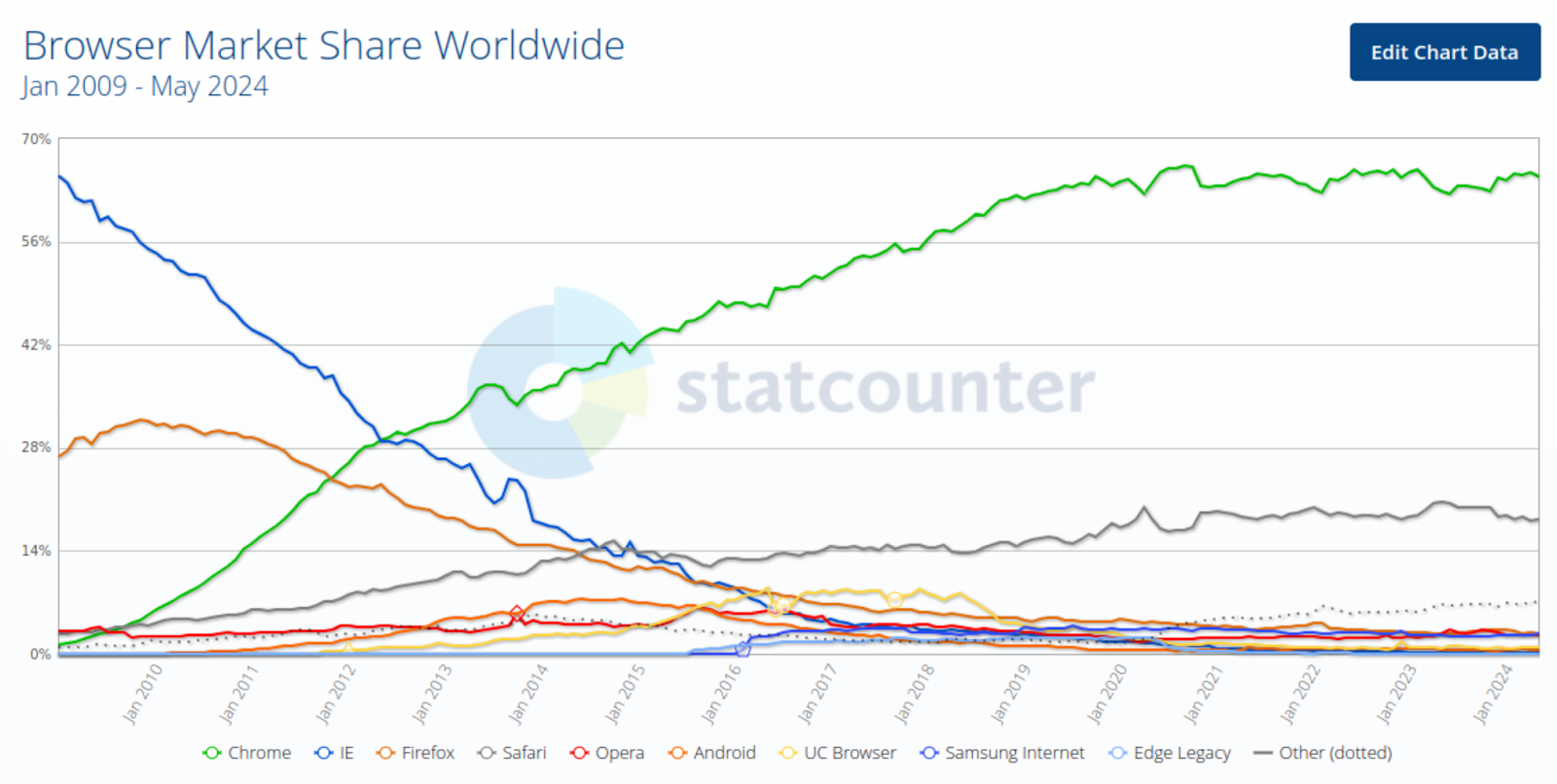
Here’s a graph of the most common browsers over time.

According to statcounter, around 2012 Chrome became the most common browser, and in past few years well over 50% of internet usage is from Chrome.
Source: https://gs.statcounter.com

Chrome is a Google browser with Google’s tracking built into it, saving and sending information to Google as you hop around the web. Many of these features can be disabled, but also, the more people use exclusively Chrome, the more control Google can exert over the internet.

For instance, by majorly restricting what kind of browser extensions people can create and use, which is happening soon and is expected to nerf adblockers.

DO NOT GO GENTLE INTO THAT GOOD NIGHT. USE FIREFOX. HELL FUCKING YES.

Please stick it to the man and support a diverse internet ecosystem. Use Firefox. You can customize it in a million ways. It’s privacy focused. (Yes, privacy on the web is still achievable.) It’s run by a nonprofit. It’s really easy to use and works well. It’s for desktop and mobile. Use Firefox.

(I also have a Chrome-derived backup browser, Brave, on my PC for the odd website that is completely broken either by Firefox or by my many add-ons and I don’t want to troubleshoot it. I don’t use it often! Or when I want to use Google’s auto-translation tools, which are epic – and Google’s are better than what I’ve found conveniently on Firefox. You can have two browsers. Nobody can stop you. But make one of them Firefox.)

READ BLOGS? GET AN RSS READER

I’ve heard from a few savvy people that they like the convenience of Substack blogs for keeping track of updates, and I was like – wait, don’t you have an RSS reader? Google didn’t have a monopoly on the RSS reader! The RSS reader lives on!

What it is: A lot of internet content published serially – blog posts, but other things too – has an RSS feed, which is a way of tagging the content so you can feed it into a program that will link to updates automatically. An RSS reader is a program that stores a list of RSS feeds, and when you use it, it goes and checks for new additions to those feeds, and brings them back to you. It’ll keep track of which ones you’ve clicked on already and not show you them again.

This means you can keep track of many sources: Substacks, blogs on any other platform, podcasts, news outlets, webcomics, etc. Most good blogs are NOT on substack. That’s not a knock on substack, that’s just numbers. If substack is your only way of reading blogs you are missing out on vast swathes of the blogosphere.

I use Feedly, which has multi-device support, so I can have the same feed on both my phone and laptop.

If you want to run your own server for it, I hear good things about Tiny Tiny RSS.

There are a million more, and your options get wider if you only need to use it on one device. Look it up.

FIND SOME PEOPLE YOU TRUST.

If you find yourself looking up the same kinds of things a lot, look for experts, and go seek their opinion first.

This doesn’t have to only be for like hardcore research or current events or such. My role in my group house for the past some years has been “recluse who is pretty decent at home repairs”. Here is my secret: every time I run into a household problem I don’t immediately know how to solve, I aggressively look it up. 

In this example, Wikihow is a great ally. Things like Better Home and Gardens or Martha Stewart Living are also fairly known sources. If nothing else, I just try to look for something that was written by an expert and not a content mill or, god forbid, an LLM.

Sometimes your trusted source should be offline. There are definitely good recipe sites out there, but also if you really can’t stand the state of recipe search results, get a cookbook. I’m told experts write books on other subjects too. Investigate this. Report back to me.

PAY FOR THINGS YOU LIKE TO INCENTIVIZE THEIR EXISTENCE.

But if you have the money for the creators and resources of your favorite tools or stories or what have you, it’ll help it stay around. Your support won’t always be enough to save a project you love from being too much work for its creator to keep up with. But it’s gonna fucking help.

Hey –


If you don’t like Substack but want to support the blog, I am still on Patreon. But I kind of like what Substack’s made happen, and also many cool cats have made their way to it.

That said, here are some minor beefs with Substack as a host:

  1. I want to be able to customize my blog visually. There are very few options for doing this. The existing layout isn’t bad, and I’m sure it was carefully designed. And this gripe may sound trivial. But this is my site, and I think we lose something by homogenizing ourselves in a medium (internet) that is for looking. If I want to tank my readership by putting an obnoxious repeating grid of jpeg lobsters as my background, that’s my god-given right.

    (I do actually have plans to learn enough html to swap my WordPress site over to a self-hosted self-designed website, I just have to, like, get good enough with HTML and CSS and especially CSS to get Gwern’s nice sidenotes and hosting and how to do comments. It’s gonna happen, though. Any day now.)
  2. I don’t like that I can only put other substack publications in the “recommendations” sideroll. It feels insular and social-network-y and a lot of my favorite publications aren’t on substack. I’ll recommend you a few the manual way now:

For your experience of Eukaryote Writes Blog, I think the major theoretical downside of this syndication is splitting the comments section. Someone who sees the post on WordPress and leaves a comment there means that the person reading Substack won’t see it. What if there’s a good discussion somewhere?

But I already crosspost many of my posts to Lesswrong and usually if there’s any substantial conversation, it tends to happen there, not on the WordPress. Also sometimes my posts get posted on, like, Hacker News – which is awesome – and there are a bunch of comments there that I sometimes read when I happen to notice a post there but mostly I don’t. So this is just one more. I’ll see a comment for sure on LessWrong, Substack, or WordPress.

Anyway, glad to be here! Thanks for reading my stuff. Let me know if I get anything wrong. Download Firefox. On to more and better and stranger things.

A love letter to civilian OSINT

[Content warning: discussion of violence and child abuse. No graphic images in this post, but some links may contain disturbing material.]

In July 2017, a Facebook user posts a video of an execution. He is a member of the Libyan National Army, and in the video, kneeling on the ground before his brigade, are twenty people dressed in prisoner orange and wearing bags over their heads. In the description, the uploader states that these people were members of the Islamic State. The brigade proceeds to execute the prisoners, one by one, by gunshot.

The videos was uploaded along with other executions perhaps as a threat or a boast, but it also becomes evidence, as the International Criminal Court orders an arrest warrant on the brigade’s Leader, Mahmoud Mustafa Busayf Al-Werfalli, for killing without due cause or process – the first warrant they have issued based only on social media evidence. And once the video falls into the lap of international investigative journalism collective Bellingcat, the video also becomes a map leading straight to them.

The video’s uploader is aware that they’re being hunted, and very intentionally, does not disclose the site the incident took place at. The camera focuses on an almost entirely unrecognizable patch of scrubby desert – almost entirely. At seconds, bits of horizon pop into the video, showing the edge of a fence and perhaps the first floor of a few buildings.

Bellingcat reporters knew the brigade was operating in the area around Benghazi, Libya’s second largest city. The long shadows of the prisoners in the video suggest the camera was facing one of two directions, in either early morning or late afternoon.

A Twitter user suggested that the sand color resembled that in the southwest of the city moreso than in other parts. The partial buildings glimpsed in the background looked only partly constructed, and within that district of the city, a great deal of construction had stopped do to the civil war. Rebel fighters were rumored to be living in a specific set of buildings – perhaps the same brigade? Using satellite footage, the researchers worked backwards to find where the video must have been shot, such that it could see both a fence, a matching view of a building, and other details like large shrubs. They came back with GPS coordinates, accurate out to six digits, and a date and time down to the minute.

The grim confirmation came when the coordinates were checked against a more recent set of satellite imagery from the area. In the newer footage, on the sand, facing out into the buildings, fence, and large shrubs, were fifteen large bloodstains.


Bellingcat is an organization that does civilian OSINT. OSINT is “Open Source Intelligence”, a name that comes to it from the national intelligence sphere where the CIA and FBI practice it – relevant knowledge that is gathered from openly available sources rather than from spy satellites, hacking, and the like. (OSINT is also a concept in computer security, I believe that’s related but probably a somewhat different context.) Civilian OSINT is to OSINT as citizen science is to science at large – democratized, anyone can do it, albeit perhaps fewer tools than the professionals tend to have. Given that OSINT inherently runs on public material, civilian OSINT has theoretical access to the exact same information that professionals have.

Bellingcat is, of course, an organization that employs OSINT experts (making them professionals), but they also have a commitment to openness and sharing their methods, which I believe classes them in with other. Organizations that focus on this are thin on the ground. (Outside of academia, where certain research on e.g. internet communities could be said do be doing the same thing.) For instance, the Atlantic Council has the Digital Forensics Research (DFR) Lab, which analyzes social media and other internet material in relation to global events.

Other OSINT organizations are less institutional and may be volunteer-based. Europol’s “Find an Object” program crops identifying information from pictures of child abuse, so that only items in the photo are visible (a package of cleaner, a logo on a hat) and then asks the internet if can identify the items and where they are found. WarWire is a network of professionals who gather and analyze social media data from warzones. Trace Labs is a crowdsourced project that finds digital evidence on missing persons cases, the results of which it sends to law enforcement. DNA Doe is a related project where volunteers use genetic evidence to identify unidentified bodies. Less formally, there are dedicated forums like WebSleuths and the “Reddit Bureau of Investigation” (r/RBI).

More often, though, these investigations emerge spontaneously and organically: More commonly, these efforts are not practiced or planned, but form spontaneously and organically – Reddit communities have occasionally made the news for identifying decades-old John Does, stabilizing shakey cell phone footage that provided important evidence in the case of a police shooting, and identifying that a mysterious electrical component in a user’s extension cord was a secret camera.

Volunteers

Volunteer labor is an elegant fit for OSINT:

  • Much of it is digital and doable remotely
  • Many tasks require little training
  • Depending on the cause, volunteers will work
  • Causes are things people care about
  • Volunteers work at their own hours and are thus resilient to the kind of emotional burnout bellingcat has seen in its employees
  • Willing to devote their time

Let’s unpack ‘time.’ Many investigations come down, eventually, to monotonous searches: Bellingcat was eventually able to use just five photos with vague landscape features to pinpoint two geographic locations where human trafficking had taken place for the “Trace an Object” project. A remarkable task – and one that took weeks.

(Steps in the process included “exploring major cities in Southeast Asia via Google Streetview to find ones that looked most similar to photos”, and “guessing that the closest-looking city was the correct one”. This worked.)

Overall, they spent over 2,500 hours to concretely identify 12 Europol photos in the past twelve months, and to partially identify thirteen more. And identification of objects is only one step in the way to arrest – some photographs were years old, the perpetrators and victims likely moved or worse. In the Europol program’s three year history, with tens of thousands of volunteer tips, only ten children have been rescued.

Any child saved from these horrors is, of course, a success. But it suggests that paying people for this type of work isn’t going to be efficient in the standard effective altruism framework of lives-saved per dollar.

I think practical civilian OSINT, to move monotonous mountains like this one, needs to tap into a different reservoir: the kind of digital energy that has built and maintained Wikipedia, countless open-source projects, the universe of fanpages and fanfiction, etc. This sort of collaborative, enthusiastic volunteer labor is well suited to the more repetitive and time-consuming aspects of open source investigation.

(Obviously, different projects will have different payoffs – I’m sure that some will be hugely effective per paid hour, although I don’t know which ones they are.)

Sidenote: What about automating OSINT with neural nets?

I bring this up because I know my audience, and I know people are going to go “wait, image identification? You know DeepMind can do that now, right?”

Well: the neural nets for this don’t exist yet. If someone wants to make them, I could see that being beneficial for OSINT, although I’d advise such a person to take a long hard look at the ‘OSINT is a dual use technology’ section of this post below, and to think long and hard about possible government and military uses for such a technology (both your own government and others.) I suspect this capability is coming either way, either from the government or commercial AI companies, and so may be a moot issue.

Still, I’m talking specifically about what OSINT can be used for now.

OSINT is a dual-use technology

In biology and other fields, a “dual-use” technology is one that can be used for good as well as for evil. A machine that synthesizes DNA, for instance, can be used to make medical research easier, and it can be used to make bioterror easier.

Civilian OSINT is one. While Reddit has identified missing persons, its communities also famously misidentified an innocent man as the Boston Marathon Bomber. Data gathered from a bunch of untrained unvetted internet randos should probably be viewed with some skepticism.

It’s also tragically easy to misuse. A lot of OSINT tools (for e.g. identifying people across social media) could be used by stalkers, abusers, authoritarian governments, and other bad actors just as trivially as it could by investigators. Raising the profile of these methods would expose them to misuse. Improving on OSINT tools would expose them to misuse.

If it helps, I think most small-scale efforts – like anything by Reddit or Trace Labs – are not really doing anything that large governments can’t do, technically speaking.* Ethical civilian OSINT projects should also be expected to go out of their way to demonstrate that they’re using volunteer labor ethically and for a specific purpose.

That leaves the threat as ‘malicious civilians’ (stalkers, etc.) and perhaps ‘resource-limited local governments’. This is a significant issue.

* (Though they can do things that large governments can’t do, time- and resource-wise. Keep reading.)

But here’s why we should use it anyway

Standard police and journalistic investigations (as two common uses of intelligence)are also very fallible. They may rely on misinformation and guesswork, poor eyewitness testimony, faulty drug tests, error-prone genetic methods, and debunked psychological methods. It’s not obvious to me that the average large-group civilian OSINT investigation will have a higher rate of false negatives than a standard investigation.

Moreover, that’s not really the issue. The relevant question is not “is crowd-sourced civilian OSINT worse than conventional investigation?” It’s “is crowd-sourced civilian OSINT worse than no investigation at all?” When Europol puts objects from images of child abuse online and asks for anyone who can identify the objects, and an answer is found and confirmed with online information, Europol workers could also have done that. It just would have taken them too high of a cost in time and human effort. When Reddit users solve cold cases, they are explicitly aiming for cases that are no longer under investigation by the police, or cases where police are under-investigating.

Open investigations like Bellingcat also structurally facilitate honesty because their work can be independently verified – all of the reasoning and evidence for a conclusion is explicitly laid out. In this way, civilian OSINT shares the ideals of science, and benefits because of it.

Where OSINT shines

It seems like cases where civilian OSINT works best have a few properties:

Not rushed. Reddit’s misidentification of the Boston Marathon Bomber happened within that hours after the attack. People were rushing to find an answer.

Results are easily verifiable. For instance, when Europol receives a possible identification of a product in an image, they can find a picture of that product and confirm.

Structure and training. An intentional, curated, organized effort is more likely to succeed than a popcorn-style spontaneous investigation a la Reddit. For instance, it’s probably better for investigations to have a leader. And a method. Many OSINT skills are readily teachable.

Learning OSINT

Despite the rather small number of public and actively-recruiting OSINT projects, there are a few repositories of OSINT techniques.

The Tactical Technology Collective, a Berlin nonprofit for journalists and activists, created Exposing the Invisible: a collection of case studies and techniques for performing digital OSINT research, especially around politics.

Bellingcat also regularly publishes tutorials on its methods, from using reverse image searches to identifying missiles to explaining your findings like a journalist.

The nonprofit OSINT Curious bills itself as a “learning catalyst” and aims to share OSINT techniques and make it approachable. They produce podcasts and videos demonstrating digital techniques. In addition, a variety of free tools intentionally or purposefully facilitate various OSINT practices, and various repositories collect these.

OSINT for effective altruism?

I don’t actively have examples where OSINT could be used for effective causes, but I suspect they exist. It’s a little hard to measure OSINT’s effectiveness since, as I described above, many OSINT tasks are a bad go from a reward-per-hour perspective. But they can use hours that wouldn’t be used otherwise, from people’s spare time or (more likely) by attracting people who wouldn’t otherwise be in the movement.

At the Minuteman Missile Site museum in South Dakota, I read about a civilian effort by peace activists during the Cold War to map missile silos in the Midwest. Then they published them and distributed the maps rurally. The idea was that if people realized that these instruments of destruction were so close to them, they might feel more strongly about them, or work to get them “out of our backyard.” (In a way, exploiting the Copenhagen interpretation of ethics.) Did this work? No idea. But it’s an OSINT-y project that touches on global catastrophic risk, and it’s certainly interesting.

I wondered if one could do a similar thing by mapping the locations of factory farms in the US, and thus maybe instill people to act locally to reform or remove them. The US Food and Water Watch had such an interactive digital map for the USA, but it seems to have gone down with no plans to bring it back. Opportunity for someone else to do so and give it some quality PR?

(In the mean time, here’s one for just North Carolina, and here’s a horrifying one for Australia.)

Again, I don’t know how effective it would be as a campaigning move, but I could imagine it being a powerful tool. The point I want to make is basically “this is an incredible tool.” Try thinking of your own use cases, and let me know if you come up with them.

A shot at – not utopia, but something decent

Here’s my last argument for civilian OSINT.

Trace Labs staff have pointed out that their teams tend to be more successful at finding evidence about people who have recently gone missing, versus people who have gone missing – say – over a decade ago. This is because people in the modern age are almost guaranteed to have extensive web presences. Not just their own social media but the social media of relatives and friends, online records, phone data, uploaded records, digitized news… There used to be no centralized place for the average person to find this info for a far-off stranger. Information was stored and shared locally. Now, teenagers half a world away can find it.

I have a lot of hope and respect for privacy and privacy activists. I think basic digital privacy should be a right. But the ship is sailing on that one. Widespread technology gives governments a long reach. China is using facial recognition AI to profile a racial minority. The technology is there already. A lot of social media identification is in public. A lot of non-public conversation is already monitored in some form or another; that which isn’t can often be made public to governments without too much effort. US federal agencies are hiding surveillance cameras in streetlights. You can encrypt your messages and avoid having your photo taken, but that won’t be enough for long. It’s already not. As long as citizens are happy to keep carrying around internet-connected recording and location-tracking devices, and uploading personal material to the web – and I think we will – governments will keep being able to surveil citizens.

Sci-fi author and futurist David Brin also thinks that this is close to inevitable. But he sees this balanced by the concept of ‘reciprocal transparency’: the idea that the tools that enable government surveillance, the cameras and connectivity and globally disseminated information, can also empower citizens to monitor the government and expose corruption and injustice.

A reciprocally transparent society could be a very healthy one to live in. Maybe not what we’d prefer – but still pretty good. Civilian OSINT seems like the best shot at that we have right now: Open, ubiquitous, and democratized.

COVID-19 FAQ

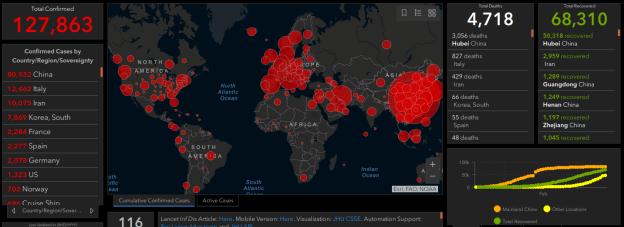
(featured image is from Johns Hopkins University’s COVID-19 live tracker map on 3-12-2020.)

A lot of people have been asking me questions about the COVID-19 (novel coronavirus) outbreak, in my informal capacity as “local biodefense person”. I’m not an expert in this. I’m just a grad student with a blog. But I have been trying to keep up on the news and research, and in the interests of sharing what I know and saving my emotional energy for more specific responses (and also the rest of my life), I thought I’d share what I’m thinking about the situation right now.

This is an emerging situation. I’m writing this on March 12th, 2020, I expect any specific information or recommendations to be valid for at least the next few days, but after that, they may change a lot. Also, this post is based on the situation in the US, where most of my readers are. Check recent information (especially in your area) and think carefully about what kinds of precautions you should take.


Q: Are you worried about COVID-19?

A: Hell yes I’m worried.

Q: Why are you worried?

A: The death rate is high, the disease is spreading very rapidly and quietly, and we don’t have medical countermeasures. There were a priori reasons to think this was a bad situation as well – novel respiratory viruses are known to be uniquely bad. SARS and MERS were famous high-lethality coronaviruses well before the current outbreak – if I’d made a list of predictions about what kind of new disease outbreaks we should be worrying about (something I’ll probably do now), I almost certainly would have written down “a SARS-like coronavirus”.

Q: Is this really worse than the seasonal flu?

A: Yes. It spreads faster and the death rate is higher.

Q: Should I be worried?

A: Yes. It depends on where you are – you’re in more active danger if you live in a city and live with or come in contact with a lot of people every day, or you’re older or have one of a few pre-existing conditions (e.g. heart disease, lung disease, diabetes). You should also be more careful if you work with elderly people or in a healthcare setting. In any case, you should almost certainly be taking some kind of precaution.

Q: How bad is this going to get?

A: Ha ha ha ha ha. I have no idea.

At the least, based on where we are now and its recent trajectory, it’s going to get worse. I see a couple plausible trajectories for this:

1) Humanity gets our collective $@%& together and contains it. Perhaps a vaccine or effective countermeasure eases the way. COVID-19 is beaten back and eventually vanishes from the human species. This is a notable outbreak for academic purposes, but in a few decades, most people barely remember it.

2) This gets very big. I’ve heard some guesses that everybody will end up getting infected. It may become endemic, meaning that it’s a constant ongoing infection rather than a one-off spillover from an animal. It may stay as deadly as it is, or attenuate, meaning it becomes less harmful but still spreads around. Or maybe literally everyone doesn’t get it, but many, many people do, and this becomes our generation’s version of the 1918 flu. Or worse.

Q: If everyone’s going to get COVID-19, maybe I should just get it now and get it out of the way?

A: You are actively trying to give me a migraine.

Q: I promise I will still try not to get it. Theoretically, though, wouldn’t it still be better to get it early?

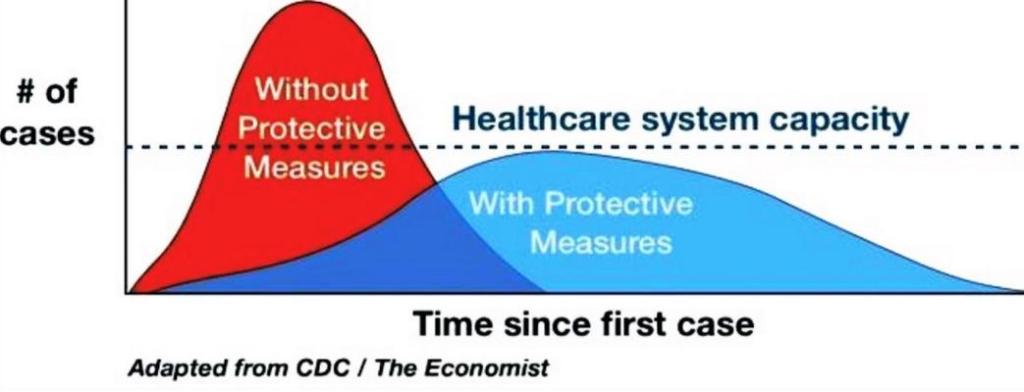
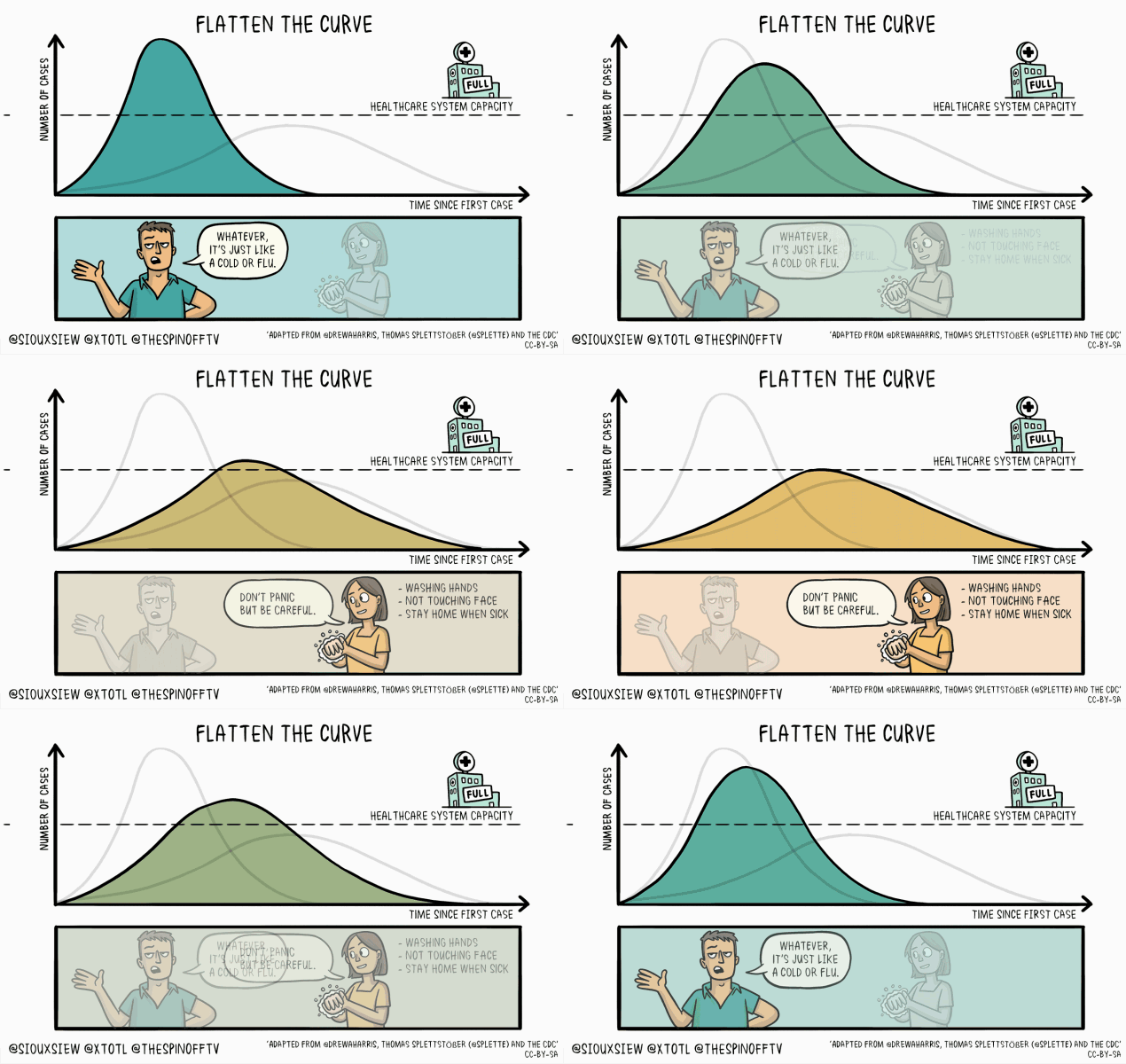
A: Okay, so there is something to this. I’ve seen some elegant little charts going around that look like this:

This suggests that yes, there’s something to spreading out infections over a longer period of time, so that in case you need to get hospitalized, hospitals will be kept under maximum capacity, and this will save lives in the long run.

First, however, these graphs assume that we are capable of getting the infection peak to below the point where hospitals are overwhelmed. I have my doubts.

Second, if you can get the disease later rather than earlier, you’ve bought the healthcare system more time to prepare, and perhaps for the market to provide more supplies.

Third, there’s at least some amount of evidence that the virus is not immunizing in all cases – that there’s some chance you could get the virus, recover, and then get it again. Most people I’ve talked to think that this is probably not actually true and that it’s a mistake with the earlier tests (that is, the tests that showed the person no longer had the virus were wrong, and they did still have it.) But in case it’s not a mistake, it’s horrifying, so maybe don’t get it.

Fourth, if the model that “everyone will get it” is wrong, you’ve just gotten the virus and maybe helped spread it for no good reason at all.

If for some reason you still that this is a good idea, note that if you get the disease, you put everyone you live with and interact with at risk. If you think you have it, you need to stay quarantined and avoid interacting with people face-to-face for at least fourteen days + the duration of any symptoms. Otherwise, you are putting people at unnecessary risk.

Just do your best to avoid getting it. Gosh.

Q: How should I be preparing?

A: If the virus is in your area, you should prepare for:

1) Avoiding transmission via social distancing

Avoid large groups. The degree to which you should do this is dependent on how bad the threat is where you are. In the DC area, I would strongly consider not attending even small parties or meetups at this point. As a reference point, Oregon, Maryland, New York, Seattle, and Santa Clara governments have all banned gatherings of more than a certain number of people (250-500).

Avoid crowded areas. Stock up on shelf-stable groceries now so that you have to go to the store less.

Can you work from home, either full or part-time? If so, figure out how to now.

Elderly and immunocompromised people, as well as people with certain pre-existing conditions (e.g. heart disease, lung disease, diabetes) , are at particular risk. Figure out who these people in your life are. Help them figure out plans for reducing risk. And note that these people will be existing and interacting in public, as always, even if you don’t know who they are.

2) Supply chain disruptions

If the disease gets worse, we may see disruptions in supply chains. We are already seeing shortages of e.g. masks and hand sanitizer in grocery stores. Extra stockpiled food and supplies will be helpful if this happens. (I think “at least two weeks” is a good guideline, but do more if you can. I think I have at least a month of food in my house now.)

If you need medication, try to get a larger supply from your doctor now. (You may try asking for a ninety-day or six-month supply, lots of doctors can do this for travelling patients.) China produces a lot of medication precursor ingredients. This FDA list contains an updated list of which meds are in short supply.

Q: How do I tell when to start doing social distancing?

A: If you’re in the US, the US government has been reacting kind of slowly, so you should be planning to do it before official recommendations say to. I would say: start doing some social distancing as soon as there are reports of community transmission in your area. (That is, someone who did not travel to an infected country gets the disease.) Amp up your distancing efforts as more people get it.

Q: I was about to travel. Should I cancel my plans?

A: I would not take a plane or greyhound-type bus anywhere at this point. If you are very sure you are not sick (no cold- or flu-like symptoms for at least the past 14 days, and no close contact with a sick person), and you’re travelling to a place without community transmission, this is less risky. If you’re planning on driving, it’s even less risky. …But I’d still be careful, and if there’s a lot of community transmission where you are, I think it’s best to stay home.

Q: Actually, I was going on a cruise ship –

A: Do not go on a cruise ship.

Q: What should I be stockpiling?

A: My suggestions:

  • At least two weeks’ worth of shelf-stable food (ideally a month’s worth).
    • Including coffee or tea if you caffeinate (it’s cheap and will make your life much better should you need it).
    • Including food that’s easy to prepare and eat, like canned soup and powdered drink mix, in case you get sick.
    • Including protein and vegetables.
    • Potentially: a multivitamin. In particular, there is some evidence that Vitamin D supplements help prevent respiratory infections.
  • Plenty of hand soap (wash your hands a lot, especially when in public or coming home).
  • Plenty of hand sanitizer (start using this now).
  • Other consumables you need to live – laundry detergent, dish soap, toilet paper, etc.
  • Disinfectant wipes (start using these now. They are largely safe for phone screens).
  • Things you like when you have the cold or flu (painkillers, cough drops, honey, etc) in case you get sick.
  • Extra supplies of essential medication and supplements.
  • Things to do so you won’t get bored out of your mind if you have to start spending most of your days (or spare time) inside – craft supplies, books, whatever. I also got a yoga mat so I could exercise (via youtube videos) indoors.
  • Extra pet food and supplies, if you have a pet.
  • A digital thermometer. COVID-19 infections often come with a fever. If you get a fever, stay home.

Q: I don’t have enough space to stockpile supplies.

A: I live in a studio apartment and still have a couple boxes of calorie-dense dried and canned food and cleaning supplies tucked away. You can probably figure it out. (If you are my friend who lives in a car, you can still do a little but yeah, okay, that kind of blows. Ask a friend if you can keep supplies in their shed.)

Q: What about masks?

A: For preventing you from getting sick, I’m confused about masks. I think they must be beneficial, but also that mask production doesn’t seem to be ramping up quickly and there are already shortages for groups in need. Some groups are saying not to use them to protect yourself, but I think that’s a response to the shortage, and the fact that healthcare workers and immunocompromised people and sick people need them more than you. If you have a mask already, it will probably help you avoid getting sick.

If you are sick, masks will definitely help prevent you from infecting other people. But if you’re sick, try and avoid other people anyway.

I hear that there are DIY masks out there and think it makes sense that there should be some effective ways to make them with common materials, but I haven’t looked into this and have no idea how to assess this. 

A few relevant studies are summarized here, with equivocal results. Note that just slapping e.g. a t-shirt over your face will not help much. Either way, look up how to make sure your mask is fitted properly, and how to take it off safely.

Q: I get my groceries or [INSERT IMPORTANT THING HERE] delivered. Does that work?

A: I wouldn’t count on it. Your deliveryperson or anybody who interacts with your products beforehand might be sick. Stockpile anyway, and if the situation gets really dire, either shut down deliveries or think of ways to disinfect sealed packages first. If you rely on deliveries, I’d order those deliveries in bulk now and reduce deliveries later.

Some of my friends are thinking about ways to disinfect normal postal mail. I don’t know enough to say if this is important yet. I think it’s worth considering. The virus potentially survives for up to 9 days on surfaces (but this likely depends on the surface.) Bleach, alcohol, and quaternary ammonia all seem to kill the virus.

Q: Do I need to stockpile water, or prepare for power outages?

A: Probably not. Utilities, especially water, tend to be relatively easy to keep running even if many people become sick. (In Wuhan, for instance, the power and water supplies never shut off.) That said, it’s never a bad idea to have a few days’ worth of water on hand for disasters, or a backup system for an electronics you absolutely need. Or if you rely on fuel or deliveries for water or power, you may want to store extra. (Note that the US Department of Homeland Security recommends having a 2-week supply of water on hand in pandemics.)

Q: What about people who can’t work from home, or afford to social-distance themselves, or afford to stockpile supplies?

A: They are at higher risk. This just sucks and there’s no great answer. Broadly, these people will still be better off if other people decide to stay at home, stockpile food from the grocery store rather than going every week, etc. If you can do social distancing, keep in mind that you’re not just reducing risk to yourself, but also to everyone else you come in contact with.

Q: Isn’t stockpiling bad because it will deplete supplies for other people?

A: If you stockpile early, you send a signal to the market that they need to provide more food and supplies. If you stockpile too late, yyyesss. I’m not sure what to do about this, aside from noting that you’re probably not the only one doing it. If you’re worried, just stockpile earlier.

Q: We’ve already been seeing xenophobic/racist attitudes towards Chinese people emerge as a result of this. Is it possible this is the real danger?

A: It is a danger, but the stance that stoking racism is “the real danger” is misguided. In the aftermath shortly after 9/11, I think it would have been fair to say that “the social ramifications that this incites will be worse than the attack itself.” But this is not 9/11. This is a lethal disease that has spread worldwide. It has already killed more people than 9/11 and may well kill many, many, many more in the coming months, including in the United States (where most of my readers are). People are afraid and they are right to be fearful.

This does not excuse xenophobia. People should be afraid of the disease – we owe all the compassion we can muster and more to other people. You ought to combat racism where you see it, think about your own attitudes, and certainly not uphold racist ideas like “maybe I should avoid Chinese people” – but you should also be preparing and treating the disease itself as a real threat.

Q: I’m young and have no no pre-existing conditions. I don’t need to be worried, right?

A: You don’t need to be as worried as other groups. But COVID-19 might still have a ~0.2% mortality rate for young, healthy adults. If you were offered the chance to do something really cool for free (hang-gliding, an amusement park) but it came with a 1-in-500 chance you’d be killed, you wouldn’t do it, and you shouldn’t.

Arguably, you should be more scared for other people with worse conditions, but you’re allowed to be scared for yourself too. Do you, personally, need permission to be selfishly afraid? Here it is. I am young and healthy and afraid for my own health. Death is really, really bad, and a 1-in-500 chance of dying is awful, even if other people have it worse. This is a horrible situation.

Also: The worst is yet to come. Pneumonia and hospitalization are deeply unpleasant and still fairly probable outcomes. If hospitals become overloaded, your chance of surviving severe pneumonia goes way down. 

Q: Are there reasons for hope?

A: Yes. At least a couple different groups are now doing human trials on candidate vaccines. After a ~3 month span, this is literally unprecedented in vaccine development.

The virus’ genome was also sequenced faster than any other novel disease.

Also, while the media has been spreading a lot of misinformation and undirected panic, the modern media environment also means that more people can be informed and prepared than ever before.

We’re in this together. Stay strong, readers. ❤

(Thanks to friends for reviewing this piece, especially Glenn Willen / @gwillen.)