Category Archives: culture

Ave Imperator, morituri te salutant: a review of Skibidi Toilet

Art has died and been reborn a thousand times now. Join me at its graveside once again. Let us speak a few words for what once was. Let us imagine the inconceivable and hollow future ahead without it. If you weep, I will pass you my handkerchief. And let us all pretend to be surprised once more when it bursts out of its coffin, on fire, and singing.

Do you know what song it sings this time? I think you do.

Skibidi Toilet is a wildly popular animated video series. Particularly, it is popular among the youth. Most millennials-and-above I’ve talked to go glass-eyed when its name is invoked. Their souls momentarily leave their bodies, but float back down again in short order. “Why?” they ask, laughing. “Why would you watch that?”

And it’s not completely naive. There’s always been vapid absurd art popular among kids, and wise adults remember and know this. On the internet, it’s stick figure fights and zombocom. Saladfingers and Badger Badger Mushroom. Baby Shark and those weird Spiderman Finger Family Dancing Elsa Learn Colors videos. 

Skibidi Toilet is different from all of those. Skibidi Toilet is, like, actually okay.

At time of writing, the series stands at 26 seasons and 78 total episodes – but most of the episodes are under a minute long, so it’s only 2.5 hours total. Created by DaFuq!?Boom!, AKA Alexey Gerasimov, Skibidi Toilet is a serial narrative about the unfolding conflict between two groups: the Skibidi Toilets, which are human heads that come out of toilets, and what I think of as the AV Army – humanoid figures with cameras, speakers, televisions, and so on for heads. 

The AV Army is completely nonverbal. The Skibidi Toilets sing, but only the one song, incessantly. There is extremely little verbal or written language throughout the series. Even “skibidi” is a nonsense scat word. (It’s been speculated that this has to do with why the show has been so popular with children, and with international audiences. Is that true? I don’t know, maybe.)

Yes, obviously the toilets can move. You cannot even begin to fathom what these toilets are capable of.


Looking at Skibidi Toilet for the first time, you might think it was made in a janky 3D engine. And you’re partially right. What you might not realize is that it’s made in Source Filmmaker, a 3D engine developed by Valve in 2012 to make animations with video game assets. You might not realize that the series is littered with video game assets and models from games like Half Life and Counter-Strike, and that it was inspired by animations done with Garry’s Mod.

Source Filmmaker is the logical extension of machinima, e.g., movies shot in video games. While Source Filmmaker is definitively a piece of animation software that happens to run on game assets, machinima even in “real” games is a rich genre. Consider Emesis Blue, a psychological action thriller made and set in the world of Team Fortress 2; Whitepine, a sensitive and artistic period drama/mystery made in Minecraft; and of course, the award-winning documentary Grand Theft Hamlet.

Historically, these all stem from an interesting question: Why would you want to watch someone else play a video game?

A brief history of machinima


This makes more sense then you might think. I think for a lot of us, our first memories of video games were watching someone else play it. Friends. An older sibling. Waiting for your turn on the controller, or handing over the reins to your sibling to see if they can do the hard part for you, or just watching. 

It’s oddly enchanting to watch someone else play: you get to see the visuals. If there’s a story, you still get to experience the story. If they’re good at the game, it becomes like watching sport. Earliest preserved game footage – not games, videos of people playing games preserved for reasons other than technical demos of the game itself – are of PVP combat or speedruns, i.e., skill. 

But even decades ago, people became interested in games as artistic medium. Telling stories about things that might have happened in the game, but then really getting wacky with it, just using the game as artistic expression.

I think it’s interesting to note different levels of storytelling in this process, all of which are still widespread:

There’s the narrative a game has in the first place. You’re there to rescue the princess, you’re there to slay the princess, whatever. As a viewer, you might have the added narrative layer of the player learning about or reacting to the story, but the root story is the one the game is designed to tell.

Then there are stories invented by the players that still operate under the game’s world and logic.

Then there’s the full abandonment of the game mechanic aside from as stage. Garry’s Mod can be used to make games and is designed to open up this end of the spectrum, and Source Filmmaker completely departs from the game premise – Skibidi Toilet takes place far on this end of the spectrum, maybe even off of it.

Skibidi Toilet remembers its heritage in video games – video game characters and models, the first-person camera angles, the fact that they’re literally shot from a person’s head perspective, guns and weapons in arms akimbo at the side of the screen, enemies bearing down on the POV – these are all familiar video game features. Later, there are HUD overlays. It does not occur to you at first to wonder why you’re seeing it this way.

But Skibidi Toilet has a lot up its titanic sleeves.


The first smoldering clue that this series has something really interesting going on, over the first dozen or so episodes – which is to say, the first few minutes – is the dawning realization that the camera is always diagetic. Every single shot has a camerahead behind it, filming. 

With this realization, some of the more inexplicable elements suddenly make sense. The toilets are always lunging straight for the camera because he is an enemy. 

Do you need arms to have an arms race?

It’s possible you’re wondering: okay, so that’s the basic plot, but what is Skibidi Toilet, like, about? Does it have themes?

I’m so glad you asked. Skibidi Toilet is about technological escalation during warfare.

The nature of the conflict changes dramatically over the course of the series. Skibidi Toilet is breathtakingly internally consistent about who has what capacity and when. 

For instance, perhaps the first technology we see change hands is size. From very early on (even in the first few otherwise dubiously-relevant episodes), we see that there are small toilets and large toilets. There are a few plattoons of regular-sized toilets led by one very big toilet, maybe up to many stories high. 

And yet, all of the AV Army we see at first are about human-sized. When the first large camerahead appears, it’s maybe twice as tall as a human, kind of a buff Bigfoot creature. Strong, but not a game-changer. The introduction in Episode 18 of an actual many-stories-tall AV kaiju – pardon me, I’m being told by the loyal soldiers of the Skibidi Toilet Wiki that they’re called “titans” – deeply transforms the battle. By the very next episode, we see cameraheads relaxing while the titan does its work fighting, and into the future, cameraheads seem to go from constantly afraid to living more of a relaxed lifestyle on the winning side. Titans remain a crucial tactic for the rest of the series. 

The titans also become the first of a trend of recurring characters, which I suppose makes sense – a few titans are presumably substantial investments. (Obviously, we never get any idea where or how new technologies are invented, or how any of these soldiers are born or created, or where resources come from. It’s not ratfic, it’s Skibidi Toilet. Relax.)

Not all advancements are especially useful. We first see a camera on gangly metal crab-legs in Episode 12, alongside an advancing camera army. It’s a few episodes later when we see toilets on crab legs. The advantage of this is unclear – the toilets already move, and maybe that’s why this doesn’t confer a strong advantage. We see some toilets on crab legs afterwards (maybe they’re going a little faster?), but they’re not uniformly better. 

As goes war. Unpowered military gliders offer some unique advantages, like fuel efficiency, deploying troops together rather than dispersed as if landing by parachutes, and being unconstrained by certain aircraft treaties, and multiple countries developed them in World War II. But gliders are not an important part of any military strategy today – they’re just not as good as planes and parachutes and so forth. We tried them out, we went back – the technology is still around, it’s just not optimal. That’s what I see the situation with the crab legs to be.

Far more impactful is the mind-control-parasite strategy. I think this might have been inspired by the AV army’s use of a camera with a toilet base in Episode 16, but it’s the Skibidi Toilets that pioneer the technology: infiltrating a large AV warrior by using a smaller-than-life toilet, living inside the host’s body. (Helpfully indicated to the viewer with crackling lines of electricity around the head of the infected.) The AV Army later develops a crude variation, in which human-sized cameraheads hijack a toilet Titan, but it’s not quite the same. The hijacking of powerful AV titans remains a useful Toilet strategy for the rest of the series.

The AV Army, in response, looks for solutions elsewhere – they invent sound weapons that play the THX riff, disabling both regular toilets and parasitic toilets inside hosts. They also produce a TV-headed woman who teleports, introducing who I believe is the first of the non-titan recurring characters. Interestingly, I think only her or maybe a very small number of other AV warriors can teleport – admittedly breaking the “technological development” pattern, because you would think that if she could do it, others could be taught the skill. They’re all mechanical, right? 

This is actually kind of confirmed in the universe – we see AV people both large and small being “repaired” with mechanical tools rather than bandaged by doctors. So maybe there’s some story there, or maybe not. I don’t know. I didn’t check.

Either way, the progression is tightly adhered to, and this is only a tiny smattering of the developments. Weapons and strategies and body forms of both sides expand and diversify over the series. The Toilets even produce some true body horror combatants with the body of a camerahead and the head of a Skibidi Toilet, if you can even imagine such a thing.

At one point, an AV warrior’s arm is ripped off on the battlefield. It detaches an arm from a nearby dead toilet construct and just attaches it onto itself, where it starts working right away. Insofar as Skibidi Toilet has worldbuilding, I think this moment is crucial – it shows the depths to which these two seemingly disparate species are innately interoperable, and goes a long way to explaining the rapid pace of the (to to speak) arms race throughout the series.

This rapid technological exchange has the obvious Doylistic interpretation: it’s more exciting to show people something they haven’t seen before, and the creator gets new ideas the longer the series runs. Also, the entire series is built on “blending components of 3D models together” – see human-toilets, human-cameras. But the attention to detail and consistency? That has to be intentional. Watsonianly, this is a story of two powerful biomechanical species in a technological arms race.

There are a few weapons that emerge later that don’t feel like they follow this pattern, except for in a metatextual way. As the series matures, its aesthetics mature too. I think the artistic high point of this is when we see an AV army champion, facing a toilet squadron, wield a pair of plungers like swords. As far as I recall, we never saw any plungers before this, but it feels, instinctively, like an older and more disciplined form of warfare. We know in our bones that this plunger camera is cool. A real smooth operator.

But down the line, there are just knives. Before this, we saw toilets die to two things: flushing the head, and sort of generically in explosions. But by episode 50 or so, an AV Army guy just stabs a toilet in the head, with a knife. There’s blood (albeit in a 2012-video-game particle-effect-cloud kind of way). In addition to the space-age ray guns or directed sound weapons, realistic guns enter play around this time. 

The psychological effect of this is jarring. You are reminded that DaFuq!?Boom! is not under the thumb of any major American television network. I think it’s an interesting artistic choice, but I’m still not sure what to make of it.


Oh, and other hallmarks of war are all over the series. In Episode 21, two cameraheads apparently interrogate a captured toilet in a dark room regarding the location (or… something) about a particular recurring Toilet Titan (this one has the head of the G-man from Half Life. He is called the G-Toilet, according to the Skibidi Toilet Wiki. I mostly didn’t refer to outside information, since I think personal interpretation is part of the fun of such a surreal piece of art, but a friend pointed out that the model is recognizable if you’ve played Half Life, which I haven’t, and I reluctantly admit that “G-Toilet” is a better name than the one I’d come up with, which was “Titan Toilet Richard Nixon.”) Anyway, that’s fucked up, right?

Two cameraheads torture a toilet for information about the Titan Toilet Boss. Or something.

And we watch as the cameramen, in their new hegemony, hound and beat single toilets (who they now outnumber.) They patrol the streets but in a relaxed, this-is-just-my-day-job way. They sit on the empty husks of defeated enemy toilets.

Even in the later episodes, when the apparent primary drivers of the action are huge familiar titans, Skibidi Toilet never quite forgets the little guy.  After one brutal toilet attack, the POV camerahead is injured and we see its vision black out… but reawaken, moments later, in an AV hospital ward. There are medical personnel and cameraheads in wheelchairs. We’ve seen titans being repaired but we’ve never seen regular cameraheads being repaired. This too reinforces that the tide is turning in the AV Army’s favor – that it’s now possible to give care and repair to the previously-disposable footsoldiers.

(Does being on the winning side of a war mean regaining your ability to exercise your humanity? Discuss.)

I think my favorite episode is 58, after the toilets have taken the lead. 

It features a late-stage-Skibidi Toilet-typical battle involving both smaller combatants and titans. who look cool, and do cool stunts. At the start of the episode, large bladed toilet drives by with a camerahead impaled on one of its sword-arms. (At first, this seems unreasonably cruel, but remember we’ve also seen the AV Army sitting on the husks of dead toilets – is this really any different?)

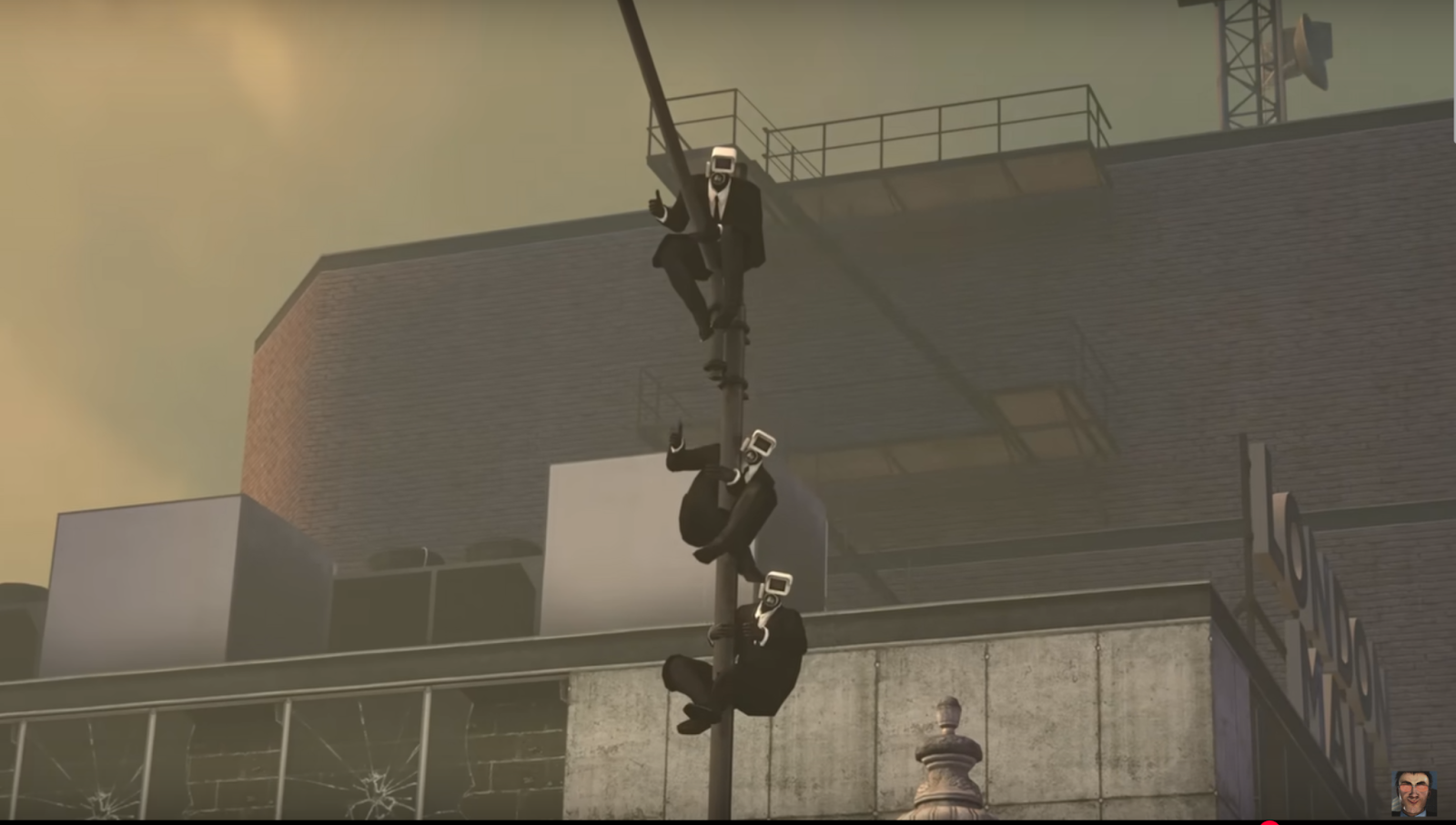
Anyway, the episode refers back to – almost centering – these three little identical regular cameraheads, clinging to a streetlamp amid the chaos. We’ll never get to know them as individuals. We’ll never even know if we’ve seen them again after this episode. But we are given space to care about their survival and personhood for just a moment.
Wait, maybe you don’t want to watch this

The series does drag. I don’t want to overstate it. The realism is superficial; we have no idea where either of these groups come from, or why they’re fighting. We don’t know how they produce new soldiers, or where they’re fighting, or why they can’t just build one titan the size of the city and be done with it. Often a previously unseen enemy titan will emerge from somewhere at a dire moment and it’s unclear where it came from or how the latest skyscraper-sized Titan Toilet could have remained unnoticed until right now. Doesn’t the AV Army have literal sentient security cameras? How did you miss that, Harold?

We have indications that both sides have culture and internal lives, but we don’t know anything about those. Without a good explanation like “toilet mind control parasites momentarily creating turncoats”, literally every toilet is fighting literally every camerahead – the war is fixed, and the war is absolute.

This gets draining, especially combined with the short-format. See, Skibidi Toilet is highly responsive to the Youtube algorithm. Around the start of Skibidi Toilet, Youtube really liked Shorts (phone-screen-aspect videos under a minute long), and so dozens of episodes are that short. Many are under 30 seconds. The effect of that is that each 30 second episode has to have an entire and complete arc, and the arc usually ends in “a Skibidi Toilet throwing itself disorientingly at the camera.” They are always singing the same song. 

I watched it for the first time in one two-hour sitting, and that was probably part of it. I have enough Gen Alpha joie de vivre that I can take a lot of 30-second absurd shorts, but… maybe not that many. 

I can’t completely compare it to qntm’s proposed film concept “One Hour Fight Scene”, because Skibidi Toilet has more diversity of setting and arc than that, but the repetitiveness and even the constant escalation is just… grating.

So I’d advise not watching it all at once – but that’s bad advice too, because I discovered that the wordlessness and repetition lends it a dreamlike quality of transience. 24 hours after watching Skibidi Toilet, you’ll be like “what happened last time? Which titan just did what? Have we seen that character before or not?” I legitimately found that taking notes helped. Maybe there’s just no way to comfortably ride this wild steed.

For what it’s worth, Skibidi Toilet is mostly self-aware about its descent into formulaicness, and there are a lot of small moments playing with this that make the series sparkle. When the AV Army steals secret documents from some kind of Toilet research base, the documents… just write out the lyrics of the Skibidi Toilet song in bungled Cyrillic. The plot beat is just that familiar one of stealing big enemy plans. It doesn’t really matter what the plans are, and this deep in, you know this and I know this and DaFuq!?Boom! knows this. 

At one point, we see a camerahead scientist “drink” a cup of coffee by dumping it down the front of its shirt. 

And later on, a human man apparently representing DaFuq!?Boom! himself shows up in the series – a face we’ve previously only seen as a youtube avatar, suddenly breaking the assumed laws of the narrative by appearing in his own creation. I won’t spoil any more, but it’s a buck fucking wild ride.

I don’t want to assure you that it’s worth it. I don’t know you. I won’t say that. At the end of watching some small toilets fight some small camera guys, you’ll be rewarded with a much bigger toilet fighting a much bigger camera guy. Does that sound fun? Hey, if it does, I know a series you might like.

Found footage and horror

Skibidi Toilet is not really a horror series, but it takes a lot of its beats and inspiration from horror.

The oldest kind of internet-original video horror is screamers. It’s the cheapest and easiest way to make horror – take a pretty normal piece of footage or imagery, let people watch it for a few minutes, then BAM! Sudden cut to a creepy face. It’s the digital equivalent of yelling “BOO” behind someone’s back, automated for your inconvenience. Ghost Car [content warning: bro, read the room] is a classic of the genre, 19 years old and with 41 million views at the time of writing. The hook of early episodes of Skibidi Toilet is not much different from 19 years ago – some weird stuff happens and then a distorted face flies real quick at your screen. 

DaFuq!?Boom! has stated that he was literally inspired by toilet-related nightmares, so the surreality and sense of panic at the outset make a lot of sense. But as the plot develops, Skibidi Toilet starts taking influence from a wider variety of genres, especially horror subgenres.

One of these is found footage. We’ve touched on the cameraheads and their diegetic filming already – we also see alterations to the footage, like a cameraman falls and the footage goes wavery for a second, or a camerahead is hit by a beam weapon and the footage distorts. 

Horror that pretends (at some level) to be reality is not new – how many ghost stories are intentionally told as “no, my cousin’s friend’s friend said this really happened to her”? Dracula in 1897 and The Phantom of the Opera in 1910 are both framed as letters and diaries and news reports. 

Skibidi Toilet is obviously not going full Blair Witch Project or War of the Worlds in terms of trying to convince us the story is real, but just in the footage, the full commitment to the bit that all of this is being witnessed by a person(-thing) really adds intrigue and serious sophistication. The shot will end when the POV camerahead either chooses to end the shot, or when it dies. It builds tension by default. I think there’s maybe one moment in the whole series when the filming camerahead dies mid-episode and we are swapped without context to another camerahead. Everything else flows.

How any of this footage gets to us, relatedly, is unclear. It’s not so found-footage as to say “here are the tapes I found in a box in the woods” or “we now present footage from the Joint War Archive, documenting our shared dark history prior to the Toilet-AV Peace Treaty of 2065.” (But that’s pretty good – hey, DaFuq!?Boom!, if you’re reading this, feel free to use that.) But I like to imagine that a peak virtue among AV society is the act of witnessing, and that having and curating this footage of dark moments is good to them. That might explain why so many of them wade into battle, why there’s always someone watching from a good spot, why so many of them stay under fire until the last moment.

There are also underground institutional labs that strike me as borrowed from horror – your Half Lifes, your Resident Evils, your Stranger Things, your SCP Foundations. (Given that Skibidi Toilet borrows other assets from Half Life, it’s kind of the obvious thing to go for.) We see surprisingly little combination between these laboratories and the technological arms race, although I think it’s implied that many new developments come out of these labs. These environments connect more to the post-apocalyptic elements of the series and the vestiges of humanity and the possible origin of the Skibidi Toilets and the AV Army both – although any real answers remain beyond me, if they exist at all.

The real culture war

I didn’t expect, before starting the series, that the eponymous Skibidi Toilets would be the villains. But the existence and narrative role of the AV Army opens up a very interesting series of questions.

What fraction of the viewers of Skibidi Toilet have ever worked with a TV camera? Or a regular camera, for that matter? Wouldn’t they just do all of that on a phone?

I notice that the AV Army doesn’t have any smartphone-heads – or laptop-heads, for that matter. Even flatscreen-heads are rather thin on the ground. They use an older aesthetic: steely surveillance cameras, CRT televisions, tape video recorders or film cameras. They wear suits. Their theme song – only heard a few times, possibly because of Youtube copyright strikes, but distinct – is an echoey version of 80s hit Everybody Wants to Rule the World

Their enemies are, of course, the toilets: frightening, gross, offensive, always lunging at the viewer, always singing their song that has certainly become repetitive by the 20th time (and you will not escape Skibidi Toilet having heard the Skibidi Toilet song only 20 times.)

Even Source Filmmaker is a millennial’s animation tool. DaFuq!?Boom! isn’t a babe in arms, he has years of machinima experience.

People drag Skibidi Toilet as trash, as brainrot, as the meaningless poison of the youth du jour. Do they see the war? The uncouth screaming toilets versus the cool suits of the older generation? I have no idea how intentional this was, but it just sits with me.

A friend, who is much closer to the usual Skibidi Toilet viewing age than I am, described that the cameraheads evoked a sense of omnipresent surveillance that rang true to his life. I suppose it’s true of all of us, even if the older generations are less aware of it. Everybody has a camera on them at all times. Everybody has a screen on them at all times. The AV Army may be our heroes but they’re also literally a surveillance state. We watch through the eyes of the smallest and weakest among them as they die repeatedly. 

I don’t know. I just think it’s an interesting angle on the show, intentional or not.

A glorious collage

DaFuq!?Boom!’s earlier Youtube work includes other popular machinima skits and series, as well as SFX masterpieces like “Optimus Prime Crushed in Hydraulic Press” and “Optimus Prime Explodes in Microwave”. He’s clearly a talented 3D animator. 

There’s one predecessor series, the DaFuq series, which feels to me like the real precursor for Skibidi Toilet. This series involves clips of regular scenes – people shopping, walking in a park, etc – until every model suddenly distorts, and there are screams as they’re rearranged into a surreal hybrid tableau. 

This feels like the invocation of a thing that I’m sure machinima artists have done since the beginning – just played with the models, used them as toys, as sandboxes, made monstrosities just for the hell of it while learning the tools. DaFuq!?Boom! renders these dollhouse abominations as growing from realistic scenes, thus turning them into surreal horror-comedy. I am absolutely certain this is what Skibidi Toilet grew out of.

There’s a genre of media on the internet where the creator clearly didn’t intend for a goofy new project to grow into an epic, but it did. Griffin Mcelroy recorded The Adventure Zone, a game of Dungeons and Dragons with his brothers and father, as a podcast, which they had intended as an easy interlude to their regular podcast while one family member was on paternity leave. But instead the game spiraled out for months, developing real characterization, narratives, a universe-bending arc, and it became a beloved franchise now adapted as a comic book. He described the unexpected whirlwind as “a car that learned to fly.” 

Now, I’m sure that novelists have been starting what they think is going to be a short story and what spirals into, I don’t know, Moby Dick, or The Bible, since the beginning of time. But crucially, in novels, once you figure out it’s going to be a big deal, you can go back and rewrite the beginning to fit with the quality and scope of your vision. 

But barely-planned epic serial media, which the internet is rife with, doesn’t let you do that. The beginning is already out there.

This means:

A) If the authors improve over time, the beginning will still be rough. You can watch Skibidi Toilet grow. Literally: in episode duration and in physical size (it started as a series of youtube shorts and thus the first few dozen episodes are in the upright-phone-screen aspect ratio, but past episode 38 all videos are full-screen.) Figuratively: in animation and visual quality, in coherence, there’s a plot, there’s characters, etc.

B) Relatedly, the authors are stuck with whatever stupid gags they started out with. They’re stuck with wizards named Taco, with teenagers obsessed with Nicholas Cage, with Minecraft nations named “L’manberg” because they didn’t have any women and they wanted to sound European, with toilets with human heads sticking out of the bowls that you can kill by flushing them.

And it is so, so beautiful. To wax philosophic for a moment, I don’t think you’ve truly appreciated art until you’ve been swayed to your very soul by the inner turmoil of Taako the Wizard or the sad little pixels of a Minecraft face or the fact that the Nicholas Cage teen stopped liking Nicholas Cage or the camera-headed guys giving each other thumbs-up after flushing toilet-men – by something so dumb it’s embarrassing. Yes, it’s stupid. It’s so very, very stupid. A novice home-cooked meal or an inadvisable crush or an inside joke can also be stupid. They can also be everything. 

Past the veil of shame is where the dark, gross, raw workings of the heart lie. Meet me there.


Anyway, another interesting thing about Skibidi Toilet is that almost all of its assets are recycled from elsewhere.

Take the AV army. All of the models are other people’s – suited figures and AV equipment. DaFuq!?Boom! cites the creators in his video description. TVheads are a surprisingly common modern internet chimera. They’re not especially common characters in any particular piece of media, but look it up and you’ll find people cosplaying and making art of TVheads. They might have stemmed from people inspired by the 2000 character Canti, a robot with a TV-like screen for a head in the anime FLCL. But the modern suited TVhead is now a fully separate species of cryptid. Yoink!

Probably the earliest camera-headed character appeared in a series of frankly awesome 2007 Japanese PSAs against movie theater piracy, in which dancing, suited, camera-headed people(?) dance and illegally film movies. Oops! Culture has been changed forever!

Interestingly, the diagetic camerahead – a human with supernatural camera head or features who films relevant parts of the series – also plays a minor but impressive role in a legendary 2010-2019 slenderman youtube series and alternate reality game. In EverymanHYBRID, the supernatural villain character (uh, the one who’s not slenderman), the one who’s been hijacking the main team’s youtube channel, also begins hijacking human victims and using them as living video cameras. We never see a camerahead in EverymanHYBRID – it’s a live-action series on a shoestring budget that plays hard for realism – but we do see their camerawork, and we see the main cast react with horror to the thing shooting the picture. It directly asks the question “who’s behind the camera” with a horror flavor, which is of great thematic interest in EverymanHYBRID and which I was surprised to see echoed in Skibidi Toilet

(I have no reason to think DaFuq!?Boom! has watched EverymanHYBRID, but it’s a very interesting parallel.)

In the first version of this review, I wrote that speakerheads don’t have much in the way of cultural context, but how could I forget Sirenhead? This creepy monster invented by artist Trevor  Henderson is a slenderman-esque figure with multiple gaping fleshy megaphone heads, that like the cameraheads, was appropriated by the internet as a folk villain. 

Skibidi Toilet’s speakerheads are the domesticated version – they’re just suited humanoids with speaker clusters for heads, in and among the TV heads and cameraheads. The speakerhead titans in Skibidi Toilet are major characters, apparently developing out of the AV Army’s experiments with sound-based energy weapons. 

These more human speakerheads, and the idea of cameraheads and TVheads and speakerheads all forming a natural alliance based on shared structure? I think that’s all pure innovation on DaFuq!?Boom!’s part.

Even the Skibidi Toilet song is yoinked! It’s a remix by tiktokker doombreaker03, of the songs “Dom Dom Yes Yes” by Biser King and “Give It To Me” by Timbaland. 

(By the way, Biser King is Bulgarian and Timbaland is American, and the remixed song appears to have become viral in Turkey before being used as a video soundtrack by American Tiktokker, Paryss Bryanne, which in turn inspired Skibidi Toilet creator DaFuq!?Boom!, who is Georgian (as in country of Georgia) – thus making an unusual international journey even before reaching the world’s ears as THE Skibidi Toilet song.)

My early interest in tech and tech culture came out of the open source movement, and I have an admittedly rosy-eyed optimism around things like creative commons and free cultural exchange. The machinima community follows this spirit 100%: adapt what you want, build something new, share it around. While I’d never thought about it before, Tiktok culture loves to do this. And Skibidi Toilet rejoices in it too – it is an exquisite collage of borrowed characters, models, songs, and effects all repurposed in creative new ways. It’s a hit kid’s show that’s absolutely unbeholden to any studio or copyright law or content standard other than the bare minimum enforced by youtube. It’s a car that learned to fly. And it’s glorious, and it’s clever, and most importantly, it’s an absolute trip.

The late game

I will say that over time, along with more beautiful atmospheric animations and longer episode lengths, the series Marvelfies. It’s easy to see why – from very early on, it was about escalating fights and drama. So why not scale it to its extreme: huge clashes between titans, dramatic soundtracks and panning action shots. Get some revelations and some shadowy underground bosses and some generic one-liners in there too. Why not?

I personally draw the line at the one-liners – it’s so surprising to hear speech in Skibidi Toilet that I feel it should be conserved or avoided entirely. But as of the most recent episodes, the plot is so convoluted that it’s now necessary to verbally explain a bare minimum of what’s going on. 

(…Okay, when I say it like that, that’s actually a really high bar that basically no other story meets. Fair enough, Mr. Boom.) 

And the series loses some creativity on the way, I think – not all of it, but it has clearly turned from a post-apocalyptic psychological horror franchise with war elements into an action franchise, and I preferred the genre mixing pot.

One notable plot point that I have mixed feelings about (and if this is partially due to the fact that I was four drinks in at this point when I first saw it and completely missed what was going on, it’s surely impossible to know) – is that a force of alien Space Toilets arrive. They have their own space-age technology and aesthetics – red lights, drone-like hover capacity, fancy shields, the works. At first, they seem to be allied with the Skibidi Toilets, as one might expect; however, the alliance fractures. As of now, the Skibidi Toilets have now teamed up with the AV Army against the powerful alien forces. 

And, like, I guess? It’s very Watchmen. It feels like aw, okay, sure, now you have fans of both sides and lines of action figures sold at Target, they have to team up as heroes against a convenient new enemy. Sure. Yes, obviously I bought one.

I’d be more invested in the team-up plotline if we saw either more or less of whatever humanity the Skibidi Toilets have – while we’ve seen lots of humanizing interactions between AV Army members, even the rudiments of Skibidi Civilization are mysterious to us. On the other hand, being forced to cooperate with a nightmarish creepypasta jumpscare entity that has at most a semblance of relatability would be very interesting too. Either way, we have, alas, seen very little of the timbre of the AV Army-Toilet alliance.

More interesting is the side plot in which human beings have appeared – survivors, apparently, people who have been holed up since the fall of their world, their presence further suggesting that the entire series has taken place on some post-catastrophe Earth. They’re with the alliance too, and they’re weak and underpowered in this new paradigm. 

Mostly the series has drifted away from surreal comedy-horror and into solely epic action scenes, with occasional difficult-to-parse intrigue. A return to form would not be amiss. But it still has a lot of heart in it, a frankly wild amount of implicit worldbuilding, and as a visual spectacle it’s only growing over time. I, personally, am curious to see if the AV-Toilet alliance holds, and if the human survivors will find any place in the world to come.

I hope we all find a place in the world to come.

Final rating

5/10. I have no idea how this was monetized and I hope the creator makes ten million dollars off it. If you’re going to watch the whole thing at once, I recommend being drunk. 


This review was written as an entry for Astral Codex Ten‘s 2025 “Anything-But-A-Book Review” contest – it didn’t make the finalists, but watch for those on ACX in the coming days.

Thank you Nova for suggesting the title of this post.

Support Eukaryote Writes Blog on Patreon. Sign up for emails for new posts in the blog sidebar.

Crossposted to: [EukaryoteWritesBlog.comSubstack]

A trippy kaleidescope-type image of a scientist writing something down.

Learn to write well BEFORE you have something worth saying

I’ve been reading a lot of trip reports lately. Trip reports are accounts people write about their experiences doing drugs, for the benefit of other people who might do those same drugs. I don’t take illegal drugs myself, but I like learning about other people’s intense experiences, and trip reports are little peeks into the extremes of human consciousness. 

In some of these, people are really trying to communicate the power and revelation they had on a trip. They’re trying to share what might be the most meaningful experience of their entire life. 

Here’s another thing: almost all trip reports are kind of mediocre writing.

This is wildly judgmental but I stand by it. Here are some common things you see in them:

  • Focusing on details specific to the situation that don’t matter to the reader. (Lengthy accounting of logistics, who the person was with at what time even when they’re not mentioned again, etc.) 
  • Sort of basic descriptions of phenomena and emotions: “I was very scared”. “I couldn’t stop thinking about it.”
  • Cliches: “I was glad to be alive.” “It felt like I was in hell.” “It was an epic struggle.”
  • Insights described in sort of classically-high-sounding abstractions. “I realized that the universe is made of love.” “Everything was nothing and time didn’t exist.” These statements are not explained, even if they clearly still mean a lot to the writer, and do not really communicate the force of whatever was going on there.

It’s not, like, a crime to write a mediocre trip report. It’s not necessarily even a problem. They’re not necessarily trying to convince you of anything. A lot of them are just what it says on the tin: recording some stuff that happened. I can’t criticize these for being bland, because that seems like trying to critique a cookbook for being insufficiently whimsical: they’re just sharing information.

(…Though you can still take that as a personal challenge; “is this the best prose it can be?” For instance, How to Cook and Eat in Chinese by Chao Yang Buwei is a really well-written cookbook with a whimsical-yet-practical style. There’s always room to grow.)

But some of these trip reports very much do have an agenda, like “communicating crucial insights received from machine elves” or “convincing you not to take drug X because it will ruin your life”. In these cases, the goal would be better served if the writing were good, and boy howdy, my friends: the writing is not good.

Which is a little counter-intuitive, right? You’d think these intense and mind-blowing experiences would automatically give you rich psychic grist for sharing with others, but it turns out, no, accounts of the sublime and life-altering can still be astonishingly mid.

Now certain readers may be thinking, not unreasonably, “that’s because drug-induced revelations aren’t real revelations. The drug’s effects makes some thoughts feel important – a trip report can’t explain why a particular ‘realization’ is important, because there’s nothing behind it.”

But you know who has something new and important to say AND knows why it’s important? Academic researchers publishing their latest work.

But alas, academic writing is also, too frequently, not good. 

And if good ideas made for good writing, you’d expect scientific literature to be the prime case for it. Academic scientists are experts: they know why they made all the decisions they did, they know what the steps do, they know why their findings are important. But that’s also not enough.

Ignore academic publishing and the scientific process itself, let’s just look at the writing. It’s very dense, denser than it needs to be. It does not start with simple ideas and build up, it’s practically designed to tax the reader. It’s just boring, it’s not pleasant to read. The rationale behind specific methods or statistical tests aren’t explained. (See The Journal of Actually Well-Written Science by Etienne Fortier-Dubois for more critique of the standard scientific style.) There’s a whole career field of explaining academic studies to laypeople, which is also, famously, often misleading and bad.

This is true for a few reasons:

First, there’s a floor of how “approachable” or “easy” you can make technical topics. A lot of jargon serves useful purposes, and what’s the point in a field of expertise if you can’t assume your reader is caught up on at least the basics? A description of synthesizing alkylated estradiol derivatives, or a study on the genome replication method of a particular virus, is simply very difficult to make layperson-accessible.

Second, academic publishing and the scientific edifice as it currently stands encourage uniformity of many aspects of research output, including style and structure. Some places like Seeds of Science are pushing back on this, but they’re in the minority.

But third, and this is what trips up the trip-reporters and the scientists alike, writing well is hard. Explaining complicated or abstract or powerful ideas is really difficult. Just having the insight isn’t enough – you have to communicate it well, and that is its own, separate skill.

A trippy kaleidescope-type image of a scientist writing something down.

I don’t really believe in esoterica or the innately unexplainable. “One day,” wrote Jack Kerouac, “I will find the right words, and they will be simple.” Better communication is possible. There are great descriptions of being zonked out of one’s gourd and there is great, informative, readable science writing.

So here’s my suggestion: Learn to write well before you have something you really need to tell people about. Practice it on its own. Write early and often. Write a variety of different things and borrow techniques from writing you like. And once you have a message you actually need to share, you’ll actually be able to express it.

(A more thorough discussion of how to actually write well is beyond the scope of this blog post – my point here is just that it’s worth improving. if you’re interested, let me know and I might do a follow-up.)


Thank you Kelardry for reviewing a draft of this post.

Support Eukaryote Writes Blog on Patreon.

Crossposted to: [EukaryoteWritesBlog.comSubstackLessWrong]

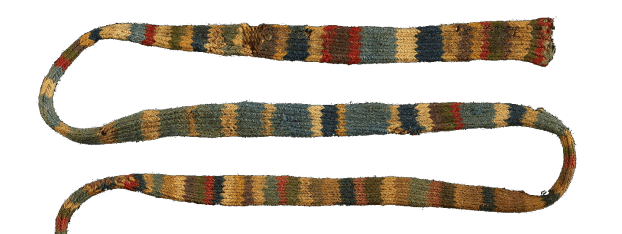
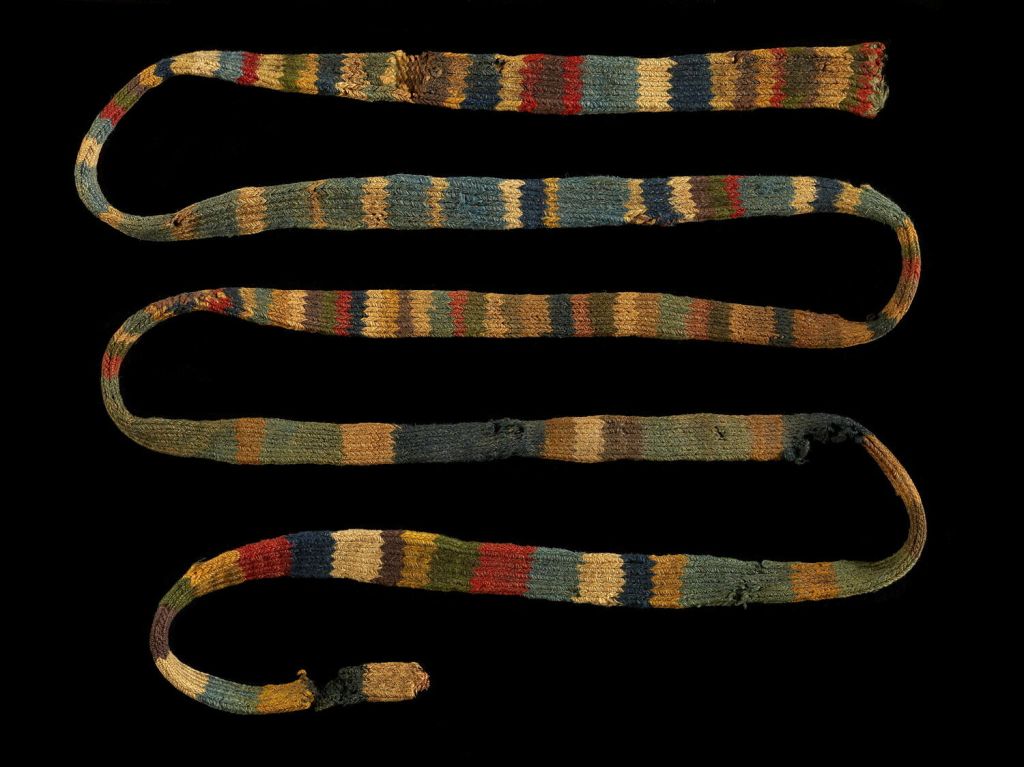
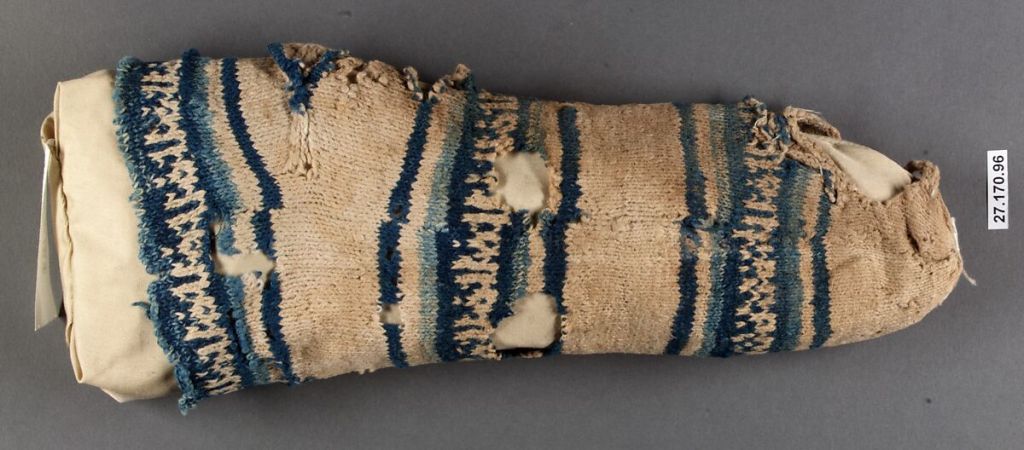
An old knit tube with colorful stripes

Who invented knitting? The plot thickens

Last time on Eukaryote Writes Blog: You learned about knitting history.

You thought you were done learning about knitting history? You fool. You buffoon. I wanted to double check some things in the last post and found out that the origins of knitting are even weirder than I guessed.

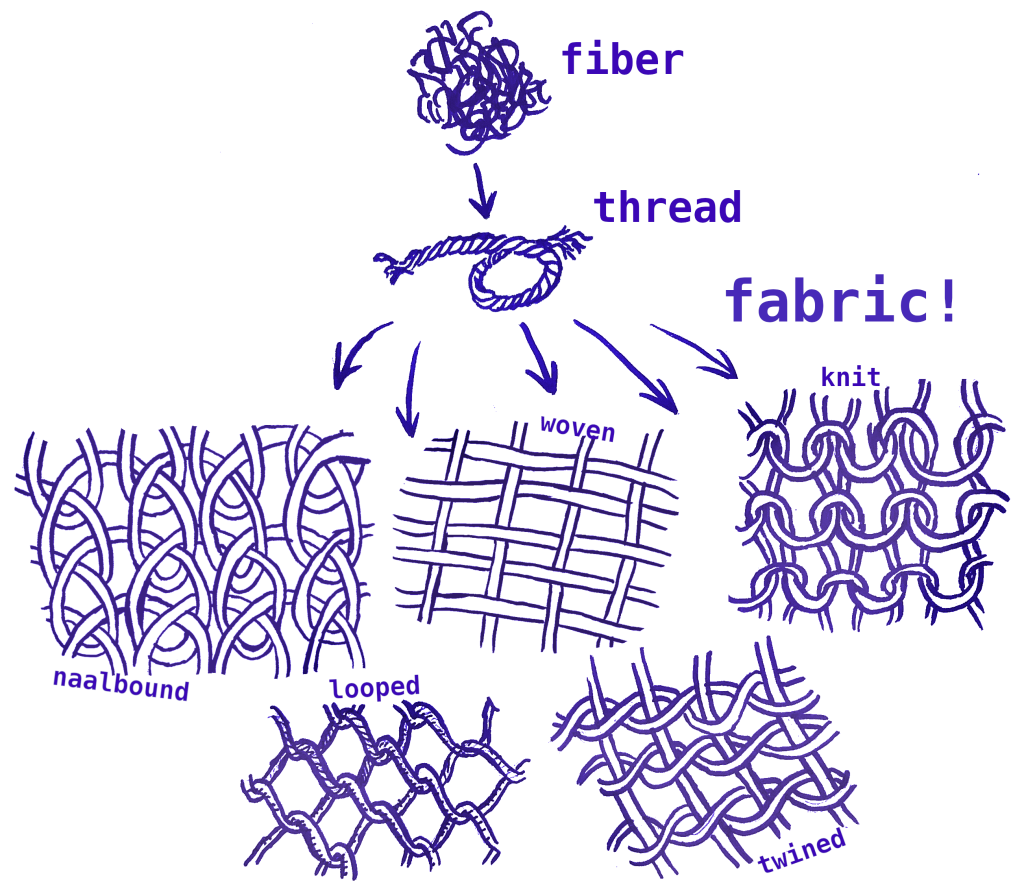
Humans have been wearing clothes to hide our sinful sinful bodies from each other for maybe about 20,000 years. To make clothes, you need cloth. One way to make cloth is animal skin or membrane, that is, leather. If you want to use it in any complicated or efficient way, you also need some way to sew that – very thin strips of leather, or taking sinew or plant fiber and spinning it into thread. Also popular since very early on is taking that thread, and turning it into cloth. There are a few ways to do this.

A drawing showing loose fiber, which turns into twisted thread, which is arranged in various ways to make different kinds of fabric structures. Depicted are the structures for: naalbound, woven, knit, looped, and twined fabric.
By the way, I’m going to be referring to “thread” and “yarn” interchangeably from here on out. Don’t worry about it.

(Can you just sort of smush the fiber into cloth without making it into thread? Yes. This is called felting. How well it works depends on the material properties of the fiber. A lot of traditional Pacific Island cloth was felted from tree bark.)

Now with all of these, you could probably make some kind of cloth by taking threads and, by hand, shaping them into these different structures. But that sounds exhausting and nobody did that. Let’s get tools involved. These different structures correspond to some different kind of manufacturing technique.

By far, the most popular way of making cloth is weaving. Everyone has been weaving for tens of thousands of years. It’s not quite a cultural universal but it’s damn close. To weave, you need a loom.1 There are ten million kinds of loom. Most primitive looms can make a piece of cloth that is, at most, the size of the loom. So if you want to make a tunic that’s three feet wide and four feet long, you need cloth that’s at least three feet wide and four feet long, and thus, a loom that’s at least three feet wide and four feet long. You can see how weaving was often a stationary affair.

Recap

Here’s what I said in the last post: Knitting is interesting because the manufacturing process is pretty simple, needs simple tools, and is portable. The final result is also warm and stretchy, and can be made in various shapes (not just flat sheets). And yet, it was invented fairly recently in human history.

I mostly stand by what I said in the last post. But since then I’ve found some incredible resources, particularly the scholarly blogs Loopholes by Cary “stringbed” Karp and Nalbound by Anne Marie Deckerson, which have sent me down new rabbit-holes. The Egyptian knit socks I outlined in the last post sure do seem to be the first known knit garments, like, a piece of clothing that is meant to cover your body. They’re certainly the first known ones that take advantage of knitting’s unique properties: of being stretchy, of being manufacturable in arbitrary shapes. The earliest knitting is… weirder.

SCA websites

Quick sidenote – I got into knitting because, in grad school, I decided that in the interests of well-roundedness and my ocular health, I needed hobbies that didn’t involve reading research papers. (You can see how far I got with that). So I did two things: I started playing the autoharp, and I learned how to knit. Then, I was interested in the overlap between nerds and handicrafts, so a friend in the Society for Creative Anachronism pitched me on it and took me to a coronation. I was hooked. The SCA covers “the medieval period”; usually, 1000 CE through 1600 CE.

I first got into the history of knitting because I was checking if knitting counted as a medieval period art form. I was surprised to find that the answer was “yes, but barely.” As I kept looking, a lot of the really good literature and analysis – especially experimental archaeology – came out of blogs of people who were into it as a hobby, or perhaps as a lifestyle that had turned into a job like historical reenactment. This included a lot of people in the SCA, who had gone into these depths before and just wrote down what they found and published it for someone else to find. It’s a really lovely knowledge tradition to find one’s self a part of.

Aren’t you forgetting sprang?

There’s an ancient technique that gets some of the benefits of knitting, which I didn’t get to in the last post. It’s called sprang. Mechanically, it’s kind of like braiding. Like weaving, sprang requires a loom (the size of the cloth it produces) and makes a flat sheet. Like knitting, however, it’s stretchy.

Sprang shows up in lots of places – the oldest in 1400 BCE in Denmark, but also other places in Europe, plus (before colonization!): Egypt, the Middle East, centrals Asia, India, Peru, Wisconsin, and the North American Southwest. Here’s a video where re-enactor Sally Pointer makes a sprang hairnet with iron-age materials.

Despite being widespread, it was never a common way to make cloth – everyone was already weaving. The question of the hour is: Was it used to make socks?

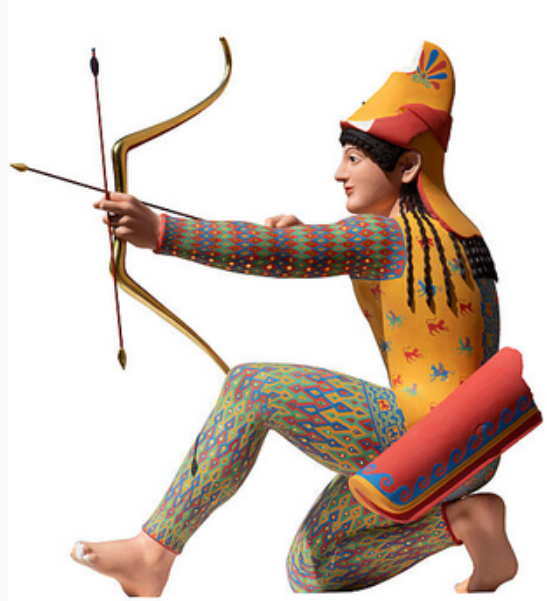
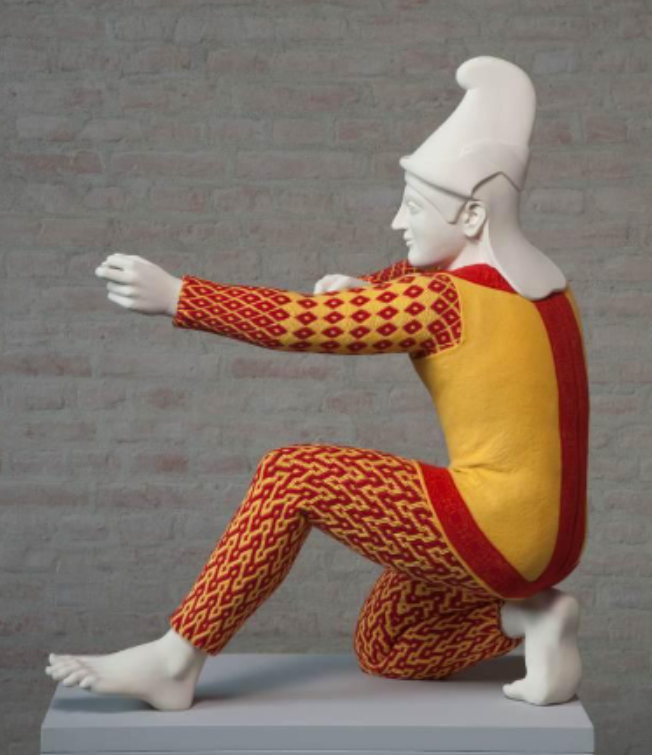
Well, there were probably sprang leggings. Dagmar Drinkler has made historically-inspired sprang leggings, which demonstrate that sprang colorwork creates some of the intricate designs we see painted on Greek statues – like this 480 BCE Persian archer.

I haven’t found any attestations of historical sprang socks. The Sprang Lady has made some, but they’re either tube socks or have separately knitted soles.

Why weren’t there sprang socks? Why didn’t sprang, widespread as it is, take on the niche that knitting took?

I think there are two reasons. One, remember that a sock is a shaped-garment, tube-like, usually with a bend at the heel, and that like weaving, sprang makes a flat sheet. If you want another shape, you have to sew it in. It’s going to lose some stretch where it’s sewn at the seam. It’s just more steps and skills than knitting a sock.

The second reason is warmth. I’ve never done sprang myself – from what I can tell, it has more of a net-like openness upon manufacture, unlike knitting which comes with some depth to it. Even weaving can easily be made pretty dense simply by putting the threads close together. I think, overall, a sprang fabric garment made with primitive materials is going to be less warm than a knit garment made with primitive materials.

Those are my guesses. I bring it up merely to note that there was another thread → cloth technique that made stretchy things that didn’t catch on the same way knitting did. If you’re interested in sprang, I cannot recommend The Sprang Lady’s work highly enough.

Anyway, let’s get back to knitting.

Knitting looms

The whole thing about roman dodecahedrons being (hypothetically) used to knit glove fingers, described in the last post? I don’t think that was actually the intended purpose, for the reasons I described re: knitting wasn’t invented yet. But I will cop to the best argument in its favor, which is that you can knit with glove fingers with a roman dodecahedron.

“But how?” say those of you not deeply familiar with various fiber arts. “That’s not needles,” you say.

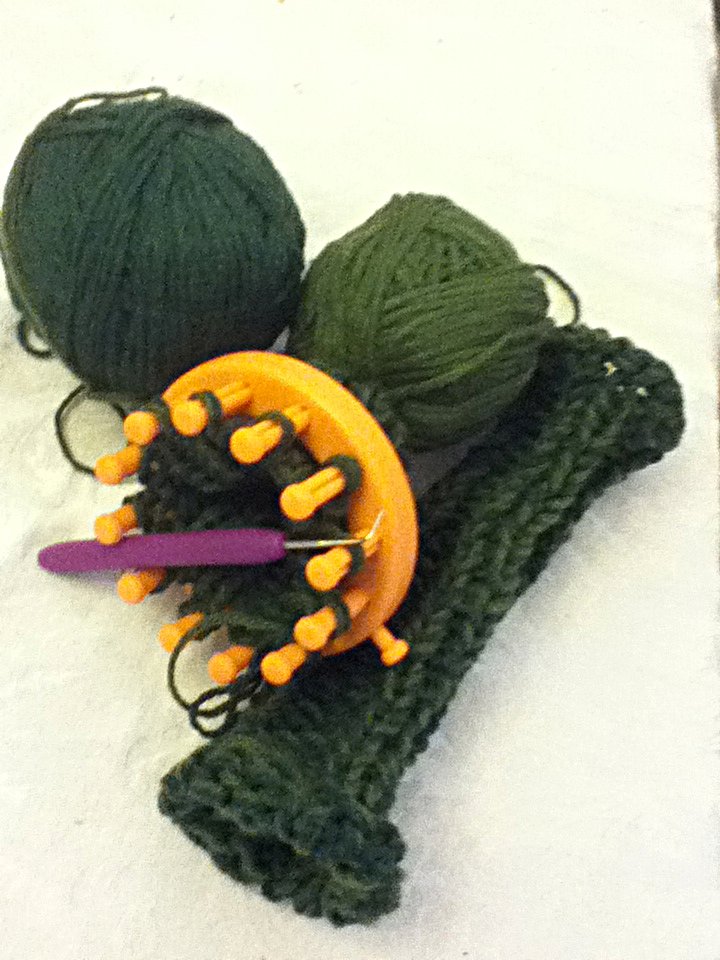
You got me there. This is a variant of a knitting loom. A knitting loom is a hoop with pegs to make knit tubes. This can be the basis of a knitting machine, but you can also knit on one on its own.. They make more consistent knit tubes with less required hand-eye coordination. (You can also make flat panels with them, especially a version called a knitting rake, but since all of the early knitting we’re talking about are tubes anyhow, let’s ignore that for the time being.)

Knitting on a modern knitting loom. || Photo from Cynthia M. Parker on flickr, under a CC BY-SA 2.0 license.

Knitting on a loom is also called spool knitting (because you can use a spool with nails in it as the loom for knitting a cord) and tomboy knitting (…okay). Structurally, I think this is also basically the same thing as lucet cord-making, so let’s go ahead and throw that in with this family of techniques. (The earliest lucets are from ~1000 CE Viking Sweden and perhaps medieval Viking Britain.)

The important thing to note is that loom knitting makes a result that is, structurally, knit. It’s difficult to tell whether a given piece is knit with a loom or needles, if you didn’t see it being made. But since it’s a different technique, different aspects become easier or harder.

A knitting loom sounds complicated but isn’t hard to make, is the thing. Once you have nails, you can make one easily by putting them in a wood ring. You could probably carve one from wood with primitive tools. Or forge one. So we have the question: Did knitting needles or knitting looms come first?

We actually have no idea. There aren’t objects that are really clearly knitting needles OR knitting looms until long after the earliest pieces of knitting. This strikes me as a little odd, since wood and especially metal should preserve better than fabric, but it’s what we’ve got. It’s probably not helped by the fact that knitting needles are basically just smooth straight sticks, and it’s hard to say that any smooth straight stick is conclusively a knitting needle (unless you find it with half a sock still on it.)

(At least one author, Isela Phelps, speculates that finger-knitting, which uses the fingers of one hand like a knitting loom and makes a chunky knit ribbon, came first – presumably because, well, it’s easier to start from no tools than to start from a specialized tool. This is possible, although the earliest knit objects are too fine and have too many stitches to have been finger-knit. The creators must have used tools.)

(stringbed also points out that a piece of whale baleen can be used as circular knitting needles, and that the relevant cultures did have access to and trade in whale parts. Although while we have no particular evidence that they were used as such, it does mean that humanity wouldn’t have to invent plastic before inventing the circular knitting needle, we could have had that since the prehistoric period. So, I don’t know, maybe it was whales.)

THE first knitting

The earliest knit objects we have… ugh. It’s not the Egyptian socks. It’s this.

Photo of an old, long, thin knit tube in lots of striped colors.
One of the oldest knit objects. || Photo from Musée du Louvre, AF 6027.

There are a pair of long, thin, colorful knit tubes, about an inch wide, a few feet long. They’re pretty similar to each other. Due to the problems inherent in time passing and the flow of knowledge, we know one of them is probably from Egypt, and was carbon-dated to 425-594 CE. The other quite similar tube, of a similar age, has not been carbon dated but is definitely from Egypt. (The original source text for this second artifact is in German, so I didn’t bother trying to find it, and instead refer to stringbed’s analysis. See also matthewpius guestblogging on Loopholes.) So between the two of them, we have a strong guess that these knit tubes were manufactured in Egypt around 425-594 CE, about 500 years before socks.

People think it was used as a belt.

This is wild to me. Knitting is stretchy, and I did make fun of those peasants in 1300 CE for not having elastic waistlines, so I could see a knitted belt being more comfortable than other kinds of belts.2 But not a lot better. A narrow knit belt isn’t going to be distribute most of the force onto the body too differently than a regular non-stretchy belt, and regular non-stretchy belts were already in great supply – woven, rope, leather, etc. Someone invented a whole new means of cloth manufacture and used it to make a thing that existed slightly differently.

Then, as far as I can tell, there are no knit objects in the known historical record for five hundred years until the Egyptian socks pop up.

Pulling objects out of the past is hard. Especially things made from cloth or animal fibers, which rot (as compared to metal, pottery, rocks, bones, which last so long that in the absence of other evidence, we name ancient cultures based on them.) But every now and then, we can. We’ve found older bodies and textiles preserved in ice and bogs and swamps.3 We have evidence of weaving looms and sewing needles and pictures of people spinning or weaving cloth and descriptions of them doing it, from before and after. I’m guessing that the technology just took a very long time to diversify beyond belts.

Speaking of which: how was the belt made? As mentioned, we don’t find anything until much later that is conclusively a knitting needle or a knitting loom. The belts are also, according to matthewpius on loopholes, made with a structure called double knitting. The effect is (as indicated by Pallia – another historic reenactor blog!) kind of hard to do with knitting needles in the way they achieved it, but pretty simple to do with a knitting loom.

(Another Egyptian knit tube belt from an unclear number of centuries later.)

Viking knitting

You think this is bad? Remember before how I said knitting was a way of manufacturing cloth, but that it was also definable as a specific structure of a thread, that could be made with different methods?

The oldest knit object in Europe might be a cup.

Photo of a richly decorated old silver cup.
The Ardagh Chalice. || Photo by Sailko under a CC BY-SA 3.0 license.

You gotta flip it over.

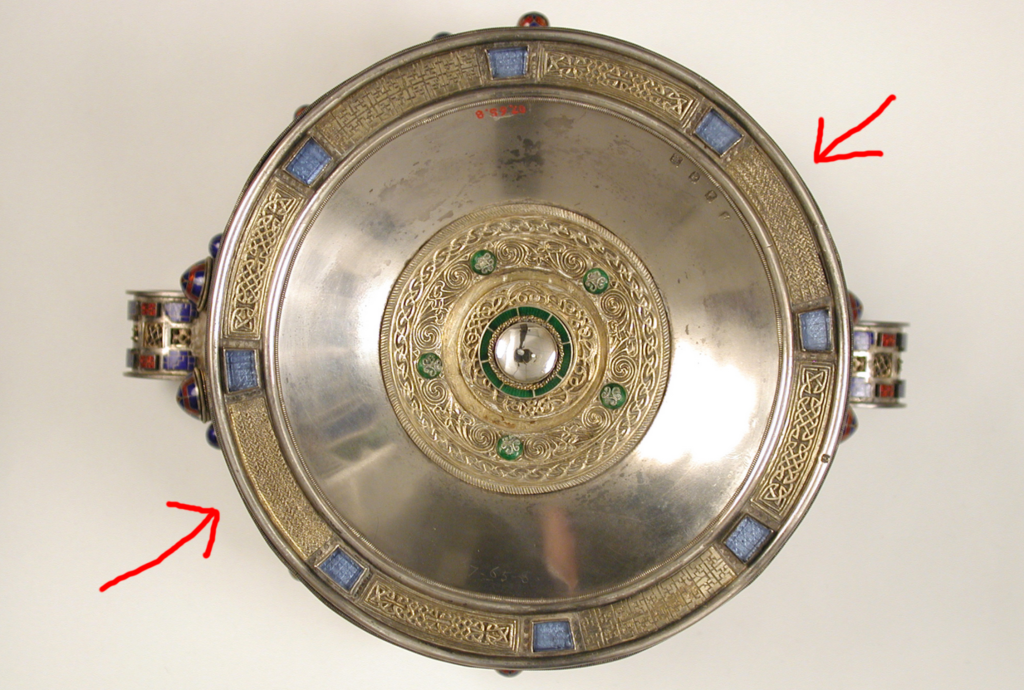
Another photo of the ornate chalice from the equally ornate bottom. Red arrows point to some intricate wire decorations around the rim.
Underside of the Ardagh Chalice. || Adapted from a Metroplitan Museum image.

Enhance.

Black and white zoom in on the wire decorations. It's more  clearly a knit structure.
Photo from Robert M. Organ’s 1963 article “Examination of the Ardagh Chalice-A Case History”, where they let some people take the cup apart and put it back together after.

That’s right, this decoration on the bottom of the Ardagh Chalice is knit from wire.
Another example is the decoration on the side of the Derrynaflen Paten, a plate made in 700 or 800 CE in Ireland. All the examples seem to be from churches, hidden by or from Vikings. Over the next few hundred years, there are some other objects in this technique. They’re tubes knitted from silver wire. “Wait, can you knit with wire?” Yes. Stringbed points out that knitting wire with needles or a knitting loom would be tough on the valuable silver wire – they could break or distort it.

Photo of an ornate silver plate with gold decorations. There are silver knit wire tubes around the edge.
The Derrynaflen Patten, zoomed in on the knit decorations at the end. || Adapted from this photo by Johnbod, under a CC BY-SA 3.0 license.

What would make sense to do it with is a little hook, like a crochet hook. But that would only work on wire – yarn doesn’t have the structural integrity to be knit with just a hook, you need to support each of the active loops.

So was the knit structure just invented separately by Viking silversmiths, before it spread to anyone else? I think it might have been. It’s just such a long time before we see knit cloth, and we have this other plausible story for how the cloth got there.

(I wondered if there was a connection between the Viking knitting and their sources of silver. Vikings did get their silver from the Islamic world, but as far as I can tell, mostly from Iran, which is pretty far from Egypt and doesn’t have an ancient knitting history – so I can’t find any connection there.)

The Egyptian socks

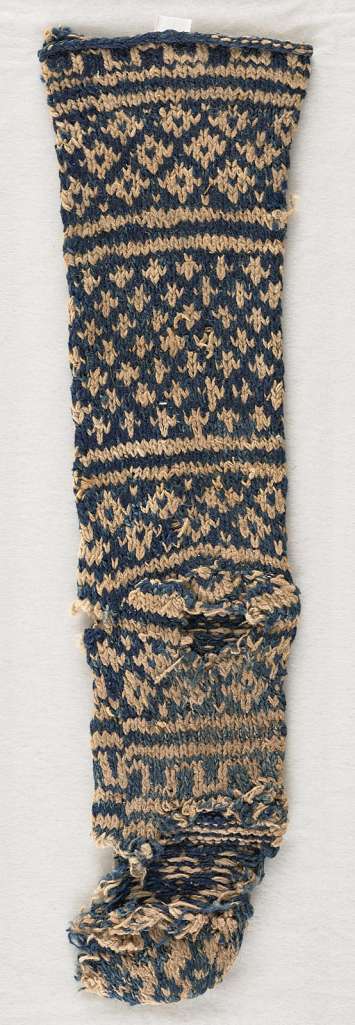
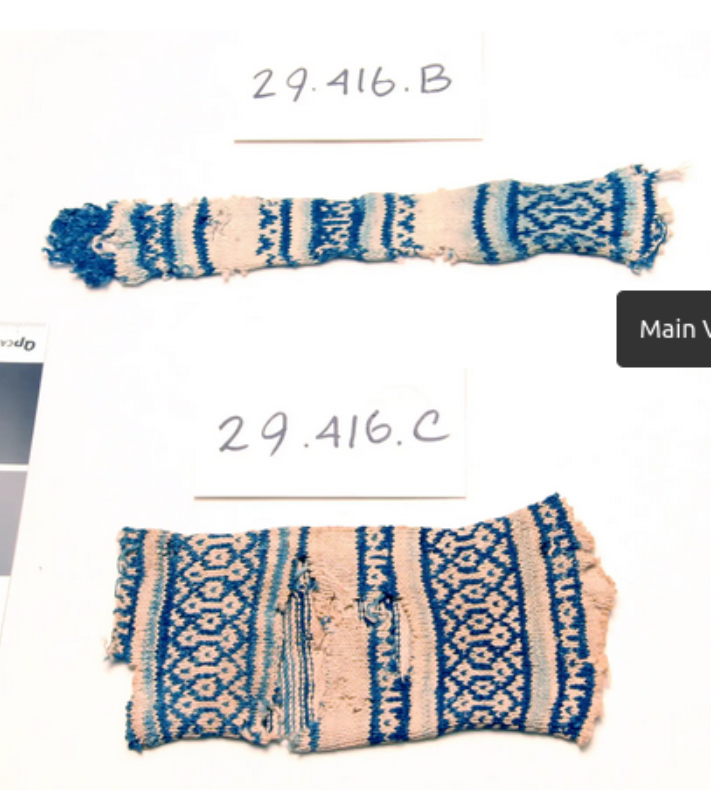
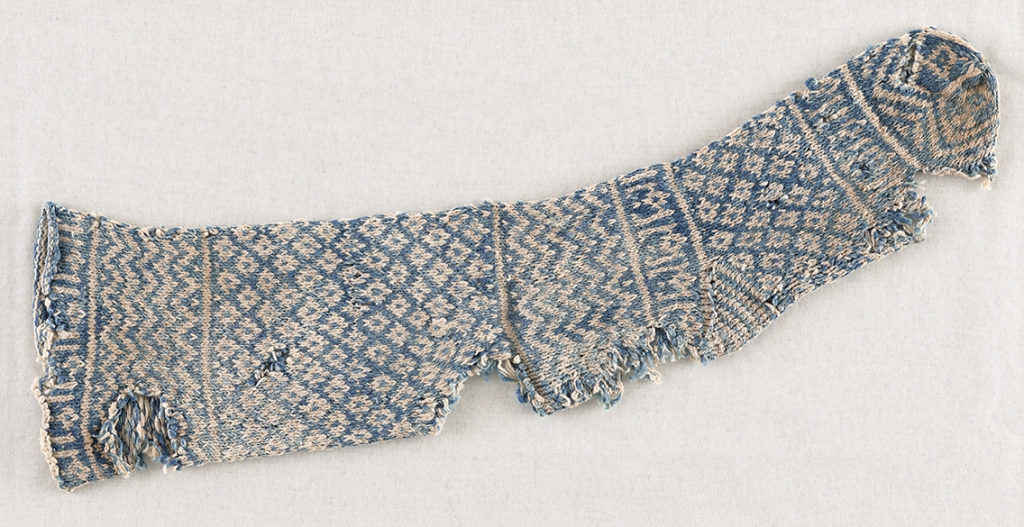
Let’s go back to those first knit garments (that aren’t belts), the Egyptian knit blue-and-white socks. There are maybe a few dozen of these, now found in museums around the world. They seem to have been pulled out of Egypt (people think Kustat) by various European/American collectors. People think that they were made around 1000-1300 AD. The socks are quite similar: knit, made of cotton, in white and 1-3 shades of indigo, geometric designs sometimes including Kufic characters.

I can’t find a specific origin location (than “probably Egypt, maybe Kustat?”) for any of them. The possible first sock mentioned in the last post is one of these – I don’t know if there are any particular reasons for thinking that sock is older than the others.

This one doesn’t seem to be knit OR naalbound. Anne Marie Decker at Nalbound.com thinks it’s crocheted and that the date is just completely wrong. To me, at least, this cast doubts on all the other dates of similar-looking socks.

That anomalous sock scared me. What if none of them had been carbon-dated? Oh my god, they’re probably all scams and knitting was invented in 1400 and I’m wrong about everything. But I was told in a historical knitting facebook group that at least one had been dated. I found the article, and a friend from a minecraft discord helped me out with an interlibrary loan. I was able to locate the publication where Antoine de Moor, Chris Verhecken-Lammens and Mark Van Strydonck did in fact carbon-date four ancient blue-and-white knit cotton socks and found that they dated back to approximately 1100 CE – with a 95% chance that they were made somewhere between 1062 and 1149 CE. Success!

Helpful research tip: for the few times when the SCA websites fail you, try your facebook groups and your minecraft discords.

Estonian mitten

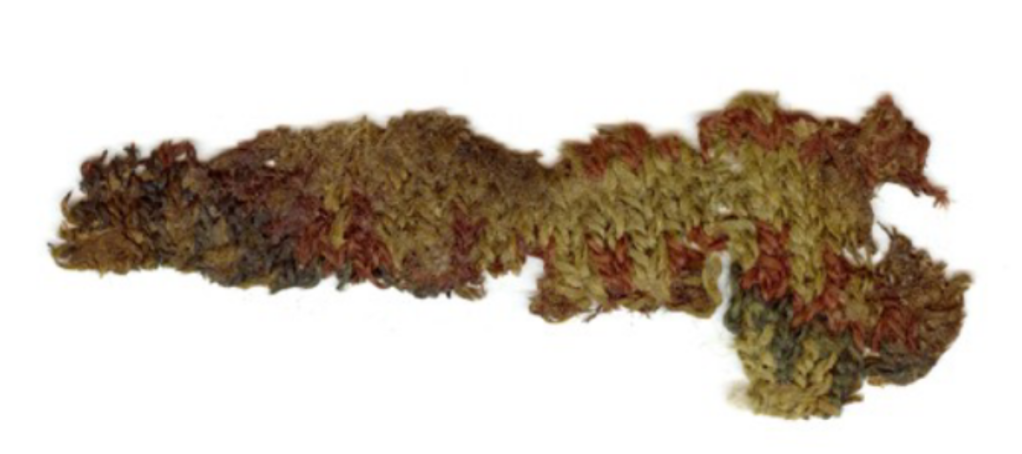
Photo of a tattered old fragment of knitting. There are some colored designs on it in blue and red.
Yeah, this is all of it. Archeology is HARD. [Image from Anneke Lyffland’s writeup.]

Also, here’s a knit fragment of a mitten found in Estonia. (I don’t have the expertise or the mitten to determine it myself, but Anneke Lyffland (another SCA name), a scholar who studied one is aware of cross-knit-looped naalbinding – like the Peruvian knit-lookalikes mentioned in the last post – and doesn’t believe this was naalbound.) It was part of a burial that was dated from 1238 – 1299 CE. This is fascinating and does suggest a culture of knitted practical objects, in Eastern Europe, in this time period. This is the earliest East European non-sock knit fabric garment that I’m aware of.

But as far as I know, this is just the one mitten. I don’t know much about archaeology in the area and era, and can’t speculate as to whether this is evidence that knitting was rare or whether we have very few wool textiles from the area and it’s not that surprising. (The voice of shoulder-Thomas-Bayes says: Lots of things are evidence! Okay, I can’t speculate as to whether it’s strong evidence, are you happy, Reverend Bayes?) Then again, a bunch of speculation in this post is also based on two maybe-belts, so, oh well. Take this with salt.

By the way, remember when I said crochet was super-duper modern, like invented in the 1700s?

Literally a few days ago, who but the dream team of Cary “stringbed” Karp and Anne Marie Decker published an article in Archaeological Textiles Review identifying several ancient probably-Egyptian socks thought to be naalbound as being actually crocheted.

This comes down to the thing about fabric structures versus techniques. There’s a structure called slip stitch that can be either crocheted or naalbound. So since we know naalbinding is that old, so if you’re looking at an old garment and see slip stitch, maybe you say it was naalbound. But basically no fabric garment is just continuous structure all the way through. How do the edges work? How did it start and stop? Are there any pieces worked differently, like the turning of a heel or a cuff or a border? Those parts might be more clearly worked with crochet hook than a naalbinding needle. And indeed, that’s what Karp and Decker found. This might mean that those pieces are forgeries – no carbon dating. But it might mean crochet is much much older than previously thought.

My hypothesis

Knitting was invented sometime around or perhaps before 600 CE in Egypt.

From Egypt, it spreads to other Muslim regions.

It spread into Europe via one or more of these:

  1. Ordinary cultural diffusion northwards
  2. Islamic influence in the Iberian Peninsula
    • In 711 CE, Al-Andalus was conquered by the Umayyad Caliphate…
      • Kicking off a lot of Islamic presence in and control over the area up until 1400 CE or so…
  3. Meanwhile, starting in 1095 CE, the Latin Church called for armies to take Jerusalem from the Byzantines, kicking off the Crusades.
    • …Peppering Arabic influences into Europe, particularly France, over the next couple centuries.

… Also, the Vikings were there. They separately invented the knitting structure in wire, but never got around to trying it out in cloth, perhaps because the required technique was different.

Another possibility

Wrynne, AKA Baronness Rhiall of Wystandesdon (what did I say about SCA websites?), a woman who knows a thing or two about socks, believes that based on these plus the design of other historical knit socks, the route goes something like:

??? points to Iran, which points to: A. Eastern Europe, then to 1. Norway and Sweeden and 2. Russia. B. to ???, to Spain, to Western Europe.

I don’t know enough about socks to have an sophisticated opinion on her evidence, but the reasoning seems solid to me. For instance, as she explains, old Western European socks are knit from the cuff of the sock down, whereas old Middle Eastern and East European socks are knit from the toe of the sock up – which is also how Eastern and Northern European naalbound socks were shaped. Baronness Rhiall thinks Western Europe invented its sockmaking techniques independently based only having had a little experience with a few late 1200s/1300s knit pieces from Moorish artisans.

What about tools?

Here’s my best guess: The Egyptian tubes were made on knitting looms.

The viking tubes were invented separately, made with a metal hook as stringbed speculates, and never had any particular connection to knitting yarn.

At some point, in the Middle East, someone figured out knitting needles. The Egyptian socks and Estonian mitten and most other things were knit in the round on double-ended needles.

I don’t like this as an explanation, mostly because of how it posits 3 separate tools involved in the earliest knit structures – that seems overly complicated. But it’s what I’ve got.

Knitting in the tracks of naalbinding

I don’t know if this is anything, but here are some places we also find lots of naalbinding, beginning from well before the medieval period: Egypt. Oman. The UAE. Syria. Israel. Denmark. Norway. Sweden. Sort of the same path that we predict knitting traveled in.

I don’t know what I’m looking at here.

  • Maybe this isn’t real and this places just happen to preserve textiles better
  • Longstanding trade or migration routes between North Africa, the Middle East, and Eastern Europe?
  • Culture of innovation in fiber?
  • Maybe fiber is more abundant in these areas, and thus there was more affordance for experimenting. (See below.)

It might be a coincidence. But it’s an odd coincidence, if so.

Why did it take so long for someone to invent knitting?

This is the question I set out to answer in the initial post, but then it turned into a whole thing and I don’t think I ever actually answered my question. Very, very speculatively: I think knitting is just so complicated that it took thousands of years, and an environment rich in fiber innovation, for someone to invent and make use of the series of steps that is knitting.

Take this next argument with a saltshaker, but: my intuitions back this up. I have a good visual imagination. I can sort of “get” how a slip knot works. I get sewing. I understand weaving, I can boil it down in my mind to its constituents.

There are birds that do a form of sewing and a form of weaving. I don’t want to imply that if an animal can figure it out, it’s clearly obvious – I imagine I’d have a lot of trouble walking if I were thrown into the body of a centipede, and chimpanzees can drastically outperform humans on certain cognitive tasks – but I think, again, it’s evidence that it’s a simpler task in some sense.

Same with sprang. It’s not a process I’m familiar with, but watching Sally Pointer do it on a very primitive loom, I can see understand it and could probably do it now. Naalbinding – well, it’s knots, and given a needle and knowing how to make a knot, I think it’s pretty straightforward to tie a bunch of knots on top of each other to make fabric out of it.

But I’ve been knitting for quite a while now and have finished many projects, and I still can’t say I totally get how knitting works. I know there’s a series of interconnected loops, but how exactly they don’t fall apart? How the starting string turns into the final project? It’s not in my head. I only know the steps.

I think that if you erased my memory and handed me some simple tools, especially a loom, I could figure out how to make cloth by weaving. I think there’s also a good chance I could figure out sprang, and naalbinding. But I think that if you handed me knitting needles and string – even if you told me I was trying to get fabric made from a bunch of loops that are looped into each other – I’m not sure I would get to knitting.

(I do feel like I might have a shot at figuring out crochet, though, which is supposedly younger than any of these anyway, so maybe this whole line of thinking means nothing.)

Idle hands as the mother of invention?

Why do we innovate? Is necessity the mother of invention?

This whole story suggests not – or at least, that’s not the whole story. We have the first knit structures in belts (already existed in other forms) and decorative silver wire (strictly ornamental.) We have knit socks from Egypt, not a place known for demanding warm foot protection. What gives?

Elizabeth Wayland Barber says this isn’t just knitting – she points to the spinning jenny and the power loom, both innovations in yarn production in general, that were invented recently by men despite thousands of previous years of women producing yarn. In Women’s Work: The First 20,000 Years, she writes:

“Women of all but the top social and economic classes were so busy just trying to get through what had to be done each day that they didn’t have excess time or materials to experiment with new ways of doing things.”

This speculates a kind of different mechanism of invention – sure, you need a reason to come up with or at least follow up on a discovery, but you also need the space to play. 90% of everything is crap, you need to be really sure that you can throw away (or unravel, or afford the time to re-make) 900 crappy garments before you hit upon the sock.

Bill Bryson, in the introduction to his book At Home, writes about the phenomenon of clergy in the UK in 1700s and 1800s. To become an ordained minister, one needed a university degree, but not in any particular subject, and little ecclesiastical training. Duties were light; most ministers read a sermon out of a prepared book once a week and that was about it. They were paid in tithes from local landowners. Bryson writes:

“Though no one intended it, the effect was to create a class of well-educated, wealthy people who had immense amounts of time on their hands. In conesquence many of them began, quite spontaneously, to do remarkable things. Never in history have a group of people engaged in a broader range of creditable activities for which they were not in any sense actually employed.”

He describes some of the great amount of intellectual work that came out of this class, including not only the aforementioned power loom, but also: scientific descriptions of dinosaurs, the first Icelandic dictionary, Jack Russel terriers, submarines aerial photography, the study of archaeology, Malthusian traps, the telescope that discovered Uranus, werewolf novels, and – courtesy of the original Thomas Bayes – Bayes’ theorem.

I offhandedly posited a random per-person effect in the previous post – each individual has a chance of inventing knitting, so eventually someone will figure it out. There’s no way this can be the whole story. A person in a culture that doesn’t make clothes mostly out of thread, like the traditional Inuit (thread is used to sew clothes, but the clothes are very often sewn out of animal skin rather than woven fabric) seems really unlikely to invent knitting. They wouldn’t have lots of thread about to mess around with. So you need the people to have a degree of familiarity with the materials. You need some spare resources. Some kind of cultural lenience for doing something nonstandard.

…But is that the whole story? The Incan Empire was enormous, with 12,000,000 citizens at its height. They didn’t have a written language. They had the quipu system for recording numbers with knotted string, but they didn’t have a written language. (Their neighbors, the Mayans, did.) Easter Island, between its colonization by humans in 1000 CE and its worse colonization by Europeans in 1700 CE, had a maximum population of maybe 12,000. It’s one of the most remote islands in the world. In isolation from other societies, they did develop a written language, in fact Polynesia’s only native written language.

Color photo of a worn wooden tablet engraved with intricate Rongorongo characters.
One of ~26 surviving pieces of Rongorongo, the undeciphered written script of Easter Island. This is Text R, the “Small Washington tablet”. Photo from the Smithsonian Institution. (Image rotated to correspond with the correct reading order, as a courtesy to any Rongorongo readers in my audience. Also, if there are any Rongorongo readers in my audience, please reach out. How are you doing that?!)
A black and white photo of the same tablet. The lines of characters are labelled (e.g. Line 1, Line 2) and the  symbols are easier to see. Some look like stylized humans, animals, and plants.
The same tablet with the symbols slightly clearer. Image found on kohaumoto.org, a very cool Rongorongo resource.

I don’t know what to do with that.

Still. My rough model is:

A businessy chart labelled "Will a specific group make a specific innovation?" There are three groups of factors feeding into each other. First is Person Factors, with a picture of a person in a power wheelchair: Consists of [number of people] times [degree of familiarity with art]. Spare resources (material, time). And cultural support for innovation. Second is Discovery Factors, with a picture of a microscope: Consists of how hard the idea "is to have", benefits from discovery, and [technology required] - [existing technology]. ("Existing technology" in blue because that's technically a person factor.) Third is Special Sauce, with a picture of a wizard. Consists of: Survivorship Bias and The Easter Island Factor (???)

The concept of this chart amused me way too much not to put it in here. Sorry.

(“Survivorship bias” meaning: I think it’s safe to say that if your culture never developed (or lost) the art of sewing, the culture might well have died off. Manipulating thread and cloth is just so useful! Same with hunting, or fishing for a small island culture, etc.)

…What do you mean Loopholes has articles about the history of the autoharp?! My Renaissance man aspirations! Help!


Delightful: A collection of 1900’s forgeries of the Paracas textile. They’re crocheted rather than naalbound.

1 (Uh, usually. You can finger weave with just a stick or two to anchor some yarn to but it wasn’t widespread, possibly because it’s hard to make the cloth very wide.)

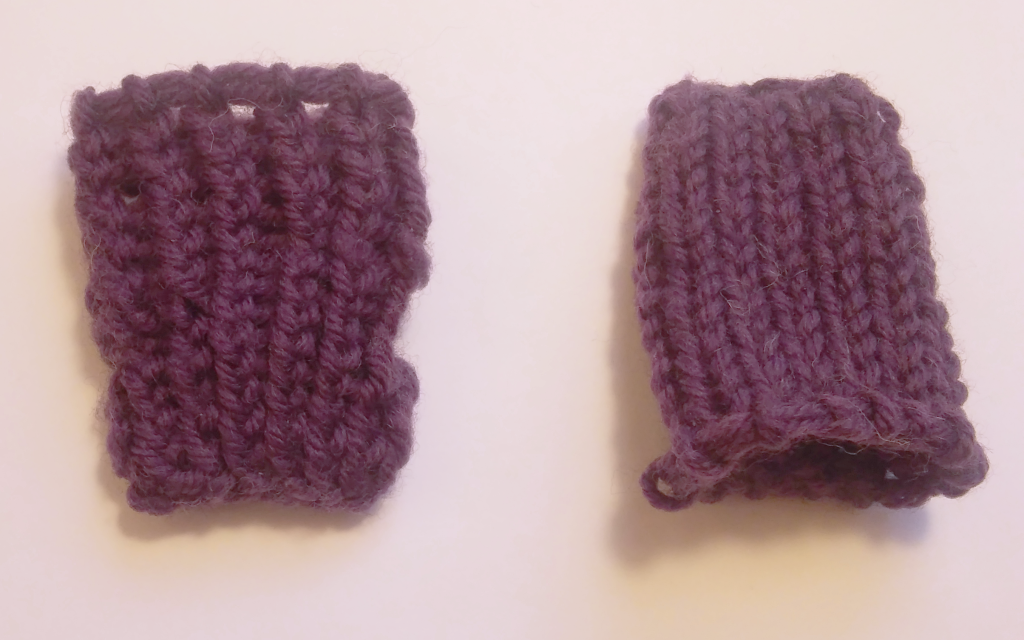
2 I had this whole thing ready to go about how a knit belt was ridiculous because a knit tube isn’t actually very stretchy “vertically” (or “warpwise”), and most of its stretch is “horizontal” (or “weftwise”). But then I grabbed a knit tube (fingerless glove) in my environment and measured it at rest and stretched, and it stretched about as far both ways. So I’m forced to consider that a knit belt might be reasonable thing to make for its stretchiness. Empiricism: try it yourself!

3 Fun fact: Plant-based fibers (cotton, linen, etc) are mostly made of carbohydrates. Animal-based fibers (silk, wool, alpaca, etc) and leather are mostly made of protein. Fens are wetlands that are alkaline and bogs are acidic. Carbohydrates decay in acidic bogs but are well-preserved in alkaline fens. Proteins dissolve in alkaline environments fens but last in acidic bogs. So it’s easier to find preserved animal material or fibers in bogs and preserved plant material or fibers in fens.


Cross-posted to LessWrong.

Fiber arts, mysterious dodecahedrons, and waiting on “Eureka!”

Part 1: The anomaly

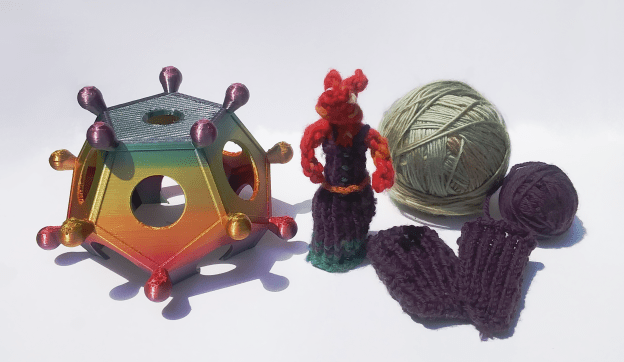
This story starts, as many stories do, with my girlfriend 3D-printing me a supernatural artifact. Specifically, one of my favorite SCPs, SCP-184.

This attempt got about 75% of the way through. Close enough.

We had some problems with the print. Did the problems have anything to do with printing a model of a mysterious artifact that makes spaces bigger on the inside, via a small precisely-calibrated box? I would say no, there’s no way that be related.

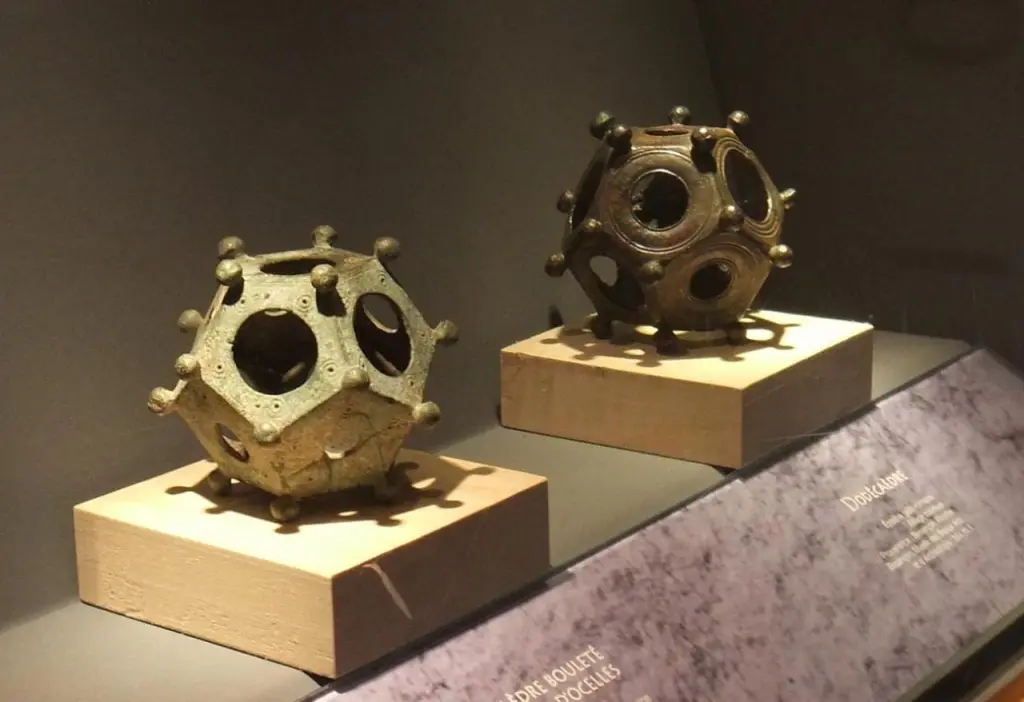
Anyway, the image used for the SCP in question, and thus also the final printed model, is based a Roman dodecahedron. Roman dodecahedrons are a particular shape of metal object that have been dug up in digs from all over the Roman period, and we have no idea why they exist.

Roman dodecahedra. || Image source unknown.

Many theories have been advanced. You might have seen these in an image that was going around the internet, which ended by suggesting that the object would work perfectly for knitting the fingers of gloves.

There isn’t an alternative clear explanation for what these are. A tool for measuring coins? A ruler for calculating distances? A sort of Roman fidget spinner? This author thinks it displays a date and has a neat explanation as for why. (Experimental archaeology is so cool, y’all.)

Whatever the purpose of the Roman dodecahedron was, I’m pretty sure it’s not (as the meme implies is obvious) for knitting glove fingers.1

Why?

1: The holes are always all different sizes, and you don’t need that to make glove fingers.

2: You could just do this with a donut with pegs in it, you don’t need a precisely welded dodecahedron. It does work for knitting glove fingers, you just don’t need something this complicated.

3: The Romans hadn’t invented knitting.

Part 2: The Ancient Romans couldn’t knit

Wait, what? Yeah, the Romans couldn’t knit. The Ancient Greeks couldn’t knit, the Ancient Egyptians couldn’t knit. Knitting took a while to take off outside of the Middle East and the West, but still, almost all of the Imperial Chinese dynasties wouldn’t have known how. Knitting is a pretty recent invention, time-wise. The earliest knit objects we have are from Egypt around 1000 CE.

Possibly the oldest knit sock known, ca 1000-1200 CE according to this page. || Photo is public domain from the George Washington University Textile Museum Collection.

This is especially surprising because knitting is useful for two big reasons:

First, it’s very easy to do. It takes yarn and two sticks and children can learn how. This is pretty rare for fabric manufacturing – compare, for instance, weaving, which takes an entire loom.

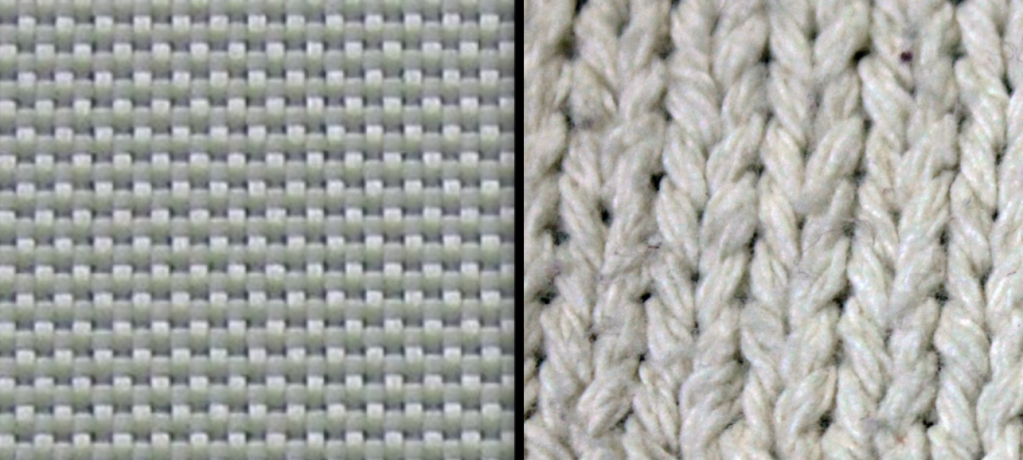
Sidenote: Do you know your fabrics? This next section will make way more sense if you do.

Woven fabricKnit fabric
Commonly found in: trousers, collared/button up shirts, bedsheets, dish towels, woven boxers, quilts, coats, etc.
Not stretchy.
Loose threads won’t make the whole cloth unravel.
Commonly found in: T-shirts, polo shirts, leggings, underwear, anything made of jersey fabric, sweaters, sweatpants, socks.
Stretchy.
If you pull on a lose thread, the cloth unravels.

Second, and oft-underappreciated, knitted fabric is stretchy. We’re spoiled by the riches of elastic fabric today, but it wasn’t always so. Modern elastic fabric uses synthetic materials like spandex or neoprene; the older version was natural latex rubber, and it seems to have taken until the 1800s to use rubber to make clothing stretchy. Knit fabric stretches without any of those.

Before knitting, your options were limited – you could only make clothing that didn’t stretch, which I think explains a lot of why medieval and earlier clothing “looks that way”. A lot of belts and drapey fabric. If something is form-fitting, it’s probably laced. (…Or just more-closely tailored, which unrelatedly became more of a thing later in the medieval period.)

You think these men had access to comfortable elastic waistlines? No they did not. || Image from the Luttrell Psalter, ~1330.

You could also use woven fabric on the bias, which stretches a little.

Woven fabric is stretchier this way. Grab something made of woven fabric and try it out. || Image by PKM, under a CC BY-SA 3.0 license.

Medieval Europe made stockings from fabric cut like this. Imagine a sock made out of tablecloth or button-down-shirt-type material. Not very flexible. Here’s a modern recreation on Etsy.

Other kinds of old “socks” were more flexible but more obnoxious, made of a long strip of bias-cut fabric that you’d wrap around your feet. (Known as: winingas, vindingr, legwraps, wickelbänder , or puttees.) Historical reenactors wear these sometimes. I’m told they’re not flexible and restrict movement, and that they take practice to put on correctly.

Come 1000 CE, knitting arrives on the scene.

Which is to say, it’s no surprise that the first knitted garments we see are socks! They get big in Europe over the next 300 years or so. Richly detailed bags and cushions also appear. We start seeing artistic depictions of knitting for the first time around now too.

Italian Madonna knitting with four needles, ~1350. Section of this miniature by Tommaso de Modena.

Interestingly, this early knitting was largely circular, meaning that you produce a tube of cloth rather than a flat sheet. This meant that the first knitting was done not with two sticks and some yarn, but four sticks and some yarn. This is much easier for making socks and the like than using two needles would be. …But also means that the invention process actually started with four needles and some yarn, so maybe it’s not surprising it took so long.2

(Why did it take so long to invent knitting flat cloth with two sticks? Well, there’s less of a point to it, since you already have lots of woven cloth, and you can do a lot of clothes – socks, sweaters, hats, bags – by knitting tubes. Also, by knitting circularly, you only have to know how to do one stitch (the knit stitch) whereas flat knitting requires you also use a different stitch (the perl stitch) to make a smooth fabric that looks like and is as stretchy as round knitting. If you’re not a knitter, just trust me – it’s an extra step.)

(You might also be wondering: What about crochet? Crochet was even more recent. 1800s.)

Part 3: The Ancient Peruvians couldn’t knit either, but they did something that looks the same

You sometimes see people say that knitting is much older, maybe thousands of years old. It’s hard to tell how old knitting is – fabric doesn’t always preserve well – but it’s safe to say that it’s not that old. We have examples of people doing things with string for thousands of years, but no examples of knitting before those 1000 CE socks. What we do have examples of is naalbinding, a method of making fabric from yarn using a needle. Naalbinding produces a less-stretchy fabric than knitting. It’s found from Scandinavia to the Middle East and also shows up in Peru.

The native Peruvian form of naalbinding is a specific technique called cross-knit looping. (This technique also shows up sometimes in pre-American Eurasia, but it’s not common.) The interesting thing about cross-knit looping is that the fabric looks almost identical to regular knitting.

Here’s a tiny cross-knit-looped bag I made, next to a tiny regularly knit bag I made. You can see they look really similar. The fabric isn’t truly identical if you look closely (although it’s close enough to have fooled historians). It doesn’t act the same either – naalbound fabric is less stretchy than knit fabric, and it doesn’t unravel.

The ancient Peruvians cross-knit-looped decorations for other garments and the occasional hat, not socks.

Cross-knit-looped detail from the absolutely stunning Paracas Textile. If you look closely, it looks like stockinette knit fabric, but it’s not.

Inspired by the Paracas Textile figures above, I used cross-knit-looping to make this little fox lady fingerpuppet:

I think it was easier to do fine details than it would be if I were knitting – it felt more like embroidery – but it might have been slower to make the plain fabric parts than knitting would have been. But I’ve done a lot of knitting and very little cross-knit-looping, so it’s hard to compare directly. If you want to learn how to do cross-knit looping yourself, Donna Kallner on Youtube has handy instructional videos.

I wondered about naalbinding in general – does the practice predate human dispersal to the Americas, or did the Eurasian technique and the American technique evolve separately? Well, I don’t know for certain. Sewing needles and working with yarn are old old practices, definitely pre-dating the hike across Beringia (~18,000 BCE). The oldest naalbinding is 6500 years old, so it’s possible – but as far as I know, no ancient naalbinding has every been found anywhere in the Americas outside of Peru, or in eastern Russia or Asia – it was mostly the Middle East and Europe, and then, also, separately, Peru. The process of cross-knit looping shares some similarities with net-making and basket-weaving, so it doesn’t seem so odd to me that the process was invented again in Peru.

For a while, I thought, it’s even weirder that the Peruvians didn’t get to knitting – they were so close, they made something that looks so similar. But cross-knit-looping doesn’t actually particularly share any other similarities with knitting more than naalbinding or even more common crafts like basketweaving or weaving – the tools are different, the process is different, etc.

So the question should be the same for the Romans or any other other culture with yarn and sticks before 1000 AD: why didn’t they invent knitting? They had all the pieces. …Didn’t they?

Yeah, I think they did.

Part 4: Many stones can form an arch, singly none

Let’s jump topics for a second. In Egypt, a millenium before there were knit socks, there was the Library of Alexandria. Zenodotus, the first known head librarian at the Library of Alexandria, organized lists of words and probably the library’s books by alphabetical order. He’s the first person we know of to alphabetize books with this method, somewhere around 300 BCE.

Then, it takes 500 years before we see alphabetization of books by the second letter.3

The first time I heard this, I thought: Holy mackerel. That’s a long time. I know people who are very smart, but I’m not sure I know anyone smart enough to invent categorizing things by the second letter.

But. Is that true? Let’s do some Fermi estimates. The world population was 1.66E8 (166 million) in 500 BCE and 2.02E8 (202 million) in 200 CE. But only a tiny fraction would have had access to books, and only a fraction of those in the western alphabet system. (And of course, people outside of the Library of Alexandria with access to books could have done it and we just wouldn’t know, because that fact would have been lost – but people have actually studied the history of alphabetization and do seem to treat this as the start of alphabetization as a cultural practice, so I’ll carry on.)

For this rough estimate, I’ll average the world population over that period to 2E8. Assuming a 50 year lifespan, that’s 10 lifespans and thus 2E10 people living in the window. If only one in a thousand people would have been in a place to have the idea and have it recognized (e.g. access to lots of books), that’s 1 in 2E7 people, or 1 in 20 million. That’s suddenly not unreachable. Especially since I think “1 in 1,000 ‘being able to have the idea’” might be too high – and if it’s more like “1 in 10,000” or lower, the end number could be more like 1 in 1 million. I might actually know people who are 1 in 1 million smart – I have smart friends. So there’s some chance I know someone smart enough to have invented “organizing by the second letter of the alphabet”.

Sidenote: Ancient bacteria couldn’t knit

A parallel in biology: Some organisms emit alcohol as a waste product. For thousands of years, humans have been concentrating alcohol in one place to kill bacteria. (… Okay, not just to kill bacteria.) From 2005 to 2015, some bacteria have been getting 10x resistant to alcohol.

Isn’t it strange that this is only happened in the last 10 years? This question actually lead, via a winding path, to the idea that became my Funnel of Human Experience blog post. I forgot to answer the question, but suffice to say that if alcohol production is in some way correlated&&& with the human population, 10 years is more significant but still not very much.

And yet, alcohol resistance seems to have involved in Enterococcus faecium only recently. The authors postulate the spread of alcohol handwashing. Seems as plausible as anything. Or maybe it’s just difficult to evolve.

Knitting continues to interest me, because a lot of examples of innovation do rely heavily on what came before. To have invented organizing books by the second letter of the alphabet, you have to have invented organizing books by the first letter of the alphabet, and also know how to write, and have access to a lot of books for the second letter to even matter.

The sewing machine was invented in 1790 CE and improved drastically over the next 60 years, where it became widely used to automate a time-consuming and extremely common task. We could ask: “But why wasn’t the sewing machine invented earlier, like in 1500 CE?”

But we mostly don’t, because to invent a sewing machine, you also need very finely machined gears and other metal parts, and that technology also came up around the industrial revolution. You just couldn’t have made a reliable sewing machine in 1500 CE, even if you had the idea – you didn’t have all the steps. In software terms, as a technology, sewing machines have dependencies. Thus, the march of human progress, yada yada yada.

But as far as I can tell, you had everything that went into knitting for thousands of years beforehand. You had sticks, you had yarn, you had the motivation. Knitting doesn’t have dependencies after that. And you had brainpower: people in the past everywhere were making fiber into yarn and yarn into clothing all of the time, seriously making clothes from scratch takes so much time.

And yet, knitting is very recent. That was so big of a leap that it took thousands of years for someone to figure it out.


UPDATE: see the follow-up to this post with more findings from the earliest days of knitting, crochet, sprang, etc.


1 I’m not displaying the meme itself in this otherwise image-happy post because if I do, one of my friends will read this essay and get to the meme but stop reading before they get to the part where I say the meme is incorrect. And then the next time we talk, they’ll tell me that they read my blog post and liked that part where a Youtuber proved that this mysterious Roman artifact was used to knit gloves, and hah, those silly historians! And then I will immediately get a headache.

2 Flexible circular knitting needles for knitting tubes are, as you might guess, also a more modern invention. If you’re in the Medieval period, it’s four sticks or bust.

3 My girlfriend and I made a valiant attempt to verify this, including squinting at some scans of fragments from Ancient Greek dictionaries written on papyrus from Papyri.info – which is, by the way, easily one of the most websites of all time. We didn’t make much headway.

The dictionaries or bibliographies we found on papyrus seem to be ordered completely alphabetically, but even those “source texts” were copies from ~1500 CE or that kind of thing, of much older (~200 CE) texts. So those texts we found might have been alphabetized by the copiers. Also, neither of us know Ancient Greek, which did not help matters.

Ultimately, this citation about both primary and secondary alphabetization seems to come from Lloyd W. Daly’s well-regarded 1967 book Contributions to a history of alphabetization in Antiquity and the Middle Ages, which I have not read. If you try digging further, good luck and let me know what you find.

[Crossposted to LessWrong.]

Algorithmic horror

There’s a particular emotion that I felt a lot over 2019, much more than any other year. I expect it to continue in future years. That emotion is what I’m calling “algorithmic horror”.

It’s confusion at a targeted ad on Twitter for a product you were just talking about.

It’s seeing a “recommended friend” on facebook, but who you haven’t seen in years and don’t have any contact with.

It’s skimming a tumblr post with a banal take and not really registering it, and then realizing it was written by a bot.

It’s those baffling Lovecraftian kid’s videos on Youtube.

It’s a disturbing image from ArtBreeder, dreamed up by a computer.

PIctured: a normal dog. Don’t worry about it. It’s fine.

I see this as an outgrowth of ancient, evolution-calibrated emotions. Back in the day, our lives depended on quick recognition of the signs of other animals – predator, prey, or other humans. There’s a moment I remember from animal tracking where disparate details of the environment suddenly align – the way the twigs are snapped and the impressions in the dirt suddenly resolve themselves into the idea of deer.

In the built environment of today, we know that most objects are built by human hands. Still, it can be surprising to walk in an apparently remote natural environment and find a trail or structure, evidence that someone has come this way before you. Skeptic author Michael Shermer calls this “agenticity”, the human bias towards seeing intention and agency in all sorts of patterns.

Or, as argumate puts it:

the trouble is humans are literally structured to find “a wizard did it” a more plausible explanation than things just happening by accident for no reason.

I see algorithmic horror as an extension of this, built objects masquerading as human-generated. I looked up oarfish merchandise on Amazon, to see if I could buy anything commemorating the world’s best fish, and found this hat.

If you look at the seller’s listing, you can confirm that all of their products are like this.

It’s a bit incredible. Presumably, no #oarfish hat has ever existed. No human ever created an #oarfish hat or decided that somebody would like to buy them. Possibly, nobody had ever even viewed the #oarfish hat listing until I stumbled onto it.

In a sense this is just an outgrowth of custom-printing services that have been around for decades, but… it’s weird, right? It’s a weird ecosystem.

But human involvement can be even worse. All of those weird Youtube kid’s videos were made by real people. Many of them are acted out by real people. But they were certainly done to market to children, on Youtube, and named and designed in order to fit into a thoughtless algorithm. You can’t tell me that an adult human was ever like “you know what a good artistic work would be?” and then made “Learn Colors Game with Disney Frozen, PJ Masks Paw Patrol Mystery – Spin the Wheel Get Slimed” without financial incentives created by an automated program.

If you want a picture of the future, imagine a faceless adult hand pulling a pony figurine out of a plastic egg, while taking a break between cutting glittered balls of playdoh in half, silent while a prerecorded version of Skip To My Lou plays in the background, forever.

Everything discussed so far is relatively inconsequential, foreshadowing rather than the shade itself. But algorithms are still affecting the world and harming people now – setting racially-biased bail in Kentucky, potentially-biased hiring decisions, facilitating companies recording what goes on in your home, even career Youtubers forced to scramble and pivot as their videos become more or less recommended.

To be clear, algorithms also do a great deal of good – increasing convenience and efficiency, decreasing resource consumption, probably saving lives a well. I don’t mean to write this to say “algorithms are all-around bad”, or even “algorithms are net bad”. Sometimes it’s solely with good intentions, but it still sounds incredibly creepy, like how Facebook is judging how suicidal all of its users are.

This is an elegant instance of Goodhart’s Law. Goodhart’s Law says that if you want a certain result and issue rewards for a metric related to the result, you’ll start getting optimization for the metric rather than the result.

The Youtube algorithm – and other algorithms across the web – are created to connect people with content (in order to sell to advertisers, etc.) Producers of content want to attract as much attention as possible to sell their products.

But the algorithms just aren’t good enough to perfectly offer people the online content they want. They’re simplified, relies on keywords, can be duped, etcetera. And everyone knows that potential customers aren’t going to trawl through the hundreds of pages of online content themselves for the best “novelty mug” or “kid’s video”. So a lot of content exists, and decisions are made, that fulfill the algorithm’s criteria rather than our own.

In a sense, when we look at the semi-coherent output of algorithms, we’re looking into the uncanny valley between the algorithm’s values and our own.

We live in strange times. Good luck to us all for 2020.


Aside from its numerous forays into real life, algorithmic horror has also been at the center of some stellar fiction. See:

From the Month of Halloween – The Devil’s Hoofprints

UPDATE: I actually posted this to the wrong blog. But I’ll leave it up as a reminder that October has started, and as a taste of what’s happening over at the Month of Halloween 2018 for the rest of the month.  Thanks for your patience!


The story tells of a chilly February morning in 1855. Smoke from the night’s fires puffing up through chimneys. Villagers across the countryside of Southern England woke up to a strange sight: trails of large hoofprints in the thick snow, in single file. These trails crossed the county back and forth, making about a hundred mile journey. The tracks crossed rivers, wound through cities, and most disconcertingly were seen going straight up houses, across the roofs, and going down the other side, without a break. What or who would have left this one-legged gait?

hoofprints.jpg

This text and image is reproduced from Mysteries of the Unexplained, a 1982 publication of The Reader’s Digest Association

This is the first of a few Month of Halloween treats you’ll see drawn from Mysteries of the Unexplained. An early childhood staple of mine (originally making its appearance in my elementary school library), it contains a vast variety of mysterious news reports and anecdotes on a variety of subjects. The concept and some of the entries were borrowed wholesale from Charles Fort, a 1930’s writer who collected such stories as well and knit them together with his own bizarre philosophies. Mysteries of the Unexplained may be less original, but it at least pretends to maintain some objectivity, so there’s that.

(I’ve skimmed over some snippets of Fort’s writing and it reads like 1910’s newspaper journalism mixed with an advertisement for a salt lamp that purifies WiFi – which is to say, delightful.)

So as per everything that comes out of Fort and Mysteries of the Unexplained, I must clarify that this story possibly isn’t real. All of these accounts in this book came from someone and are written down as if infallible, and probably a large number of them were invented wholesale. Or are at least garbled versions of something real. We know that drawings and a description of the event were published in a London newspaper in 1855, and evidence was collected by a vicar in the area around the same time.

It was certainly enough to scare me in middle school. And it’s a good story, right?

Nemesis club

[Cover photo taken by T. R. Shankar Raman, under a CC BY-SA 4.0 license.]

College season is starting soon and many, including me, will be returning to school soon. In that spirit, I thought I’d try and pitch the Eukaryotes Read Blog collective on an idea I never tried out in undergrad.*

On undergrad campuses, fall is a magical time. A lot of energetic new students have found themselves joining together, bereft of their previous friends and social networks, away from their family, drastically changing their lifestyles, and making it on their own in the world.

University campuses are well-equipped to help you make friends. There are plenty of campus-organized bonding opportunities in the first few weeks, and, if you’re like most people, you’ll end up making friends with roommates, classmates, other people on your floor, people you eat with in the cafeteria, etc.

What university campuses do not help you make are enemies.

Enemies are an important and time-honored form of human relationship. Beowulf had Grendel, Batman had Catwoman, St. Patrick had the snakes. But forming and nurturing early-stage enemyships can be difficult. Sometimes your enemy has killed your son and you’ve come to exact retribution, or you’re investigating the same murder, or you’re driving your enemy out of Ireland. But these opportunities are few and far between.

Don’t get me wrong. True nemesis relationships can happen early on in the college career. Maybe you were in a conversation with them about land management during your “get acquainted” circle in Orientation Week, and their opinions were so bad you wanted to punch them, and now they’re dating your roommate. But most people aren’t looking to make nemeses off the bat, and the stifling atmosphere of today’s college campuses – rife with memes like “be good to each other” – is simply not fertile ground for real adversarial relationships.

Without this release valve early on, nemeses tend to form painfully and explosively at random points throughout your college career, when you’ve already signed a 12-month lease with them. Eventually, they get increasingly awful, and you have to kick them out and suffer through a massive screaming fit that goes on all night when you have a six-hour O-chem lab the next day. Go fuck yourself, Amy.

I don’t want that. None of us want that. Enter Nemesis Club.

Upon joining Nemesis Club, you fill out a form. It asks for your name and class standing, and goes into what you’re looking for in a nemesis.

2018_08_02_20:24:42_Selection

A sample nemesis-matching survey.

Over the next week, organizers match you with another participant with similar needs and desires. Congratulations! You now have a nemesis. While you make friends, reorient your life, and try to ace your classes, this friendly face will be there to curse, shake your fist at, and plot against.

There’s a tricky balance here – society has poorly equipped us for the nuances of the comradversarial relationship, so the club has to be ready to help members navigate this. What if two nemeses have different assumptions about the seriousness of the enemyship? What if people are unhappy in their nemesis bonds?

It’s important that these bonds be navigated carefully. Ideally, these relationships will be satisfying. Maybe they’ll lead to academic success, grudging friendship, or romance. Maybe at the end of the college career, both nemeses will set aside their grudges and continue their lives as pals. Or maybe, if we’re lucky, these connections will blossom into life-long rivalries.

If anyone starts a nemesis club, or some variation of it, do let me know.


  • My ex did actually briefly try to start this. I declined to participate because he refused to take out “physical violence” as a club-endorsed nemesis activity (between willing participants). I admire his commitment to the aesthetic, but have to disrecommend this approach if you’re planning on starting your own, for reasons both of legitimacy and of gaining members that really don’t want to be involved with something that includes physical violence (which is to say: most people).

The children of 3,500,000,000 years of evolution

[NASA image of the winter solstice from space. Found here.]

This is the speech I gave during the “Twilight” portion of Seattle’s 2017 Secular Solstice. See also the incomparable Jai’s speech. A retrospective on our solstice and how we did it coming soon.


Eons ago, perhaps in a volcanic vent in the deep sea, under crushing pressure, in total darkness, chemicals came together in a process that made copies of itself. We’re not exactly sure how this happened – perhaps a simple tangle of molecules grabbed other nearby molecules, and formed them into identical tangles.

You know the story – some of those chemical processes made mistakes along the way. A few of those copies were better at copying themselves, so there were more of them. But some of their copies were subtly different too. And so it goes. This seems straightforward, but this alone is the mechanic of evolution, the root of the tree of life. Everything else follows.

So these tangles of protein or DNA or whatever-it-was in the deep sea, it keeps going. This chemical process grows a cell wall, DNA, a metabolism, starts banding together and eating sunlight.

By this point, the deep-sea vent itself had long since been swallowed up by tectonic plates, the rock recycled into magma beneath the ocean floor. But the process carried on.

Biologists even understand that if you let this process run for long enough, it starts going to war, and paying taxes, and curing diseases, and driving old beat-up cars, and lying awake at night wondering what it means to exist at all.

All of that? Evolution didn’t tell us to do that. Evolution is what gave you a fist-sized ball of neurons, and gave you the tools to reshape those neurons based on what you learned. And you did the rest.

Sure, evolution gave you some other things – hands for grabbing, a voice for communicating, a vague predilection for fat and sugar and other entities who are similar to you. But all of this is the output of a particular process – a long and unlikely chemical process for which you, the building blocks of your brain, your hands, your tastes, are a few of the results. None of this happened on purpose. In the eyes of the evolutionary tree of life, you can’t think about existing ‘for a greater reason’ beyond the result of this process. What would that mean? Does fusion ‘happen on purpose’? Does gravity work ‘for a greater reason’?

This might sound nihilistic. I think this has two lessons for us. First of all, when you and your friends are sitting in a diner eating milkshakes and french fries at 2 AM, as far as evolution gets any say in your life, you’re doing just fine.

But here’s the other thing – we’re a biological process. Apparently, we’re just what happens when you mix rocks and water together and then wait 3.5 billion years. Everything around us today, our lives, our struggles, nobody prepared us for this. It makes sense that there will be times when nothing makes sense. When your body or your brain don’t seem to be enough, well, we weren’t made for anything.

Nobody exists on purpose. There’s no promise that we’ll get to keep existing. There’s no assurance that we, as a species, will be able to solve our problems. Maybe one day we’ll run into something that’s just too big, and the tools evolution gave us won’t enough. It hasn’t happened yet, but what do we know? As far as we’re aware, we’re the only processes in the whole wide night sky that have ever come this far at all. We don’t have the luxury of examples or mentors to look to.

All we have are these tools, this earth, this process, these hands, these minds, each other. Nothing less and nothing more.


This blog has a Patreon. If you like what you’ve read, consider giving it a look.

Diversity and team performance: What the research says

(Photo of group of people doing a hard thing from Wikimedia user Rizimid, CC BY-SA 3.0.)

This is an extended version (more info, more sources) version of the talk I gave at EA Global San Francisco 2017. The other talk I gave, on extinction events, is  here. Some more EA-focused pieces on diversity, which I’ve read but which were assembled by the indomitable Julia Wise, are:

Effective altruism means effective inclusion

Making EA groups more welcoming

EA Diversity: Unpacking Pandora’s Box

Keeping the EA Movement welcoming

How can we integrate diversity, equity, and inclusion into the animal welfare movement?

Pitfalls in diversity outreach


There are moral, social, etc. reasons to care about diversity, all of which are valuable. I’m only going to look at one aspect, which is performance outcomes. The information I’m drawing from here are primarily meta-studies and experiments in a business context.

Diversity here mostly means demographic diversity (culture, age, gender, race) as well as informational diversity – educational background, for instance. As you might imagine, each of these has different impacts on team performance, but if we treat them as facets of the same thing (“diversity”), some interesting things fall out.

(Types of diversity which, as far as I’m aware, these studies largely didn’t cover: class/wealth, sexual orientation, non-cis genders, disability, most personality traits, communication style, etc.)

Studies don’t show that diversity has an overall clear effect, positive or negative, on the performance of teams or groups of people. (1) (2) The same may also be true on an organizational level. (3)

If we look at this further, we can decompose it into two effects (one where diversity has a neutral or negative impact on performance, and one where it has a mostly positive impact): (4) (3)

Social categorization

This is the human tendency to have an ingroup / outgroup mindset. People like their ingroup more. It’s an “us and them” mentality and it’s often totally unconscious. When diversity interacts with this, the effects are often – though not always – negative.

Diverse teams tend to have:

  • Lower feelings of group cohesion / identification with group
  • Worse communication (3)
  • More conflict (of productive but also non-productive varieties) (also the perception of more conflict) (5)
  • Biases

A silver lining: One of these ingrouping biases is the expectation that people more similar to us will also think more like us. Diversity clues us into diversity of opinions. (6) This gets us into:

Information processing 

— 11/9/17 – I’m much less certain about my conclusions in this section after further reading. Diversity’s effects on creativity/innovation and problem-solving/decision-making have seen mixed results in the literature. See the comments section for more details. I now think the counterbalancing positive force of diversity might mostly be as a proxy for intellectual diversity. Also, I misread a study that was linked here the first time and have removed it. The study is linked in the comments. My bad! —

Creative, intellectual work. (7) Diversity’s effects here are generally positive. Diverse teams are better at:

  • Creativity (2)
  • Innovation (9)
  • Problem solving. Gender diversity is possibly more correlated than individual intelligence of group members. (Note: A similarly-sized replication failed to find the same results. Taymon Beal kindly brought this to my attention after the talk.) (10)

Diverse teams are more likely to discuss alternate ideas, look at data, and question their own beliefs.


This loosely maps onto the “explore / exploit” or “divergent / convergent” processes for projects. (2)

    1. Information processing effects benefit divergent / explore processes.
    2. Social categorization harms convergent / exploit processes.

If your group is just trying to get a job done and doesn’t have to think much about it, that’s when group cohesiveness and communication are most important, and diversity is less likely to help and may even harm performance. If your group has to solve problems, innovate, or analyze data, diversity will give you an edge.


How do we get less of the bad thing? Teams work together better when you can take away harmful effects from social categorization. Some things that help:

    1. The more balanced a team is along some axis of diversity, the less likely you are to see negative effects on performance. (12) (7) Having one woman on your ten-person research team might not do much to help and might trigger social categorization. If you have five women, you’re more likely to see benefits.
    2. Remote teams are less biased (w/r/t gender). Online teams will be less prone to gender bias.
    3. Time. Obvious diversity becomes less salient to a group’s work over time, and diverse teams end up outperforming non-diverse teams. (13) (6) Recognition of less-obvious cognitive differences (e.g. personality and educational diversity) increases over time. As we might hope, the longer a group works together, the less surface-level differences matter.

This article has some ideas on minimizing problems from language fluency, and also for making globally dispersed teams work together better.


How do we get more of the good thing? Diversity is a resource – more information and cognitive tendencies. Having diversity is a first step. How do we get more out of it?

    1. At least for age and educational diversity, high need for cognition. This is the drive of individual members to find information and think about things. (It’s not the same as, or especially correlated to, either IQ or openness to experience (1)).

Harvard Business Review suggests that diversity triggers people to stop and explain their thinking more. We’re biased towards liking and not analyzing things we feel more comfortable with – the “fluency heuristic.” (14) This is uncomfortable work, but if people enjoy doing it, they’re more likely to do it, and get more out of diversity.

But need for cognition is also linked with doing less social categorization at all, so maybe diverse groups with high levels of this just get along better or are more pleasant for all parties. Either way, a group of people who really enjoy analyzing and solving problems are likely to get more out of diversity.

2) A positive diversity mindset. This means that team members have an accurate understanding of potential positive effects from diversity in the context of their work. (4) If you’re working in a charity, you might think that the group you might assign to brainstorming new ways to reach donors might benefit from diversity more than the group assigned to fix your website. That’s probably true. But that’s especially true if they understand how diversity will help them in particular. You could perhaps have your team brainstorm ideas, or look up how diversity affects your particular task. (I was able to find results quickly for diversity in fundraising, diversity in research, diversity in volunteer outreach… so there are resources out there.)


Again, note that diversity’s effect size isn’t huge. It’s smaller than the effect size of support for innovation, external and internal communication, vision, task orientation, and cohesion – all these things you might correctly expect correlate with performance more than diversity (8). That said, I think a lot of people [at EA Global] want to do these creative, innovative, problem-solving things – convince other people to change lives, change the world, stop robots from destroying the earth. All of these are really important and really hard, and we need any advantage we can get.


  1. Work Group Diversity
  2. Understanding the effects of cultural diversity in teams: A meta-analysis of research on multicultural work groups
  3. The effects of diversity on business performance: Report of the diversity research network
  4. Diversity mindsets and the performance of diverse teams
  5. The biases that punish racially diverse teams
  6. Time, Teams, and Task Performance
  7. Role of gender in team collaboration and performance
  8. Team-level predictors of innovation at work: A comprehensive meta-analysis spanning three decades of research
  9. Why diverse teams are smarter
  10. Evidence of a collective intelligence factor in the performance of human groups
  11. When and how diversity benefits teams: The importance of team members’ need for cognition
  12. Diverse backgrounds and personalities can strengthen groups
  13. The influence of ethnic diversity on leadership, group process, and performance: an examination of learning teams
  14. Diverse teams feel less comfortable – and that’s why they perform better

Fictional body language

Here’s something weird.

A common piece of advice for fiction writers is to “show, not tell” a character’s emotions. It’s not bad advice. It means that when you want to convey an emotional impression, describe the physical characteristics instead.

The usual result of applying this advice is that instead of a page of “Alice said nervously” or “Bob was confused”, you get a vivid page of action: “Alice stuttered, rubbing at her temples with a shaking hand,” or “Bob blinked and arched his eyebrows.”

The second thing is certainly better than the first thing. But a strange thing happens when the emotional valence isn’t easily replaced with an easily-described bit of body language. Characters in these books whose authors follow this advice seem to be doing a lot more yawning, trembling, sighing, emotional swallowing, groaning, and nodding than I or anyone I talk to does in real life.

It gets even stranger. These characters bat their lashes, or grip things so tightly their knuckles go white, or grit their teeth, or their mouths go dry. I variously either don’t think I do those, or wouldn’t notice someone else doing it.

Blushing is a very good example, for me. Because I read books, I knew enough that I could describe a character blushing in my own writing, and the circumstances in which it would happen, and what it looked like. I don’t think I’d actually noticed anyone blush in real life. A couple months after this first occurred to me, a friend happened to point out that another friend was blushing, and I was like, oh, alright, that is what’s going on, I guess this is a thing after all. But I wouldn’t have known before.

To me, it was like a piece of fictional body language we’ve all implicitly agreed represents “the thing your body does when you’re embarrassed or flattered or lovestruck.” I know there’s a particular feeling there, which I could attach to the foreign physical motion, and let the blushing description conjure it up. It didn’t seem any weirder than a book having elves.

(Brienne has written about how writing fiction, and reading about writing fiction, has helped her get better at interpreting emotions from physical cues. They certainly are often real physical cues – I just think the points where this breaks down are interesting.)

Online

There’s another case where humans are innovatively trying to solve the problem of representing feelings in a written medium, which is casual messaging. It’s a constantly evolving blend of your best descriptive words, verbs, emoticons, emojis, and now stickers and gifs and whatever else your platform supports. Let’s draw your attention to the humble emoticon, a marvel of written language. A handful of typographic characters represent a human face – something millions of years of evolution have fine-tuned our brains to interpret precisely.

(In some cases, these are pretty accurate: :) and ^_^ represent more similar things than :) and ;), even though ^_^ doesn’t even have the classic turned-up mouth of representation smiles. Body language: it works!)

:)

:|

:<

Now let’s consider this familiar face:

:P

And think of the context in which it’s normally found. If someone was talking to you in person and told a joke, or made a sarcastic comment, and then stuck their tongue out, you’d be puzzled! Especially if they kept doing it! Despite being a clear representation of a human face, that expression only makes sense in a written medium.

I understand why something like :P needs to exist: If someone makes a joke at you in meatspace, how do you tell it’s a joke? Tone of voice, small facial expressions, the way they look at you, perhaps? All of those things are hard to convey in character form. A stuck-out tongue isn’t, and we know what it means.

The ;) and :D emojis translate to meatspace a little better, maybe. Still, what’s the last time someone winked slyly at you in person?

You certainly can communicate complex things by using your words [CITATION NEEDED], but especially when in casual conversations, it’s nice to have expressive shortcuts. I wrote a bit ago:

Facebook Messenger’s addition of choosing chat colors and customizing the default emoji has, to me, made a weirdly big difference to what it feels like to use them. I think (at least with online messaging platforms I’ve tried before) it’s unique in letting you customize the environment you interact with another person (or a group of people) in.

In meatspace, you might often talk with someone in the same place – a bedroom, a college dining hall – and that interaction takes on the flavor of that place.

Even if not, in meatspace, you have an experience in common, which is the surrounding environment. It sets that interaction apart from all of the other ones. Taking a walk or going to a coffee shop to talk to someone feels different from sitting down in your shared living room, or from meeting them at your office.

You also have a lot of specific qualia of interacting with a person – a deep comfort, a slight tension, the exact sense of how they respond to eye contact or listen to you – all of which are either lost or replaced with cruder variations in the low-bandwidth context of text channels.

And Messenger doesn’t do much, but it adds a little bit of flavor to your interaction with someone besides the literal string of unicode characters they send you. Like, we’re miles apart and I may not currently be able to hear your voice or appreciate you in person, but instead, we can share the color red and send each other a picture of a camel in three different sizes, which is a step in that direction.

(Other emoticons sometimes take on their own valences: The game master in an online RPG I played in had a habit of typing only “ : ) ” in response when you asked him a juicy question, which quickly filled players with a sense of excitement and foreboding. I’ve tried using it since then in other platforms, before realizing that doesn’t actually convey that to literally anyone else. Similarly, users of certain websites may have a strong reaction to the typographic smiley “uwu”.)

Reasoning from fictional examples

In something that could arguably be called a study, I grabbed three books and chose some arbitrary pages in them to look at how character’s emotions are represented, particularly around dialogue.

Lirael by Garth Nix:

133: Lirael “shivers” as she reads a book about a monster. She “stops reading, nervously swallows, and reads the last line again”, and “breaths a long sigh of relief.”

428: She “nods dumbly” in response to another character, and stares at an unfamiliar figure.

259: A character smiles when reading a letter from a friend.

624: Two characters “exchange glances of concern”, one “speaks quickly”.

Most of these are pretty reasonable. I think the first one feels overdone to me, but then again, she’s really agitated when she’s reading the book, so maybe that’s reasonable? Nonetheless, flipping through, I think that this is Garth Nix’s main strategy. The characters might speak “honestly” or “nervously” or “with deliberation” as well, but when Nix really wants you to know how someone’s feeling, he’ll show you how they act.

American Gods by Neil Gaiman:

First page I flipped to didn’t have any.

364: A character “smiles”, “makes a moue”, “smiles again”, “tips her head to one side”. Shadow (the main character) “feels himself beginning to blush.”

175: A character “scowls fleetingly.” A different character “sighs” and his tone changes.

The last page also didn’t have any.

Gaiman does more laying out a character’s thoughts: Shadow imagines how a moment came to happen, or it’s his interpretation that gives flavor – “[Another character] looked very old as he said this, and fragile.”

Earth by David Brin:

First two pages I flipped to didn’t have dialogue.

428: Characters “wave nonchalantly”, “pause”, “shrug”, “shrug” again, “fold his arms, looking quite relaxed”, speak with “an ingratiating smile”, and “continue with a smile”.

207: Characters “nod” and one ‘plants a hand on another’s shoulder”.

168: “Shivers coursed his back. Logan wondered if a microbe might feel this way, looking with sudden awe into a truly giant soul.” One’s “face grows ashen”, another “blinks.” Amusingly, “the engineer shrugged, an expressive gesture.” Expressive of what?

Brin spends a lot of time living in characters’ heads, describing their thoughts. This gives him time to build his detailed sci-fi world, and also gives you enough of a picture of characters that it’s easy to imagine their reactions later on.

How to use this

I don’t think this is necessarily a problem in need of a solution, but fiction is trying to represent the way real people might act. Even of the premise of your novel starts with “there’s magic”, it probably doesn’t segue into “there’s magic and also humans are 50% more physically expressive, and they are always blushing.” (…Maybe the blushing thing is just me.) There’s something appealing about being able to represent body language accurately.

The quick analysis in the section above suggests at least three ways writers express how a fictional character is feeling to a reader. I don’t mean to imply that any is objectively better than the other, although the third one is my favorite.

1) Just describe how they feel. “Alice was nervous”, “Bob said happily.”

This gives the reader information. How was Alice feeling? Clearly, Alice was nervous. It doesn’t convey nervousness, though. Saying the word “nervous” does not generally make someone nervous – it takes some mental effort to translate that into nervous actions or thoughts.

2) Describe their action. A character’s sighing, their chin stuck out, their unblinking eye contact, their gulping. Sheets like these exist to help.

I suspect these work by two ways:

  1. You can imagine yourself doing the action, and then what mental state might have caused it. Especially if it’s the main character, and you’re spending time in their head anyway. It might also be “Wow, Lirael is shivering in fear, and I have to be really scared before I shiver, so she must be very frightened,” though I imagine that making this inference is asking a lot of a reader.
  2. You can visualize a character doing it, in your mental map of the scene, and imagine what you’d think if you saw someone doing it.

Either way, the author is using visualization to get you to recreate being there yourself. This is where I’m claiming some weird things like fictional body language develop.

3) Use metaphor, or describe a character’s thoughts, in such a way that the reader generates the feeling in their own head.

Gaiman in particular does this quite skillfully in American Gods.

[Listening to another character talk on and on, and then pause:] Shadow hadn’t said anything, and hadn’t planned to say anything, but he felt it was required of him, so said, “Well, weren’t they?”

[While in various degrees of psychological turmoil:] He did not trust his voice not to betray him, so he simply shook his head.

[And:] He wished he could come back with something smart and sharp, but Town was already back at the Humvee, and climbing up into the car; and Shadow still couldn’t think of anything clever to say”

Also metaphors, or images:

Chicago happened slowly, like a migraine.

There must have been thirty, maybe even forty people in that hall, and now they were every one of them looking intently at their playing cards, or their feet, or their fingernails, and pretending as hard as they could not to be listening.

By doing the mental exercises written out in the text, by letting your mind run over them and provoke some images in your brain, the author can get your brain to conjure the feeling by using some unrelated description. How cool is that! It doesn’t actually matter whether, in the narrative, it’s occurred to Shadow that Chicago is happening like a migraine. Your brain is doing the important thing on its own.


(Possible Facebook messenger equivalents: 1) “I’m sad” or “That’s funny!” 2) Emoticons / emotive stickers, *hug* or other actions 3) Gifs, more abstract stickers.)


You might be able to use this to derive some wisdom for writing fiction. I like metaphors, for one.

If you want to do body language more accurately, you can also pay attention to exactly how an emotion feels to you, where it sits in your body or your mind – meditation might be helpful – and try and describe that.

Either might be problematic because people experience emotions differently – the exact way you feel an emotion might be completely inscrutable to someone else. Maybe you don’t usually feel emotions in your body, or you don’t easily name them in your head. Maybe your body language isn’t standard. Emotions tend to derive from similar parts of the nervous system, though, so you probably won’t be totally off.

(It’d also be cool if the reader than learned about a new way to feel emotions from your fiction, but the failure mode I’m thinking of is ‘reader has no idea what you were trying to convey.’)

You could also try people-watching (or watching TV or a movie), and examining how you know someone is feeling a certain way. I bet some of these are subtle – slight shifts in posture and expression – but you might get some inspiration. (Unless you had to learn this by memorizing cues from fiction, in which case this exercise is less likely to be useful.)


Overall, given all the shades of nuance that go into emotional valence, and the different ways people feel or demonstrate emotions, I think it’s hardly surprising that we’ve come up with linguistic shorthands, even in places that are trying to be representational.


[Header image is images from the EmojiOne 5.0 update assembled by the honestly fantastic Emojipedia Blog.]