

I’m back this April as a writing advisor for the second Inkhaven cohort – a month-long blogging residency where residents must post every day or get kicked out. In my more open-ended capacity as a writing advisor, rather than a working coach, I’ve had plenty of free time, and I’ve either done a lot of my own writing OR downloaded and played a lot of a trashy mobile game, for unclear reasons. You’ll never know!
Either way, the residents have been doing a lot of writing. The blogs are, once again, really good. I’ll do a proper round-up post of some of my favorite pieces later on.
If you’re reading this on the day of publishing and you’re in the San Francisco Bay Area, you can come tomorrow (2026/4/25) to the public Inkhaven Fair in Berkeley! A blogging celebration with activities and celebration for writing in general and more specifically our brave residents, only one of whom will be publicly executed for failure to publish.

Some things I’ve been up to while visiting:
I taught a class for writers on ethically clickbaiting your readers. I think this is valuable skillset but very much a dark art – it’s okay if the Inkhaven bloggers learn it, because the stuff they write is good, but I’m dubious about posting it on here, because what if people who write bad stuff read it? What if it falls into the wrong hands? Let me know if you’re interested in this and/or have moral stances about this and I’ll consider sharing it.
Vishal and I learned a lot about a certain prehistoric tree and its current role in society. Watch for an upcoming post plus bonus foray into a new Artistic Medium(TM) for this eukaryote.
Also, I contributed to THE LOOP, a delightful science zine from Slime Mold Time Mold.
I will upload my contribution here for posterity and since it was great fun – though readers should know that I researched and wrote this over the course of a few hours, so it’s goofy and not up to my usual epistemic snuff.
Read the entire zine, as written by Inkhaven residents and advisors, here. Readers should note that other articles in this issue contain a lot of diet culture/weight loss stuff, read with caution.) (I also did some graphic design for this issue.)
Read the back issues at looploop.blog.
IS THE URGE TO HAVE SEX OLDER THAN THE URGE TO BREATHE?
Once I hatewatched a video where someone claimed that the human instinct to have sex is, evolutionarily speaking, older than the instinct to breathe. They then made a lot of other stranger claims but THIS ONE caught my eye because that’s KIND OF EMPIRICAL! The reasoning presumably goes like this: fish have sex and do not breathe. So if you go back in the evolutionary tree far enough that we’re fish, those guys were having sex, so the urge to breathe is newer than the urge to bang. Also, and I am not making this up, something something chakras.
MY HYPOTHESIS:
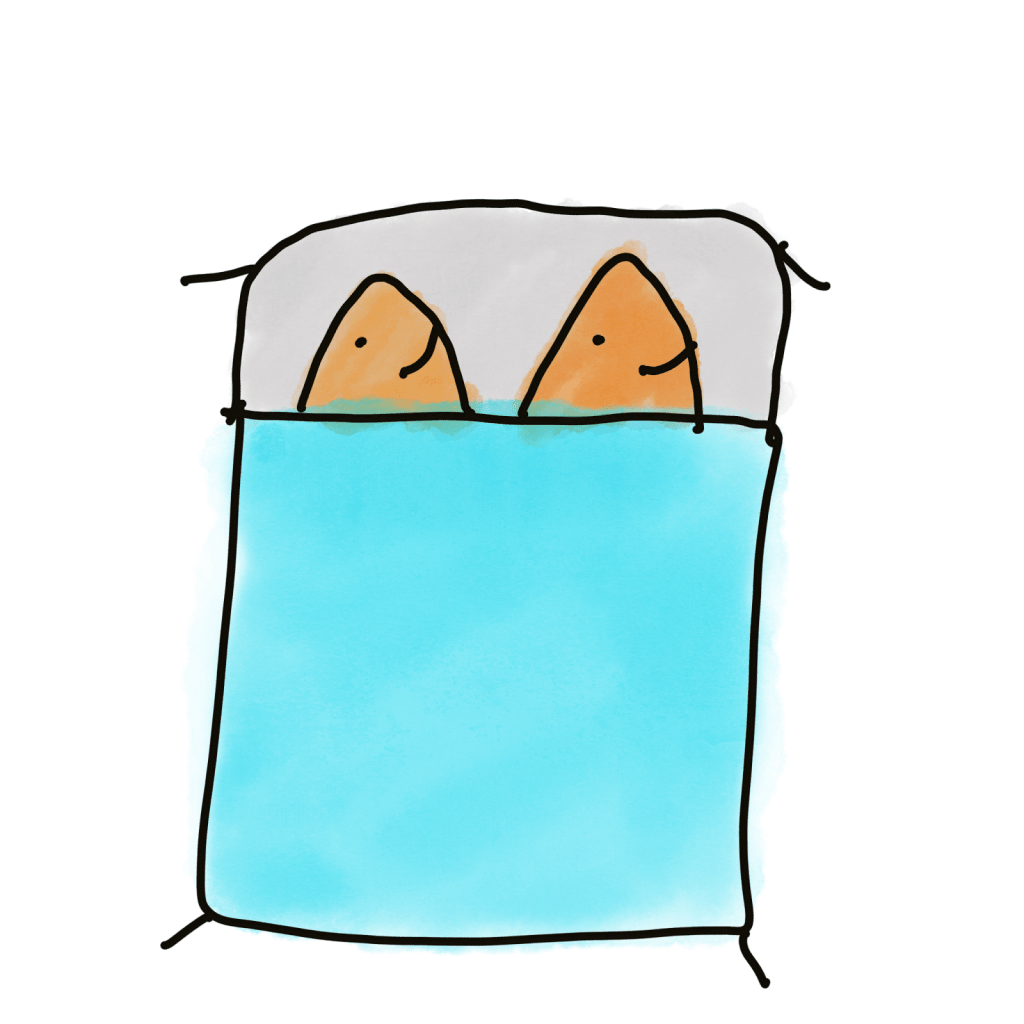
Our fish ancestors were having sex and not breathing air. But fish do “breathe” by inhaling water through their mouth and letting water wash over their gills, to oxygenate their cells, and they basically have to do it all the time. I suspect this mechanism was co-opted by the later development of lungs so these fish did have the qualia of breathing. More tentatively: I bet this mouth-gill mechanism also predates sex behavior.
LETS BE CLEAR:
- “Sex” in the sense of gametes is really old, probably back to single-celled days. But early animals do other forms of external fertilization,like releasing sperm or eggs into the water en masse, or depositing one and then the other like salmon. We’re specifically talking about internal fertilization by means of genitalia. You know, bangin’. Copulation. To learn more, look up pictures of this on the internet.
- Our question here is about qualia, which obviously we cannot “answer.” So I’m going to use a lot of dubious reasoning about evolutionary history to guess. “Dubious reasoning” is, alas, how we got here in the first place. But I am coming out ahead morally ahead of the competition, because I am learning more about fish.
THE OG SEX-HAVER:
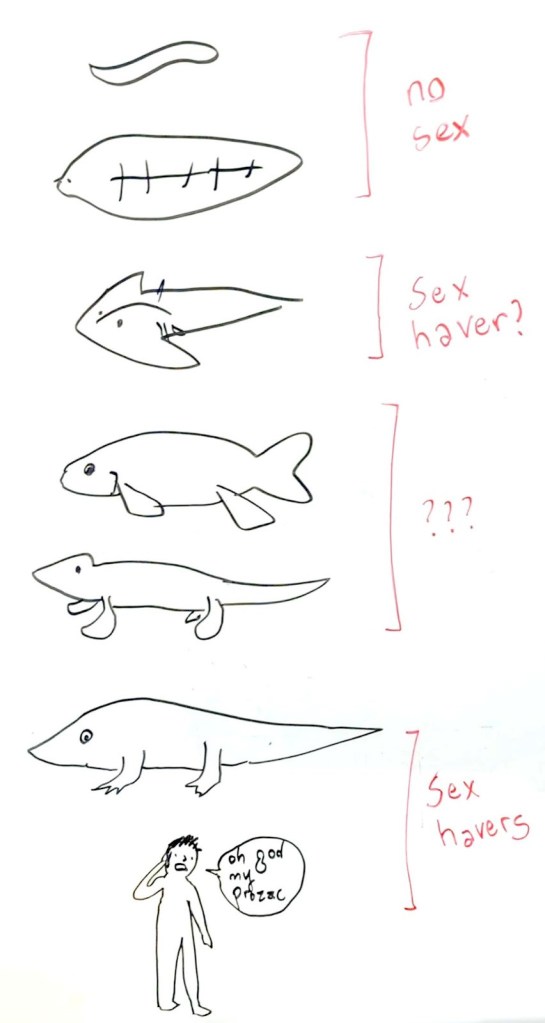
As far as we know, copulation was invented about 385 million years ago by a species of placoderm fish named, and I am not making this up, Microbrachius dicki. Its fossils have little arm-type appendages kinda analogous to the ‘clasper’ fins of modern sharks, plus genital shapes that indicate internal fertilization – they probably had sex!1
But then later placoderms might have gone back to external fertilization. Microbrachius was a pretty early placoderm, and the human vertebrate lineage did come out of placoderms (although Microbrachius wasn’t necessarily in the human lineage.)
Later come the sarcoptygians. Lungfishes do external fertilization but coelacanths, to my surprise, are ovoviviparous – which I think indicates some kind of internal fertilization
must be happening, because how else does the sperm get into the fish? So we might be looking at an unbroken lineage of sex since the placoderms.
At the end of the day it’s unclear whomst, amoung our fossil ancestors, were bonkin’. Definitely by the time the amniotic reptiles show up, internal fertilization is back on the menu.
Also, qualia-wise, once an animal evolves sex, maybe any later sexual behavior – even if it
reverts back to external fertilization – maybe it now “feels like” sex?2 I suspect an
evolutionary history of orgasm would be of interest here but that REALLY doesn’t fossilize well.
IS GILLS BREATHING?
What “is” breathing? Humans, and our amniote relatives like reptiles, take air in through the mouth – but most of the ‘work’ you feel breathing is controlling the diaphragm. This moving of the thorax muscles is called “aspiration breathing.”
Fish do buccal pumping, where they move their mouth muscles. Amphibians seem to do a combination of both, breathing in with mouth muscles and exhaling with axial muscles. Note that it’s complicated in fish like lungfish or bettas with various lung-type situations, in addition to their water gills.
But wait, we’re asking about the urge to breathe, right? Whatever muscles you use are secondary to the need to take a breath. …Right? Like, when I’m suddenly scared, I don’t necessarily feel it in my legs or arms, even though that’s the body part I would need to jump up and run away or fight back.
BUT TAKE NOTE:
- Humans have more options – a fish needs its mouth open to inhale and closed to push water over the gills. A human has more axes of control.
- The fish version of coughing also involves buccal pumping.3
- Breathing rhythm is localized to part of the medulla oblongata of both fish and mammals.
- Air-breathing fish today use lungs AND gills, and have to switch between them. Some of our ancestors must have been similarly transitional, and also that both kinds of breathing must have had a qualitative difference.
CONCLUSION
It’s hard to know when different things evolved! We actually don’t know for sure which of our
ancestors were banging last. We know how breathing worked but not the qualia. I think it’s POSSIBLE that early fish did something qualitatively similar to breathing (pumping water over gills) but maybe not because it had to switch over at some point, and also I guess “urge to breathe in using my diaphragm” and “urge to not suffocate” are potentially distinct.
FUN FACT!
Coelacanths have vestigial lungs. They probably used these for hearing. This is, in my opinion, stupid.
Also see Shadwick, Robert, and Lauder, George (2006). Fish Physiology: vol. 23., Fish Biomechanics (Academic Press.)
- Long, J., Mark-Kurik, E., Johanson, Z. et al. Copulation in antiarch placoderms and the origin of gnathostome internal fertilization. Nature 517, 196–199 (2015). https://doi.org/10.1038/nature13825 ↩︎
- Look up “oviposition” on human sexuality database “Archive of Our Own” for possible evidence of vestigial human inclinations supporting this hypothesis. ↩︎
- Hoffman, M., Taylor, B. E., & Harris, M. B. (2016). Evolution of lung breathing from a
lungless primitive vertebrate. Respiratory physiology & neurobiology, 224, 11-16. ↩︎


Does this count as banging: https://en.wikipedia.org/wiki/Pilus? If so, I’d say sex wins. Also, flatworms and slugs and other invertebrates do internal fertilization: https://en.wikipedia.org/wiki/Penis_fencing. Maybe slugs breath, but I don’t think flatworms do.
LikeLike
Good thinking! I still think I’m right and here’s why:
Pilus reproduction is, like, sex-adjacent. But I think as far as the phenomenology of sex goes, it’s unconnected. It looks – glancing at the wikipedia page – like organisms in our lineage might well have done it, but I don’t think any multicellular organisms do something similar, and I think the first creatures with any neurons to speak of would have long lost the capability. I don’t know if any identifiable related gene even exists in humans. Also it’s doing DNA snippets, not gametes, so it’s not, like, sex. All that is to say that no I don’t think that’s a dunk but I’ll still accept that for a galaxy-brained definition of sex or “what if our minds, like, include our genes and not just our brains, man”, that could theoretically be in play.
Only a few flatworms that are all related to each other do penis fencing! Most don’t. Even though a flatworm or something much like a flatworm was in our lineage, probably that was a later invention by a small clade.
But like, it is for sure kind of unclear – molluscs do internal fertilization, and it seems plausible THEIR last common ancestor did also, but those guys are protostomes, so a very early division from us, like, since or before our flatworm era.
At a glance: Acorn worms, which are like some of the more distantly related deuterostomes, do external fertilization. Only three species of echinoderms do internal fertilization – the rest are external. Lancelets, which are very primitive chordates, do external fertilization. This isn’t anything conclusive right now – I don’t have, like, a diagram or a list of this – but to me it looks like our ancestors from “very very early worms” through Microbranchius-type-guys might have exclusively done asexual reproduction and/or external fertilization.
LikeLike