What’s the deal with prions?

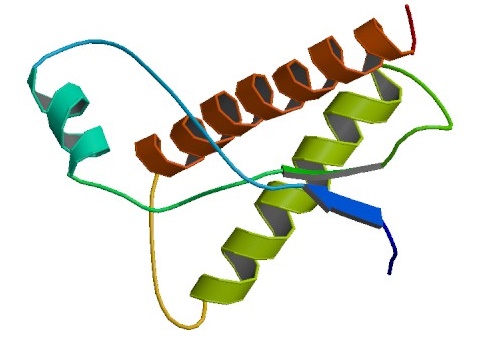
Image: Bovine spongiform encephalopathy (BSE) prion.

First of all: It’s usually pronounced “pree-on.” If you say “pry-on”, people will probably still know what you mean.

This is an exploratory post on what prions are, and how they work, and a lot of other things I found interesting about them.

Primer on protein folding

  • Proteins are strings of amino acids produced from blueprints in DNA. Proteins run your cells, catalyze reactions, and do just about every important thing in the body.
  • A protein’s function is determined from its amino acid composition, and then mostly from its shape. A protein’s shape determines what other kind of molecules it can interact with, how it’ll interact with them, and everything it can do. One of the main reasons amino acid composition is important is because it determines how proteins can fold.
  • One string of amino acids can be folded into different shapes, which will have different properties. (The particular shape of a specific string of amino acids is called an isoform.)
  • While strings of amino acids will fold themselves into some kind of shape as they’re being made, they may also be folded later – into different or more complex shapes – elsewhere in the cell.
  • One of the things that can refold proteins is other proteins.
  • A prion is a protein that folds other, similar proteins into copies of itself. These new copies are very stable and difficult to unfold.
  • These copies can then go on and fold more proteins into more copies.
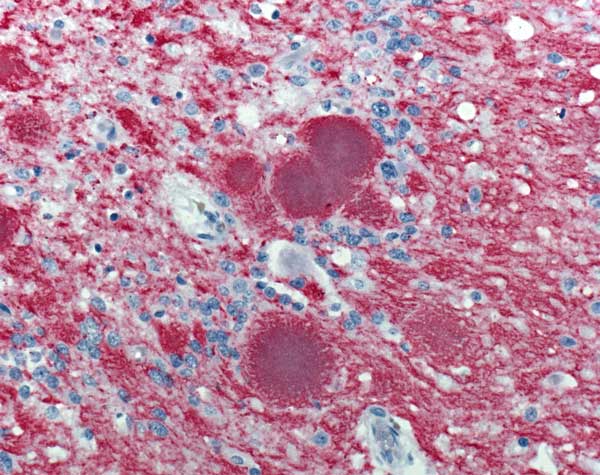
CJD plaques in the brain surrounded by prion proteins

CJD’s impact in the brain – red clumps are amyloid plaques, surrounded by blue clumps of prion proteins. || Image is public domain by the CDC.

Some prion diseases

Prion diseases in animals appear to be mostly neurological. All known mammal prions are isoforms of a single nerve protein, PrP. They can both emerge on their own when the protein misfolds in the brain, or spread as an infectious agent.


Creutzfeldt-Jakob Disease affects one in one million people. (It’s also the most common modern prion disease. Prion diseases are very rare.) It comes in a variety of forms, but all have similar symptoms: depression, fatigue, dementia, hallucinations, loss of coordination, and other neurological symptoms, generally resulting in deaths a few months after symptoms start.

  • 84-90% of cases are sporadic, meaning that the protein misfolds on its own. This mostly occurs in people older than 60.
  • 10-15% of cases are familial, where a family carriers a gene that makes PrP likely to misfold.
  • >1% of cases are iatrogenic, meaning they occur as a result of hospital treatment. If medical care fucks up really badly, they might transplant organs from people with CJD, or inject people with growth hormone extracted from the pituitary glands of dead people, or even just use surgical tools once on CJD patients, and they catch it.

(The surgical tools one is really scary. Normal autoclaves – that operate well above the threshold needed to inactivate bacteria and viruses –  kill some but not all prions. And while it takes a large dose of ingested prions before you’re likely to get sick, it takes 100,000 times less when exposure is brain-to-brain. Cleaning with “benzene, alcohol and formaldehyde” still doesn’t kill prions. The World Health Organization issued prion-specific instrument cleaning procedures in 1999- towards the end of Britain’s brush with bovine spongiform encephalopathy- which include bleach or sodium hydroxide and longer autoclaving. I don’t know if these are still used outside of known epidemics.)


Mad cow disease, or bovine spongiform encephalopathy (BSE), is also a prion disease. It transmitted between cows when they were fed a feed that contained meat and bone meal, including brain matter from cows with the disease. The incubation period is between 5 and 40 years. The source molecule is essentially a cow-originated Creutzfeld-Jakob prion, and when the prion replicates in humans, it’s probably the cause of variant Creutzfeld-Jakob disease.


Between 1900 and 1960, the Fore people of New Guinea had an epidemic of an unknown neurodegenerative disease – mostly among women – that caused shaking, difficulty walking, loss of muscle coordination, outbursts of laughter and depression, neurological degeneration, and eventually death.

The Fore tribe practiced funerary cannibalism, and women both prepared and ate the dead, including the brains, and fed them to children and the elderly. This transmitted kuru, a prion disease with an incubation period of years. The last known sufferer of kuru died in 2005.

(The source of kuru was probably a single person with CJD. There are other tribes that practiced funerary cannibalism– I wonder if any of them also had prion epidemics from eating the brains of people who spontaneously developed CJD.)


Fatal familial insomnia is a genetic prion disease. Unlike CJD or BSE, fatal familial insomnia prions target the thalamus. If your family has it, and you inherit it, you live until about 30 – then lose the ability to sleep, hallucinate, and die within months. There is no cure. There are more painful and equally fatal diseases, but this must be one of the scariest.


Undulates really get the short end of the prion stick. Chronic wasting disease affects elk and deer and can run rampant in herds. Scrapie affects sheep and goats, and makes them scrape their fleece off and then die.


Prion evolution

Prions differ from their pathogenic, self-replicating brethren – the viruses, the bacteria, the parasites – in one major way: They don’t have DNA or RNA. They don’t even have a central means of storing information.

But studies show that prions can evolve. They can’t change their amino acid composition because they’re not involved in producing it, but do change their progeny’s folding.

This doesn’t seem surprising. The criteria for something to undergo Darwinian evolution don’t necessarily require DNA – just a self-replicator that has some level of random variation, and passes that variation down to its replicas.

Most brain prions don’t transmit, though, so it seems safe to say that the evolutionary lineages of most prions are very short – less than the lifespan of the host. Very contagious prions, like scrapies, presumably have jumped from host to host many times and have longer lineages.


Structure of death

All known mammal prions are variants of a single gene, PrP, and exist in the brain. Why?

Some hypotheses:

  • Brain proteins are more likely to misfold than other proteins
    • Why? Brain proteins replicate less than other proteins, and are really really central to the body’s function.
  • PrP is especially liable to turn into a self-replicator if misfolded.
    • Predictions: Other amyloid-based brain diseases are also PrP isoforms. Prions have a similar shape that makes replication happen. Maybe PrP itself self-replicates in the body under some circumstances.
  • The brain clears misfolded proteins less well than other body parts.
    • Predictions: Other waste product buildup happens in the brain. The rest of the body has some way of combating amyloids or prions.

We know of very few prions (we know that one non-mammal animal, the ostrich, may have them.) Except in fungi. Fungi have tons of prions. Fungi prions don’t come from the same gene either – if you click through to that last link, you’ll see that the misfolds came from a variety of initial proteins that don’t appear to be related at all. Presumably, they have widely different structures.

So why are these the two prion hotbeds? Here’s what I suspect.

We know that both fungi and mammal proteins have related structures – they’re amyloids, aggregating proteins with a distinctive architecture called a cross-β-sheet. (Amyloids in general are implicated in some other diseases, and are sometimes produced intentionally as well. Spider silk has amyloids.) Beta sheets are long, sticky amino acid chains that attach to each other, forming large, water-insoluble clumps that are difficult for the body to clear.

To take an ad hoc survey that could loosely be called a literature review, let’s take the Wikipedia page for amyloid-based diseases. Of those listed, four involve deposits in the brain, and four form deposits in the kidneys (runners-up include ones that deposit in a variety of organs, and ones that deposit in the eyes.

Why the kidney? Given its role as the body’s filter,  it makes sense: if a protein floats in the blood, it’ll end up in the kidney, and if multiple sticky proteins circulate, they’ll end congregate there. Wikipedia points out that people on long-term dialysis are also more likely to develop amyloidosis.

Why the brain?

The blood-brain barrier limits the reach of the immune system into the brain, where it could potentially deal with amyloids that it recognizes as foreign material. Sequestered beyond the reach of the immune system, the brain and nervous system clear loose gunk and proteins (including amyloids) via the glymphatic system, via channels in the brain called astrocytes. (The glymphatic system appears to do much of its work while you’re asleep.)

[Caution: Speculation.] I suspect that this system has a lower flow-through rate than the circulatory or lymphatic system, which are responsible for the same task on the other side of the blood-brain barrier. Fungi, including yeast, don’t seem to have robust waste-clearing systems. This might be the connection that explains how prions build up in each.

What about other multicellular organisms without circulatory systems- do prions exist for bacteria, plants, or larger fungi? I don’t think we know. I’m guessing that they exist in other animals or organisms, but since they’re made up of the same compounds as the rest of the body, it’s very difficult to find or test for a prion – if you’re not sure what you’re looking for. [/speculation]

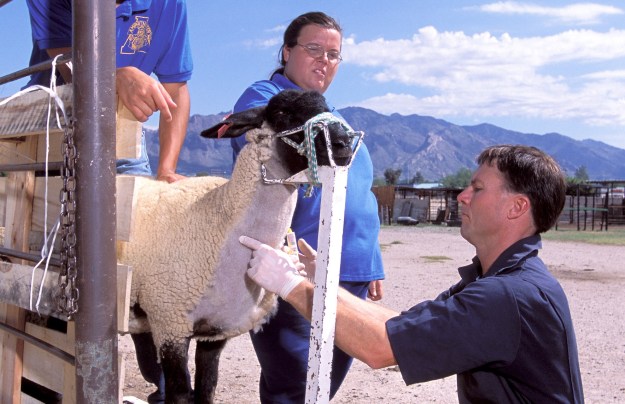
Gathering blood from a sheep to test for scrapie.

Drawing blood to test a sheep for genetic resistance to scrapie. || Public domain, by USDA Agricultural Research Service.

Some notes on infectivity

  • Scrapie is transmitted between sheep by cuts and ingestion, and chronic wasting disease is often transmitted by ingestion, as when a sick deer dies on ground that grows grass, which is eaten by new herbivores. They can also be aerosolized (yikes).
  • CJD and kuru are still infectious, but less so- you have to ingest brain matter to get them.
  • Meanwhile, Alzheimer’s disease might be slightly infectious- if you take brain extracts from people who died of Alzheimer’s, and inject them into monkey’s brains, the monkeys develop spongy brain tissue that suggests that the prions are replicating. This technically suggests that the Alzheimer’s amyloids are infectious, even if that would never happen in nature.

What makes scrapie so much more transmissible than CJD, and CJD so much more transmissible than Alzheimer’s? I’m not sure. The shape of the prion might be relevant. Scrapie is just another mutation of PrP, so I’m not sure why no human prions have ever had the same effect (except that since scrapie is a better replicator, it would only need to have happened once in sheep.)

It might also be behavioral – sheep appear to shed scrapie in feces, and undulates have more indirect contact with their own feces than other animals (deer poop on grass, deer eat the grass, repeat.)

Fun Prion Facts

  • We can design synthetic prions. Current synthetic prions are also variations of the PrP protein in mammals.
  • Did I mention they can be airborne? They can also be airborne.
  • Even though they’re just different configurations of proteins that are already in your body, the immune system can distinguish prions from normal proteins. For a while we thought this was a problem because most immune cells can’t cross the blood-brain barrier, but it turns out some can.
  • The possibility of bloodborne prion transmission (of mad cow disease) is the reason why people who lived in Britain during certain years still can’t donate blood in the US.
  • Some fungi also appear to produce a molecule that degrades mammal prions.  Don’t take that at face value – as far as I could tell, the study didn’t compare non-prion PrP to prion PrP. That said, it has implications for, say, treating surgical instruments.
  • The zombie virus isn’t real, but if it were, it would definitely be a prion and not a virus.
  • Sometimes, if you’re infected with one prion, it’s more difficult for you to get infected with another. This is true sometimes but not always.
  • Build-up of amyloids or prions may sequester pathogens in the brain.
  • Finally, for most diseases, if we eliminated all of the extant disease-causing particles, the disease would go extinct- the same way that if we kill off of species X and don’t store its DNA, species X goes extinct forever and never comes back. Creutzfeldt-Jacob is an interesting case of an infectious self-replicator where that isn’t true. Even if all CJD prions were instantly destroyed, it would emerge naturally in the genetic or spontaneous cases where the brain itself misfolds proteins, and could spread iatrogenically or through ingestion.

So You’re Not Ready To Go Vegetarian

[Content warning: Moralizing about what food you should eat, descriptions of bad things happening to animals, eating bugs. Also, lots of people can’t go vegetarian or significantly alter their diet at all due to health, cost, time, sensory issues, strong preferences, lack of options, inability to pick your own diet, etc. Most of the ‘alternatives’ posed here take money, time, or majorly changing your habits. If reading this post is likely to make you feel guilty or bad in an unproductive way, feel free to skip it.]

This is a rather utilitarian list of approaches to improving the lives of animals even if you still eat meat. I’ll start with some general strategies, ranked roughly in order from “least  to most weird”. See what works with your diet, resources, and preferences.


 Basic ideas:

  • Eat less meat in general.
  • Eat less chicken, eggs, beef, and farmed fish.
  • For other animal products, eat Animal Welfare Approved, Certified Humane, or 100% Grass-Fed meat, or buy from a source where you know how the animals are treated.
  • Eat species that suffer less, either in farms or at all.
  • Pay other people to go vegan for you.
  • Support animal welfare by donating money effectively.

I suspect that some people will object to the notion that it’s ever alright to kill or use an animal, and that encouraging people to do this in a “less bad” way is just making compromises with the devil. (As opposed to veganism, which is merely selling your soul to Seitan.) If you’re one of these people, you’re probably already a vegan and this essay isn’t for you.

Not that I entirely disagree- many more people should be vegetarian. That’s not the point, though. Many people are Vegetarian Sympathizers, as I once was. As a young person, for instance, I knew that I had moral issues with the idea of eating animals- that a cow’s brain wasn’t very different from a cat’s, which also wasn’t very different from a human’s. I also knew that meat had unfortunate impacts on the environment and that global warming was a serious problem. But my developmental environment had lots of meat. And also, I had a very strong objection- cheeseburgers.

dicks

Pictured: The Seattle restaurant that was the source of my conflict. The mind is willing, but the flesh is weak. | By Jmabel (CC BY-SA)

This wasn’t a rational objection. But we’re not rational creatures, and the Cheeseburger Objection was the actual thing standing in between me and vegetarianism. And if I’m going to eat cheeseburgers anyways, why not eat steak, chicken, fish, etc.?

Honestly, the Cheeseburger Objection is a pretty good one. One cow makes a lot of cheeseburgers. One cheeseburger might make you very happy. Acknowledging that isn’t a reason to stop caring about animal welfare entirely. And Cheeseburger Objectionists can still make extremely meaningful contributions to animal welfare without depriving themselves of that cheesey goodness.

1. Only go vegetarian sometimes.

Meatless Mondays are a thing- don’t eat meat just one day a week. That’s 1/7 fewer animals you’re eating, and gaining valuable practice in cooking and eating vegetarian. If that’s too easy, up it to two days a week. Repeat.

Some other strategies that have worked for people: eat vegan before 5 o’clock (IE, meals before dinner), only eat meat outside the house, only eat meat inside the house.

Or, if you’re inclined towards vegetarianism- except for cheeseburgers- (or orange chicken, shrimp, your uncle’s venison, baseball stadium hotdogs, etc.-) consider just being a Cheeseburger Vegetarian. I think there’s this tendency to think that if you’re not doing something 100% all the way and identify as that, any tendency you have towards it doesn’t count at all. But that’s completely untrue. Given that we live in a world where most people do eat meat, conspicuously eating less meat both saves animals, and is a talking point that puts vegetarianism on people’s radars.

(Of course, if you’re being a Cheeseburger Vegetarian and hoping to talk to other people about it, people might take you less seriously. This might be a problem. You could either keep your cheeseburger habit private and secretive, hoarding McDonald’s in the dark like the world’s most gluttonous dragon – or you could acknowledge that if someone’s going think that plant-based diets are a joke and not important, they can already find whatever reason they want to do that.)

If you don’t know how to cook food or eat meals without meat, maybe the problem is educational. Look for recipes that contain tofu, beans, lentils, TVP, or vegetables. If you only know one kind of cuisine, broaden your horizons- Indian, Ethiopian, Mexican, Chinese, etcetera, all have lots of opportunities for low meat dishes.

We live in a golden age of easily available recipes. PETA, Vegetarian Times, and Leanne Brown’s free cookbooks are a few good resources. Google it. Also, if you want to make a favorite Food X vegan or vegetarian, look up “Vegan Food X” and you will instantly get 4,000 hits including step-by-step photographs and people’s life stories as told through salad dressing recipes. The internet is a magical place.

2. Eat humanely sourced meat.

This is way harder than it sounds. The good news is that meat is given labels which reflect how it was raised. The bad news is that some of these labels are regulated, and some aren’t, and it’s difficult to determine which labels actually correspond to good living environments and which are symbolic or easily falsified.

Look for the following words on packages:

Certified Organic animals may still be subject to a variety of inhumane conditions. The label means that hormones, antibiotics, and some other treatments are not allowed, and that the animal must be allowed to “exhibit natural behaviors.” I suspect that organic animals are somewhat harder to mistreat, because farmers are incentivized to raise animals in low-disease environments, so organic may be better than conventional if those are your only two options. *

Animal Welfare Approved is an independently-verified certification that has very high welfare standards, including for slaughter. Certified Humane is a less strong but similar certification. There are probably other good ones- look for what they require and how they’ve verified.

Hoofed animals: Look for 100% Grass-Fed, a legally-defined term in which all animals must be raised entirely on pasture (grass, etc) and not fed harvested grain. It seems much harder to mistreat a cow raised this way, since it can’t be confined. This is different from grass-finished, pastured, or normal grass-fed, since all cows eat some grass before they arrive at feedlots.

3. Be careful with chicken.

Chickens are extremely common and live extremely bad lives in factory farms, probably moreso than any other animal.

Cage-free or free-range eggs are better than alternatives, but I don’t think they’re humane. A cage-free chicken may have a somewhat better and more natural life than a non-caged chicken, though they’re newly at risk of fighting with other chickens, which caged chickens aren’t. They may still be subject to having their beaks cut off, slaughter of male chicks (half of all egg-laying chickens are killed shortly after hatching), bird flu, crowded environments, being raised in darkness, starvation-based forced molting, etc.

A couple examples:

  • Free-range – the amount of time or space required for “outdoor access” isn’t legally defined, and varies from facility to facility.
  • A cage-free chicken is still raised in barns or warehouses. They may have no outdoor access, or have their beaks cut or burned off without anesthesia.
  • Organic eggs still aren’t treated with antibiotics but can still be raised in factory farms.
  • More info on labels.
eggs

Putting a picture of happy chickens here seemed disingenuous, so here’s some eggs, I guess. | The Home Front In Britain, 1935-1945.

Any given egg source may well not do some or all of these- for instance, I’ve heard that there are some egg producers that don’t slaughter male chicks, and the cost of raising them is passed to the consumer as a higher price. The key here is to do your research. If you buy based on label X or Y without further investigation, even at a “nice” natural foods store or co-op, your chicken will probably have been raised in painful, inhumane conditions.

I think your best chance at getting humanely raised chickens or eggs is to buy from a home farmer or very small permaculture farm, ideally where you can see the chickens. These are likely to be significantly more expensive than other options. Farms may still slaughter male chicks.

4. Eat species that suffer less.

Quantification of animal suffering is a new field, and practices for calculating it are general estimates. That said, its numbers come from easily understandable ideas- that it’s worse to be a factory-farmed chicken than a feedlot cow, for instance. Some other ideas include that being killed is painful, so an animal that produces more food over a long period means less suffering per food unit (assuming said animal’s day-to-day existence isn’t terrible.) Also, that having a more complex brain probably means you can suffer more. It’s not an exact science, but it’s what we’ve got.

Brian Tomasik, who has studied animal suffering extensively, suggests using this metric that by eliminating chicken, chicken products, and farmed fish from your diet, you reduce the suffering you inflict on animals by an enormous amount.

Clams and mussels have very simple nervous systems and probably do not feel much pain, while full of nutrients comparable to other animal foods. Ozymandias at Thing of Things suggests that eating bivalves and dairy, and otherwise being vegan, can be a good trade-off between health, enjoyment, and helping animals. Also, you still get to eat clam chowder (if it doesn’t have bacon.)

The jury is still out on whether insects experience suffering. On one hand, insects are pretty simple critters; on the other hand, to produce any significant amount of food, you need a lot of insects, so however much moral weight they do have gets multiplied by a lot. On the third hand, about a quintillion die every year, so your own contribution is pretty marginal. (That number is extrapolation- I suspect most insects live less than a year, so the number is probably higher.)

OLYMPUS DIGITAL CAMERA

Chingrit thot by Takeaway (CC BY-SA)

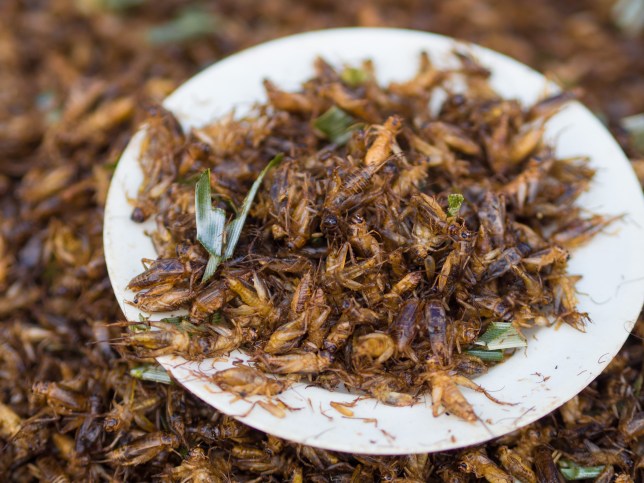
What is known is that insects are nutritious and environmentally friendly. Sourcing insects is difficult and pricey, so try raising your own.

Exotic meats. I suspect that exotic meats (deer/venison, buffalo, ostrich, etc.) are more likely to be raised in more ethical environments, because as species they’re less domesticated, and therefore harder to mistreat as in a factory farm. However, I have no evidence for this.

5. Eat environmentally sound meat.

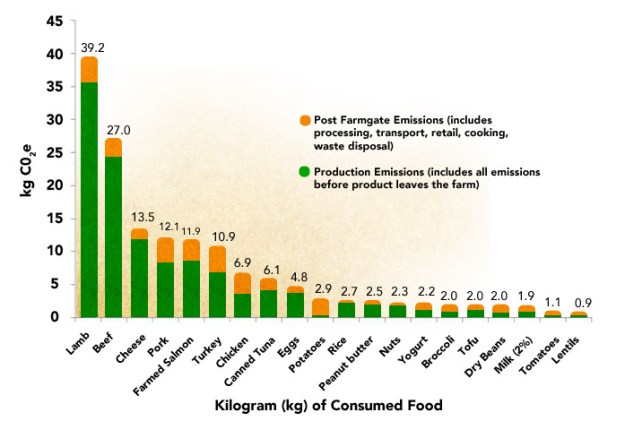
Most of this list comes from a moral argument, but the negative environmental impacts of standard meat is so well-established that it’s worth discussing. 30% of the world’s non-frozen dry land is currently devoted to feeding or raising animals, and 18% of human-produced greenhouse gases came from agriculture. Lamb and beef have disproportionately high greenhouse gas emissions. You’ll note that chicken is rather low on this ranking, but as in the above section, there are other reasons to avoid it.

“Don’t non-animal-product foods also have carbon emissions?” Not that much.

Fish is extremely nutritious, but many species are overfished. Eat conscientiously to avoid making the problem worse- the Monterey Bay Aquarium Seafood Watch has detailed recommendations for the consumer based on your location, sorted into handy “okay to eat” and “avoid this” categories. Bycatch ratios are another thing to beware: shrimp fisheries are the worst, trawling up an average 6 times more non-shrimp than shrimp.

6. Convince someone else to go vegan.

A review (again by Tomasik) of organizations that run ads promoting vegetarianism suggest that the cost of converting a someone to be vegan for a year is, conservatively, about $100. Do you have the money to spare, and think there should be more vegans, but eating meat is worth more than a hundred dollars to you?

Utilitarianism: it works.

cool skeleton

Utilitarianism: It’s this cool. And the ends justify the memes.

This approach won’t work forever, of course – if everybody decided that they individually would eat meat but convince others not to, the cost of getting anyone to go vegan would skyrocket. But not everybody is, and for the time, it’s still low-hanging fruit.

7. Donate to effective charities.

Can we do even better? The average vegetarian saves ~25 land animals per year (and perhaps 371-582 animals per year including fish and shellfish) according to the blog Counting Animals.

The Effective Altruism movement, which is near and dear to my heart, has produced several lovely projects, including Animal Charity Evaluators– a highly evidence-based group that researches which animal welfare organizations have the most bang for your buck. (Sort of the Givewell of the greater biosphere.) An $100 donation to any of their top three charities is estimated to indirectly save or spare the lives of 7,597 animals. (Via outreach, undercover video filming, corporate outreach, and more.)

ace_horizontal

A final note: People sometimes get annoyed at vegetarians or vegans because they think they’re being smug or morally uppity. This always seemed to me like a strange criticism – the problem is that they’re doing something good? – but if you think it has merit, imagine how smug you can feel in the knowledge that every year, you donate $100 to a certain charity, and that has the same effects as going vegetarian for thirteen years, every year.**


Updated 4/14/2017.

Further reading:


* Michael Pollen says in his book The Omnivore’s Dilemna that it’s difficult to get Organic certification, which has many requirements and regulatory steps, so some small and comparatively extremely humane farms may not (despite meeting many or all criteria for the certificate.)

**Note that you’re not allowed to use this to smugly dismiss vegetarianism unless you have actually made a substantial donation to ACE charities. If you don’t, and proceed to use the fact that that someone could make such a donation to be a dick to vegans, you’re doing negative good and the Utilitarianism Skeleton will get you.


The Martian image

Everything I Read and Watched in 2015 + Top Recommendations

In late 2014, I started keeping a list of every single book I read and movie I watched. I looked back at my list from 2015, and picked the best items from it. I also learned a lot about my reading habits.

Some benefits: I can look at trends, can look back someday and have a full list of things I’ve read and watched, and ideally, be able to record my thoughts immediately after to improve my memory of the content and how much I liked it, and avoid the Wikifriends phenomenon. (In practice, I didn’t do that very often.) Also, I can give recommendations! Broadly, this was a useful exercise, and I recommend trying it.

What went on the list:

  • Books
  • Movies
  • Some online works (long serials in book format)
  • Plays

What didn’t go on the list:

  • Blogs
  • Podcasts
  • TV show episodes (see a list at the end for shows I watched all of)
  • Re-reads or re-watches
  • Webcomics
  • Video games
  • Journal articles
  • Things I didn’t want to list for some reason
  • Books I only partially read

Everything I Read or Watched in 2015

Ra (online novel, qntm) *
Existence, by David Brin *^
Parable of the Sower, by Octavia Butler *
Splice *
Bender’s Big Game
The Cherry Orchard (play), Anton Chekov *
Harry Potter and the Methods of Rationality (fanfiction, Eliezer Yudkowsky)
Jupiter Ascending *
The Windup Girl, by Pablo Bacigalupi *
The Lolita Effect, by M. Gigi Durham *
The Avengers 2
Who Fears Death, by Nnedi Okorafor *
Mad Max: Fury Road *
Far from the Madding Crowds *
The Moon Moth (graphic novel)
Tig (Movie) *^
Azis Anasari (movie, stand-up special)
Chelsea Peretti (movie, stand-up special) *
Louis CK (movie, stand-up special)
The Name of the Wind, by Patrick Rothfuss
Good Omens, by Neil Gaiman and Terry Pratchet
Dr. Strangelove
Friday the 13th
Nightmare on Elm Street *
(several other sequels in this genre)
The Martian (movie)
Silence of the Lambs (movie) *^
Hannibal (book) ^
Red Dragon (book)
Nausicaa and the Valley of the Wind *
Interstellar
2001: A Space Odyssey
Star Wars: The Force Awakens *
Eddie Izzard (stand-up special) ^

Shows I watched all or almost all of: Hannibal ^, Brooklyn 99 *^, Steven Universe *^, Rick and Morty ^, Fish Tank Kings, Welcome to Night Vale ^

I didn’t write specific recommendations for shows, but will happily vouch for everything listed.

Bolded items are highly recommended, see below.
* – Female main character / mostly about a woman or women
^ – Any explicitly LGBT characters / out LGBT people

Steven Universe


Recommendations:

Ra: Dense, very clever sci-fi fantasy with fantastic attention to detail. The plot is intense and keeps escalating, and I imagine that this could get annoying- what you think the story is about, is frequently only a small part of it. But I loved it and how the stakes keep getting higher. The magic is reminiscent of engineering or programming. The characters are ambitious and engaging.

Existence by David Brin: An exciting, complex novel in the form of many entwined stories during Earth’s first contact with aliens. The author puts a lot of detail into a realistic portrayal of the future, and answering the Fermi Paradox. Unfortunately, the plot went in a lot of directions at once and it was far from cohesive, and a major part of the ending was all but copied from his anthology (which I’d already read.) This book also has some somewhat strange sections written from the point of view of an autistic character. While I think he has great intentions, and the overall plotline regarding autism seemed good, Brin isn’t autistic and I haven’t found a review of the book by an autistic person, so I don’t know how it came across.

Given all of the above, I can’t recommend it whole-heartedly. Even so, months later, I keep coming back to the ending, which is subtly inspiring. [SPOILERS ON OUT] It paints a picture of the farther-future in which the definition of humanity has been challenged- there’s the aforementioned autistic people, gay people, flesh and blood humans, and then uploaded human minds; plus: cyborgs, resurrected neanderthals, AIs, uploaded alien minds, baby aliens raised in human society, and even Brin’s beloved talking dolphins.

All of these have arrived on earth, and after social turmoil, humanity responds by… shrugging its shoulders and bringing everyone in. The novel compassionately decides that all different kinds of sentience are valuable. That we don’t need to gatekeep what it means to be a person. And that when the time comes, we’re all getting onto the spaceships together.

Harry Potter and the Methods of Rationality: In my junior year of high school, a friend recommended this to me. He wasn’t the sort of friend who would normally recommend a Harry Potter fanfiction, so I was interested and checked it out. The story finished in 2015- about five years after I found it- so I can write about it here. It’s a fanfiction written by an artificial intelligence researcher, in which Harry Potter is raised knowing about cognitive biases and the scientific method, and proceeds to go to Hogwarts and completely dismantle the magical world using logic.

It’s preachy at times- the author is clearly using it to educate the audience, or, at times, shill his personal philosophy- and yet the writing is good, the preachy parts are compellingly embedded and true to the characters, and by the end I found that it had worked and I had changed my mind on some important philosophical concepts. This story also made me want to self-identify as a rationalist and indirectly introduced me to effective altruism, which, I would say, is one of the best track records possible for a fanfiction.

Who Fears Death: Most fantasy is boring. It takes place in a somewhat sanitized Medieval Europe with wizards and kings and dragons and god, can we as a culture get past this already? Who Fears Death is not that. Who Fears Death is set in a magical post-apocalyptic Sudan and involves magic powers, a heroic quest, and a coming-of-age adventure, but that’s about where any similarity with traditional fantasy ends. It’s beautiful and imaginative and well-written. Sexual violence and genocide play major roles in the book, so read with caution.

Mad Max: Fury Road: A movie I had zero interest in until hearing that men’s rights activists called for boycotts on this “feminist piece of propaganda posing as a guy flick”. Naturally, I had to see it. It’s the most intense action movie I’ve seen- it never slows down- so if that doesn’t sound fun, you may get exhausted and want a nap afterwards. If you like that format, you’ll appreciate the worldbuilding, the stunning visuals, and the characters, yes, most of which are women. Is it feminist propaganda? Sure. The hidden message is “women are people, don’t keep women as sex slaves.” It was a great movie. Best propaganda all year.

Tig: Tig Notaro’s comedy special/documentary is, I believe, still on Netflix at the time of this writing. This is part life story and part comedy feature. Her stand-up is hilarious. I love her timing and deadpan delivery, and she’s now my favorite stand-up comic.

Good Omens: “Georgia, you haven’t read Good Omens yet?” People have been asking me this since literally the dawn of time.

painting of the big bang

14 billion BC: “You like Neil Gaiman and apocalypse stuff, right? How have you not read it?”  || Image by Cedric Sorel

Worry no longer. I’ve read Good Omens. It’s really really good. Uh, the characters are engaging and human and just trying their best in ridiculous circumstances. The humor is, well, ridiculous, and has more jokes-per-word than possibly any book I’ve read. You should read it. Am I about to become one of the swarming masses that nagged me about it in a past life? It may be. The future is so hard to predict.

The Martian: Humanity of Earth gets together to save an astronaut from dying alone on a planet. Humanity of Mars, who’s just one dude, gets his shit together to survive long enough to let them. Everyone is a nerd, and there aren’t any villains- the central conflict might be Man vs. Nature in an abstract sense, but the plot is driven by people solving problems with skill and science. It reminded me of Secular Solstice, and how refreshing it is to get together with a bunch of people and sing songs about the importance of solving problems and making good plans. This is an under-represented genre in media, and The Martian did it fantastically.


Reflections on the List

  • I’m sure I left items off on this. In the future, I should make a habit of writing something down as soon as I finish it, rather than waiting until I remember that the list exists.
  • Even so, broadly, I’m rather surprised at how short it is.
  • Especially nonfiction. I only watched one documentary in 2015? I only read one nonfiction book? Even if I left some items off, the fiction:nonfiction ratio is astonishing. I love nonfiction books! 2015 was the year I started reading a lot of blogs, online articles, and other content that I didn’t record, so I’m not convinced I actually read less fiction than non-fiction- just that it wasn’t in book form.
  • 17/33 items listed had female main characters or were mostly about women. 5/33 included LGBT people. (Not just as main characters, but at all.) My memory is foggy on the latter category- there may have been more minor characters- and that’s including Silence of the Lambs, which is about the worst, most transphobic representation imaginable. (I wasn’t actually sure if I should count the movie as such, but excellent blogger Ozymandias discussed it as such on Tumblr, so I will too. More commentary.)
  • Another 4/6 instances of LGBT representation came from shows. I’m pleased that all four shows involved gay relationships between major characters.
  • Temporal trends! This year, I’ll include dates for extra data. Still, from memory, I can notice a few trends:
    • The five-item stretch right after a break-up, where I read three novels in a week.
    • The weekend my roommate was out of town and let me use his Netflix.
    • The period right after Hannibal (the TV show) was cancelled.
  • This isn’t a great record of how much media I actually consumed. Most of what I read or watch is online or in a shorter format. You could argue now that this is a problem and  I should read more books because… reasons?… but I have no idea if that’s true. I’ll probably record more TV shows, mid-length works, and journal articles on this year’s list, as well as things I wrote.
  • Ideally, I’d like to record news/blog articles as well, but I don’t know of a way that’s easy and mindless enough I’ll reliably do it.
  • I learned that the best way to get me to read something is by getting a copy and putting it in my hands. Then, if I’ve expressed interest in reading it, apply mild bothering until desired results are achieved. Should you really want me to read something, for some reason, this may help.
Longtoothed bristlemouth

What’s the most common animal species?

I tried to answer this question by doing some reading. Why should we care?

  • Most people don’t have a good sense of the scope and scale of biodiversity and common species on the planet. Whatever you think are the most common inhabitants of earth, you’re probably wrong.
  • When scientists think of “successful” organisms, they tend to think of ones with great diversity: beetles, for instance, or in terms of environments, rainforests. Looking at sheer numbers of individual species is another way of doing this.
  • “Okay,” you say, “Why animals, and not plants or bacteria? Those are way more common.” I study bacteriophage. I know. Two reasons: Animals have brains, which is one reason to focus on them- don’t you want to know who’s doing the majority of the world’s thinking? Secondly, it’s harder to find data on non-animals, but stay tuned.
  • Similarly, if you’re concerned about wild animal suffering, this may give you a sense of where best to focus your concern.

Mammals don’t come anywhere near the top, but sure, they’re furry and warm and cute and also you’re one, so let’s begin here. Humans aren’t actually a bad call as far as larger organisms- there are 7.5 billion (7,500,000,000) of us crawling around the planet, handily beating out other close competitors.

Rule 1: If you want to make an organism numerous, association with humans is a good start.

Large wild mammals are not especially common. Cows (1.4 billion) have the largest non-human large mammal population, and sheep, pigs, and goats (~1 billion each) beat out all other competitors. The curious will be interested to know that there are 50% more cats globally than dogs (600,000,000 vs 400,000,000).

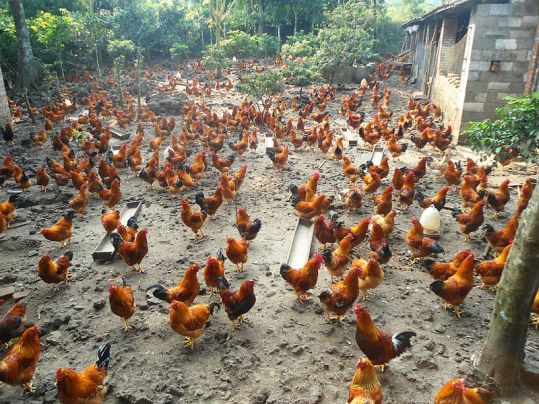
What about birds? As of 1997, between 200 and 400 billion (brought to us by the excellently titled paper, How Many Birds Are There?) The most numerous wild bird is the red-billed quelea, which terrorizes African farmers in enormous flocks (1.5 billion). (The Smithsonian flagrantly claims it’s the house sparrow, but the population of those is maybe half a billion and dropping.) Again, association with human comes in- the most common bird is the chicken, at 19 billion (19,000,000,000) or 2.5 chickens per human.

Hundreds of roosters standing in a field

“Capons in Hainan” by Anna Frodesiak / CC0 1.0

So chickens are looking good so far. What about mice or rats? They’re tiny, reproduce voraciously, and also follow humans. Unfortunately, I couldn’t find good estimates on global mouse populations. Maybe there’s ten mice per human? Maybe there’s 75 billion mice. Sure. Fortunately, it doesn’t matter. Remember the grand rule of biomes:

Rule 2: Whatever’s happening in the ocean is much bigger and much wackier than anything on land.

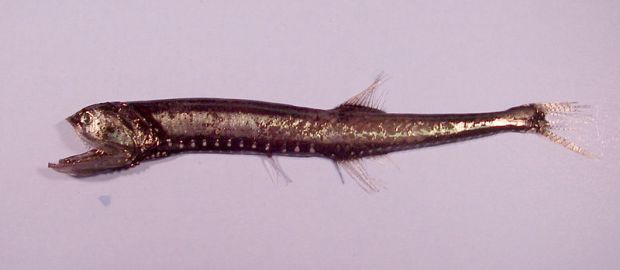
You’ve probably never heard of the bristlemouth, genus Cyclothone, a three-inch-long deep-ocean fish with a big mouth and weird teeth. As it happens, most of the planet’s surface is deep ocean. Unspecified “icthyologists” found by the New York Times speculate a population in the hundreds of trillions (> 200,000,000,000,000).

Their sheer population has only recently come to light- they’re found many meters deep into the water column and don’t surface at night, and the extent of their dominion has only recently been discovered via trawling with fine nets and the dawn of deep-sea exploration. If these “ichthyologists” can be believed, the bristlemouth is probably the most common vertebrate on earth.

Maybe you’re confused as to how there could be so many bristlemouths, since they’re relatively large compared to, say, insects. I’m not actually convinced that the trillions number is correct, but nonetheless, consider: The oceans represent 75% of the planet’s surface, and while land animals are more or less limited to a flat surface, ocean animals can “stack” in three dimensions.

Finally, a fun fact: If a bristlemouth brain weighs as much as a goldfish brain, then:

7,500,000,000 human brains * 1,350 grams/human brain = 10,000,000,000 kg

200,000,000,000,000 bristlemouth brains * 0.097 grams/bristlemouth brain = 19,400,000,000 kg

Mass of human brains ≈ mass of bristlemouth brains

Draw your own conclusions.

Rule 3: Ant biologists need to get it together.

Ants feeding on a honey droplet

“Meat eater ants feeding on honey” by flagstaffotos / CC BY-NC

All the world’s ants are popularly said to weigh the same amount as all the world’s human beings. It takes 16 million ants to outweigh a human, and since your garden-variety ant colony has about 4,000 ants, that would be 40,000 ant colonies per person.

This sounds ridiculous, and a University of Sussex professor suggests that it is– that ants may have outweighed humans earlier in our existence, but we’ve spread too far too quickly for them to catch up. This article posits 100,000,000,000,000 (1×10¹⁴) ants.

But wait. A different article from BBC suggests 1,000,000,000,000,000,000,000,000 (1×1024).

What’s going on here? To our instinctive brains, both of those guesses occupy a similar conceptual space as “really large numbers”, but they’re not close. They’re ten orders of magnitude apart. One of these numbers is ten billion times larger than the other. There’s one quantity of ants, or there’s ten billion times that number of ants. What?!

I have no idea. Worse yet, they’re both from the same source. The BBC can’t be a reliable news source if they don’t have a standard journalistic value for “total number of ants” that’s rough to within oh, say, five orders of magnitude.

Fortunately, we can perform a sanity check. The earth has 1.5×10¹⁴ square meters of dry land.

1×1024 global ants / 1.5×10¹⁴ square meters = ~7,000,000,000 ants per square meter

Given that we’re not swimming in ants at every single moment, we can knock off a few zeroes and come down to 1×10¹⁹ (10,000,000,000,000,000,000 or ten billion billion ants, at 70 ants per square meter, which seems more reasonable.)

Even if the most common ant species is just 1% of all ants, where ants ranks depends drastically on which value the right value is. Bristlemouths might outnumber them, or they might not. Dear ant researchers: work on this, but at the least, stop telling people there are 1×1024 ants. That’s too many ants.

(While researching this, I also learned about the long and short scales– everyone uses the same “million”, but my “trillion” may not be the same as your “trillion”. While normally I try to avoid being prescriptivist about language, this is a terrible use of words and everybody should either use lots of zeroes or scientific notation from here on out. Ugh. Anyways.)

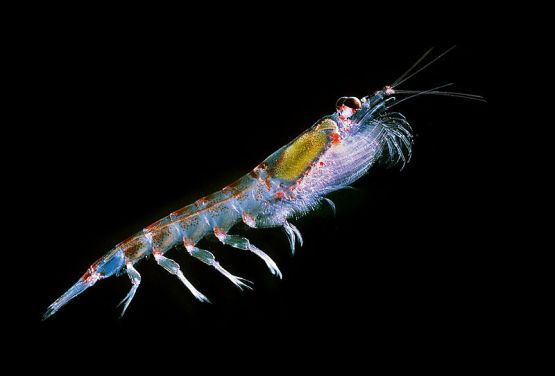
Antarctic krill

Antarctic krill by Uwe kils / CC BY-NC

The antarctic krill is the foundation of the antarctic ecosystem. It feeds whales, seals, squids, fish, and everything else. 500 million tons of it exist, and Wikipedia claims it’s probably the most abundant species on the planet. Using Wikipedia’s mass value of up to 2 grams (say, 1.5 grams on average), that’s 3×10¹⁴ (300,000,000,000,000) krill.

Rule 4: Maybe we just don’t know what’s going on.

Let’s talk about uncertainty. There are a couple other candidates. They may easily hold the title, but I don’t know because nobody has done the research. There are certainly plausible reasons to suspect any of them of holding the title, and we can use Fermi calculations for the sake of a guess, but I don’t expect these to be very accurate.

Most of the guesses above did come with specific numbers, but aren’t necessarily completely trustworthy. Articles written about ants, antarctic krill, nematodes, and copepods have all variously claimed to be the most common animal. It seems like this could happen because of the availability bias– if you’re a krill biologist, and someone asks you what the most common animal is, and you know that there are a whole lot of krill, you’re probably going to say krill.

Narrowing down a common species is also more difficult- I can attest (from work with tiny snails) that doing field identification via microscope is the worst. So presumably, most studies don’t do it, and focus on the broader picture.

Alternatively, invertebrate researchers have field-wide conspiracies in order to get more grant money. Invertebrate researchers are welcome to deny this in the comments.

Copepods

Tiny free-swimming ocean crustaceans, at the root of many food chains.

Some scientists say they form the largest animal biomass on earth.

[…]

Copepods almost certainly contribute far more to the secondary productivity of the world’s oceans, and to the global ocean carbon sink than krill, and perhaps more than all other groups of organisms together. – Wikipedia

Also, bristlemouths eat them. Oceanic food chains don’t always work the same way land food chain pyramids do- there’s not necessarily more biomass at the base of the chain than at the top– but as far as I know, it’s strong evidence for them having more biomass.

Frustratingly, as with the nematodes, nobody seems to know what the most common copepod is.

My probable candidate:

  • A small cosmopolitan mid-ocean-level copepod.

Copepod expert Geoff Boxshall on Plankton Safari estimates 1.3×10²¹ (1,300,000,000,000,000,000,000) copepods. If the most common species represents 1% of all copepods, that’s 1.3×10¹⁹ of a common copepod species out there.

But I think we can do better.One study found an average 20 zooplankton per cubic meter in the Atlantic ocean, with occasional high spikes and huge seasonal variation. If we assume that such a number is constant over all the oceans and throughout the euphotic zone (the top layer of the ocean that receives sunlight and supports photosynthesis), that adds up to at least 5.78×10¹⁷ plankton. Since we know copepods are quite common, let’s say that 50% of the zooplankton is copepods, and that the most common species represents 1% of all copepods. That’s:

5.78×10¹⁷ zooplankton worldwide x (50% copepods) x (1% of the most common species) = 2.89×10¹⁵ of the most common copepod.

Copepods

By Lennart Lennuk / CC BY-SA

Nematodes

They are ubiquitous in freshwater, marine, and terrestrial environments, where they often outnumber other animals in both individual and species counts, and are found in locations as diverse as mountains, deserts and oceanic trenches. – Wikipedia

Everyone (read: all scientists who have expressed an opinion on the matter) seems to think that nematodes are incredibly numerous. That said, Nematoda is a very broad umbrella- sort of like saying that there aren’t very many Chordates (the phylum that contains all vertebrates plus a handful of squishy sea creatures.) Bristlemouths, meanwhile, are narrowed down to a single genus of only a dozen species.

My guesses for a candidate Most Common Nematode are:

  • A small, free-living, deep ocean floor or mid-ocean-level species
  • A small parasitic nematode that inhabits cattle or bristlemouth guts.

(Why these two? My educated guess is that smaller animals tend to be more common, and that the smallest species are routinely parasites. Other small species tend to be among the more numerous free-living animals- think mice and Palegibacter ubique.)

My extrapolations (more details on those numbers) from a 2006 study of benthic microfauna – very small animals living on the ocean floor at various depths – suggest that there are maybe 9.03×10¹⁹ such critters in Earth’s oceans. These include nematodes, benthic copepods, and other species. As with copepods, let’s guess that half of these are nematodes, and that 0.1% of nematodes are in the most prolific species.

9.03×10¹⁹ microfauna on the ocean floor x (50% nematodes) x (0.1% of nematodes in the most common species) = 4.52×10¹⁶ of a common nematode species.

This aligns well with another, rougher back of the envelope calculation from a different source:

Roughly 2000 nematodes / square meter * (5.1×10¹⁴ meters on the ocean floor) * (1% of nematodes in most common species) = 1.02×10¹⁶ (1,020,000,000,000,000) of a common nematode species.

Conclusion: It’s a nematode world.

[Updated as of 4/14/2017.]